


Which hands to check/raise the river?
When it goes right you feel like a genius, but when it doesn't you curse yourself. Dara O'Kearney takes the fancy play syndrome out of river check/raises.

Check/raising the river is one of the trickier prospects in poker. It's a scary thing to do as a bluff and when you do it for value, but the Villain checks back, you feel like you missed a bet.
Thanks to the solvers, however, we have learned the best hands for check/raising the river both as bluff and value.
When it's for value with a strong hand you want to unblock the Villain's betting range. When it is as a bluff you want to pick hands that would win at showdown if it were checked back but you can turn into a bluff when it isn't.
Let's look at an example.
We have arrived at a river and the board reads A A K 3 Q. Below is a table of the hands we are left with, out of position, that we sometimes check/raise. All our other hands in our range are leads, check/calls or check/folds.
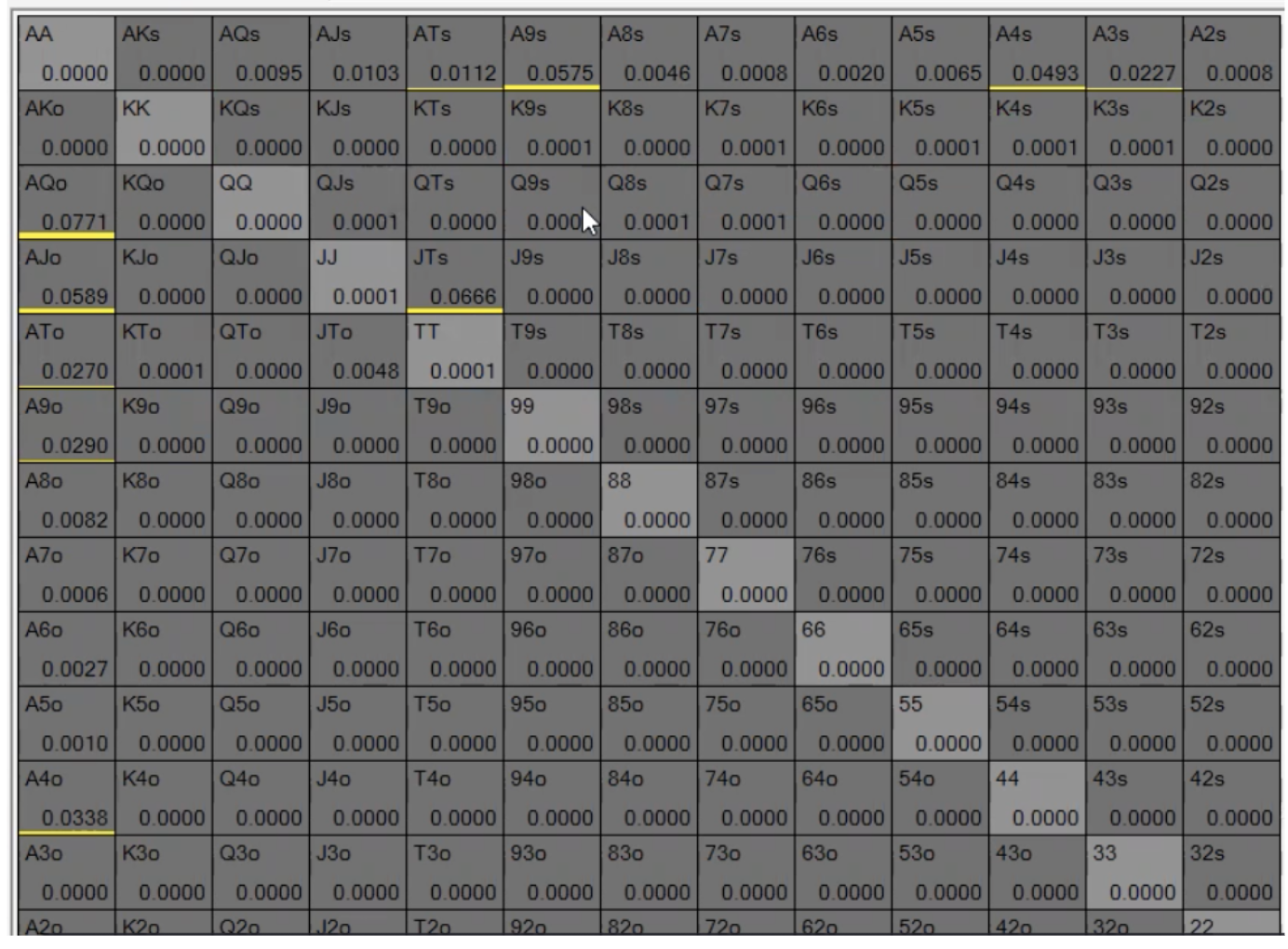
The yellow lines are occassional check/raises. You can barely see it, but any hand with a number under it is also a check/raise. JJ/TT/QJs/Q8s/Q7s are among those and they make up a very small portion of the range, just 0.36% of hands. The value hands are good Ax hands and JT for a straight.
Avoid fancy play syndrome
JJ/QJs/Q8s/Q7s and TT are bluffs, they block AQ and JT. Crucially they also likely win if the opponent does not bet. It’s hard to pick check/raise bluffs but they are best made up of hands that have OK showdown value until your opponent bets, but you have a blocker. So TT will sometimes be ahead when you check and your opponent checks behind, but when they bet you no longer like the hand. TT, however, blocks AT and JT making it a much better bluff than 99 which doesn’t block anything.
Deciding the value to keep back for a check/raise is also tricky. JT is held back here because it unblocks Ax hands, so there is more chance they will bet when checked to. Ax hands are held back less because they block other Ax hands, so it is better to lead out to stop your opponent checking back a hand they would have called. Hold backs should unblock value bets. We do have to hold back some Ax, however, to avoid being exploited.
The river check/raise is often associated with fancy play syndrome and you can certainly fall into that trap if you do it often. It is not a move you should be doing at high frequency unless you have a strong read on your opponent. Also in softer games it is usually better to lead out to guarantee your opponent has to call to continue. But if in doubt, the unexploitable approach to river check/raises is simple and applicable whether you are playing GTO or exploitative poker.
Dara O'Kearney's new book Endgame Poker Strategy: The ICM Book is out now.
