


Emotional ICM
Sometimes we nit up for fear of looking stupid rather than because we are near the money - Dara O'Kearney discusses 'Emotional ICM'

One of the fundamental maxims of ICM is that losing hurts more than winning feels good. That is, you always risk more in equity than you stand to gain, because of the way the payout structures work.
That means you broadly have to play tighter when you are covered, especially on the bubble when ICM is most extreme.
Even amateur players feel this at a gut level when the money bubble looms. They may have never looked at an ICM solver in their life, but they start to fold hands they normally would have played, and stall, near the bubble. I call this Emotional ICM.
Emotional ICM is when circumstances make you play tighter so you can avoid suffering the indignity of busting. You don't want to be tilted or embarassed, so you nit up. Sometimes Emotional ICM happens at the right time - the bubble or final table bubble - but often it doesn't.
Emotional ICM
Many players, for example, have a real complex about not busting the first level of a tournament they have been excited about playing. It could be the Main Event or just a home game they have been looking forward to, they actually fear getting dealt Aces because they might have to put their tournament life at risk early.
Another common Emotional ICM is the end of Day 1, people really want to make Day 2 and play the latter stages of Day 1 like it is a bubble. This is particularly rife in the WSOP Main Event where making Day 2 is a badge of honour even though it is way off the money.
Three handed at the final table is another good example of this. With every bust out at the final table you should actually play looser because ICM is less severe, but because the heads-up prizes are the biggest, often three handed plays tighter than it should.
My advice for you if you suffer from Emotional ICM is to study this table below. It is from the book Kill Everyone and shows the average Bubble Factor at each stage of a big tournament (this one is the Sunday Million). It essentially shows how extreme ICM is at every stage.
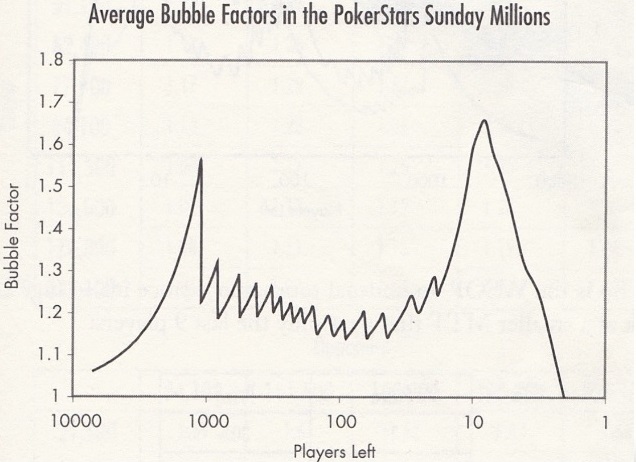
As you can see it is very steep at the money bubble, drops off afterwards, then gets steeper again for the final table, then drops off again with every bustout until heads-up, where there is no ICM.
It is a very useful reminder of the actual ICM of every stage of a poker tournament, not the ICM we create in our heads because of some emotional attachment we have to surviving for a particular length of time.
Dara O'Kearney's new book Endgame Poker Strategy: The ICM Book is out now.
