


How to understand weak Spin & Go players
Our friends at SmartSpin have a guide on how to adjust to some of the weak players you find at the Spin & Go tables.

Players who make extreme plays tend not to be familiar with the optimal strategies. Usually, they approach the game according to their emotional state instead of relying on a well-prepared strategy. As professionals, we need to understand what beliefs are behind these moves, so it would allow us to make our first adjustments against them.
Once we get familiar with these patterns, even one situation can be enough for us to start developing the psychological profile of our opponent and the appropriate counterreaction. If something happened once, it is very likely to happen again.
When the Button open limps

Tendency: Passiveness and curiosity.
Explanation: Limping BTNs isn't common in the Spin & Go strategy. The player feels he wants to "see the flop". Those players don't like bluffing and are curious about "seeing all the cards".
Adjustment: Even though limping shows weakness, we don't want to put on too much pressure, as those players are usually pretty sticky as well. Checking to them allows them to be honest with their hand strength. When they check, we know their hand is weak, so that we can bluff rivers with a small sizing. The primary adjustment is to play very tight vs. every sign of aggression. We will win by not paying out their value and by getting a lot of value when we have it.
When they overbet
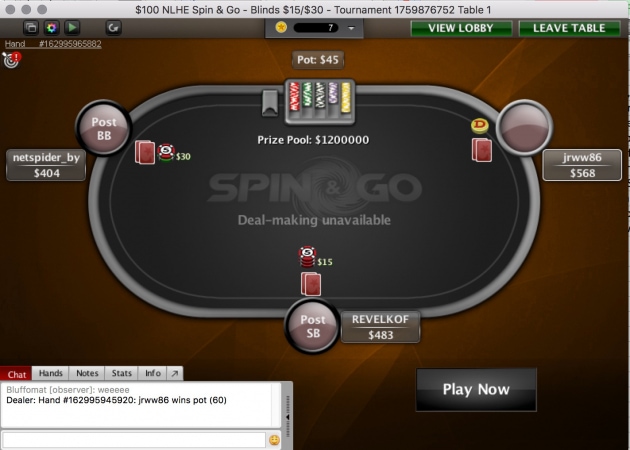
Tendency: Sizings tells or big baller.
Explanation: raising over 2bb from the BTN/HU SB or CBetting over half pot isn't common in the Spin & Go strategy. The Player feels he "wants to pump up the pot".
Using big sizings isn't equal to a higher frequency of bluffs. Often it is quite the opposite.
Usually, it's connected to the fact that players mainly want to pump up the pot with the best hands, which also flop well, and therefore when they hit, they don't mind using a big bet size. This tendency shows that the player is ready to raise the preflop sizing over the expected limit, and he will most likely go on with a similar analogy post-flop and frequently use big bets close to or over the pot.
If you connect this tendency with previously used smaller sizings, it will often mean that the increased sizing is associated with a strong hand - Big Baller. But if the increased pre-flop or post-flop sizings happen as a standard (2 or more times in a row), it's a tendency to pump the pot with a way wider range - sizing tells.
Adjustment: If we play vs. a Big Baller, we must prepare for a ride. The most important is not to lose chips without the showdown. We want to tighten the preflop range, and when we decide to continue vs. big bets, we often want to fasten our seat belts and reach the showdown. It's better to fold or raise on the flop with a bottom pair or even a middle pair on a wet board rather than call flop and fold vs. 2 barrels. Very often, on the river when we have our 2nd or 3rd pair, and we consider between thin value betting with a small sizing and checking to bluff catch, we should select the option to check. When our opponent decides to bluff, we will pick up more chips than with our small sizing adjusted to get value from the lowest pairs.
A critical adjustment vs. those big bally guys is to understand that they simply under respect big bets. It means that we should expect wider calls if we use big sizings, and it's an excellent opportunity to increase value bet sizings. At the same time, we should do the opposite with our bluffs, which won't necessarily work more efficiently with increased sizes.
If we play vs. sizing tells, simply fold your single pairs without strong redraws and wait for the next hand where your opponent should use small sizings or make passive moves. #WinningByFolding
When they check three times with no showdown value

Tendency: Under bluffer.
Explanation: Similarly to BTN limper, our opponent tends to be uninterested in picking pots without a showdown. He waits for a good hand where he can pump up the pot. At the same time, he undervalues the importance of picking up small pots.
Adjustment: As we don't expect many air cards to play aggressively, we shouldn't bluff catch our opponent. Remember that many recreational players have high aggression with a depolarised range - they tend to bet 3rd, 4th, or even 5th pair as their thought process is on a basic level. They bet because they see that their hand improved. We should watch out if the passive tendencies are connected with high sizings.
When they call 4th pair or worse across two streets
Tendency: Calling station.
Explanation: The player is curious and happy to call wide. His way of perceiving ranges is most likely around our bluff combos, which are usually visible bricked missed draws on the board.
Adjustment: The fact that our opponent likes bluff catching doesn't mean that bluffing isn't profitable. Still, there are plenty of air/missed draws in our opponent's range. We should mainly focus on spots where we can fold our opponent from his air cards, therefore using tiny bluff sizes - up to 25% - to bring the best results. Focus on one street bluffs with a sizing to fold only air cards.
When they check back rivers with strong hands
Tendency: Non-value better.
Explanation: The player is afraid of something, whether getting raised or us hitting a flush or not calling enough weaker hands. It makes his range extremely polarized, and it doesn't necessarily mean the player won't bluff.
Adjustment: In fact, playing vs. this tendency is an excellent opportunity for us to prepare to bluff catch if he decides to bet (especially on coordinated boards), as we can assume his range won't contain too many value hands, so there will be a massive disproportion between value bets and bluffs. Remember that the bluffing frequency depends on the amount of bluffing combinations and its relation to all hands that bet the river. If the number of value combos decreases, naturally, the frequency of bluffs increases due to its connection to the whole range.
An additional aspect is when we have a strong hand. Before deciding to value bet, we can frequently consider checking if we expect that the range that calls our bet (TPWK or 2nd or 3rd pair) would bet by themselves if we checked. This creates a great value check/raise opportunity. But if the player prefers checking his medium showdown value whenever the board gets more coordinated, we shouldn't slow play to give him this opportunity, and we must bet ourselves.
When they make large donkbets

Tendency: Fast player.
Explanation: Betting big and using a donkbet play most of the time is a sign of strength. If our player decides to play fast with his good hands, naturally, when he elects to check, we can exclude these hands from his checking range. It creates great opportunities for us to test our opponent and attack his capped range even on very coordinated structures.
Adjustment: If we eliminate from BB's range a part of his top range, just because we know he would donkbet these, his range becomes very capped. This means we can put a lot of pressure on players with this tendency on almost every runout. Bet and barrel even on total blanks, paired runouts, and very wet turns/rivers to put pressure on a weak checking range.
This article is written by CuAt69UsdSng, who has been a full-time MTT pro who transitioned to Spin & Go's, where he won more than $1M+ in EV+RB. He is a High Stakes Player, a coach, and CEO of Smart Pool - an EV Pool for Spin & Go's players providing protection from the variance. You can find more about it here .
