


How to handle variance in Spin & Go
Our friends at SmartSpin are back with a guide on how to cope with the swings that are unique to Spin & Go tournaments.
Example of classic variance aspects related to poker:
- Preflop cards distribution (there's exactly the same chance to get AKo as it is to get 27o)
- Preflop coolers (how frequently our opponent got dealt AK when we had AQ)
- Postflop equity realization (how frequently will we hit pairs or complete draws)
- Postflop coolers (how frequently will we have 2 pairs vs. a better 2 pairs)
Variance exclusively related to Spin & Go format:
- Multiplier distribution (how frequently we will hit 10x or a higher multiplier)
- Wining highest multipliers (how frequently we will win 10x or higher multipliers after hitting them)
- Opponents distribution (we prefer to play against two recreational players than a table with two regs)
- Our position vs. weaker player (having a fish on the right is the most profitable)
- Frequency of reaching Heads-Up (we have higher edge HU than 3-way)
- Our HU opponent (classic situation when fish flips 3-way with a reg)
On shallow stacks, many coolers are inevitable, and they are totally out of our control. For some situations, we are still in control, though!
Here's how you can minimize both the variance and the pain from being hurt by it.
Is it actually variance?
"Every time I have a top pair, my opponent has two pairs. When I have two pairs, he has a straight!”
Very often, the fact that you are losing to higher kickers or better hands it's less about variance and more about your strategy being too loose, especially when you face a 3-bet, big river bet, or a river raise. Ask yourself if you would bet or raise a weaker kicker of a pair than the one you are calling with. Keep in mind that having a 2nd pair or a top pair with a low kicker is way better for value betting by ourselves rather than for bluff catching. Tight is right!
Where's the line between natural variance and a downswing?

"How is that possible?! My opponent always has a better kicker - how much longer will this last?”
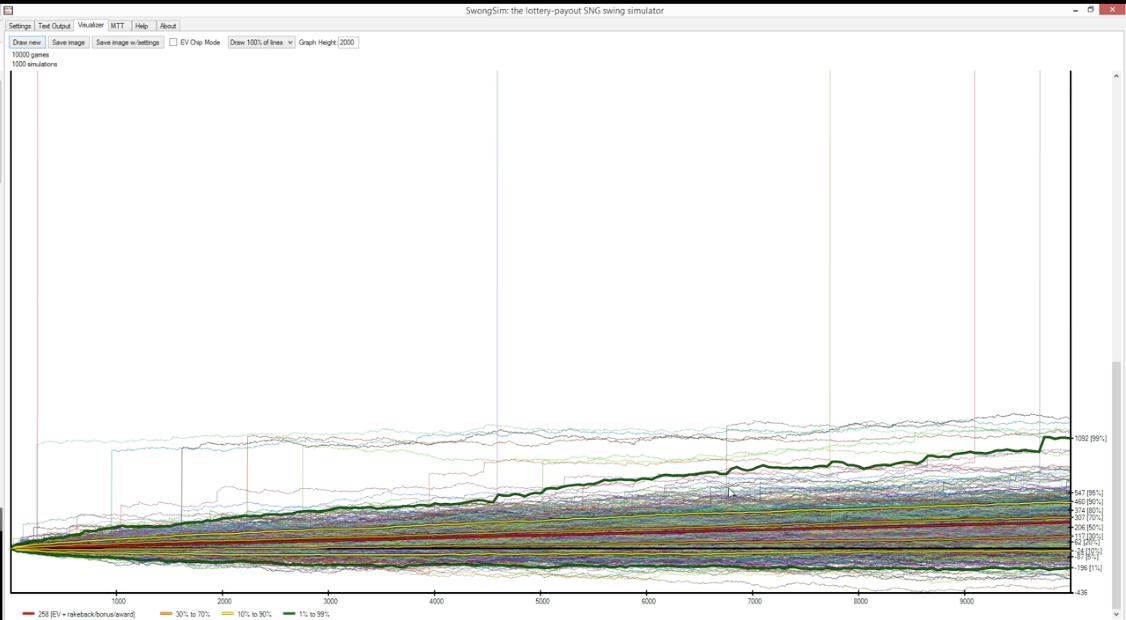
Let's look at the reality - if you expect to be a winning player with 3% EV ROI over 1000 games, then with this win rate, you expect to win 30BI in long run.
While in reality, there is:
- 1% chance to win more than 200BI
- 1% chance to lose more than 100BI
- 10% chance to win more than 100BI
- 10% chance to lose more than 45BI
- 30% chance to win more than 50BI
- 30% chance of losing more than 5BI
- 50% chance to win more than 22BI
- 50% chance to lose more than 22BI
As you can see, with an 80% of probability, you will be somewhere between +100BI and -45BI.
Not only should you accept it, but you should also expect it to happen!
How to protect your EV?

"Without hitting good multipliers, it's hard to make a sustained profit."
Actually, we figured out how to stand against these crazy Spin & Go swings, and we create a Smart Pool - an EV pool, where regs share their profits in case of good runs, and protect each other in case of bad runs.
Therefore even after such a small sample size as 1000 games, you can collect a profit close to your EV, no matter your multiplier run!
How to minimize the EV variance?
"I always have extreme EV swings! I am just unlucky!"
The best way to minimize variance is to… improve your win rate 🙂 The higher ROI, the lower the swings. How to improve the win rate? The answer is quite simple - study more and make sure you do it efficiently! There are many platforms and Spin communities available for players.
Accepting variance? Easy to say but hard to do?

Indeed! Developing a professional attitude with a good understanding of the poker reality is just the beginning of the path. That’s the part of the mental edge we can develop over other players. The key is working on the mindset, especially on Meta-Skills - the ability to emotionally NOT react to what we don't want or like. Facing adversity isn’t an easy thing to do. No one likes to deal with complex emotions, but everyone will need to conquer them sooner or later.
If we want not to react emotionally, we need to understand the reasons for the undesired situations and develop a professional attitude in the first place.
Enough theory! How do I work on this in practice?
Obviously, life isn’t always rainbows and sunshine, we are all humans. We all have days when we have limited ability to face adversity, and then variance affects us more than usual. The easiest way to avoid negative aspects that would be brought by negative results is simply… not looking at results at all for the particular day.
You will always face negative emotions during hard periods. It’s almost impossible to eliminate them completely. The goal is to lower their negative impact, which results in tilt during the game, and reflects in a lack of enthusiasm during breaks. It’s important to take breaks when you notice your mood and actions derive from your desired strategy. During a break, it takes a moment to cool down if you feel angry or to pump up and boost your confidence when you feel apathy.
If I had to leave you with one sentence, to sum up the whole article, I would say, “don't judge the results - judge the decisions.”
This article is written by CuAt69UsdSng, who has been a full-time MTT pro who transitioned to Spin & Go's, where he won more than $1M+ in EV+RB. He is a High Stakes Player, a coach, and CEO of Smart Pool - an EV Pool for Spin & Go's players providing protection from the variance. You can find more about it here .
