


All-in or Fold Omaha strategy
Get Kyyberi's lowdown on this super fast action PLO variant from GGPoker.

Kyyberi is back with a new video on an all-action format you may not have tried but you have to agree looks fun.
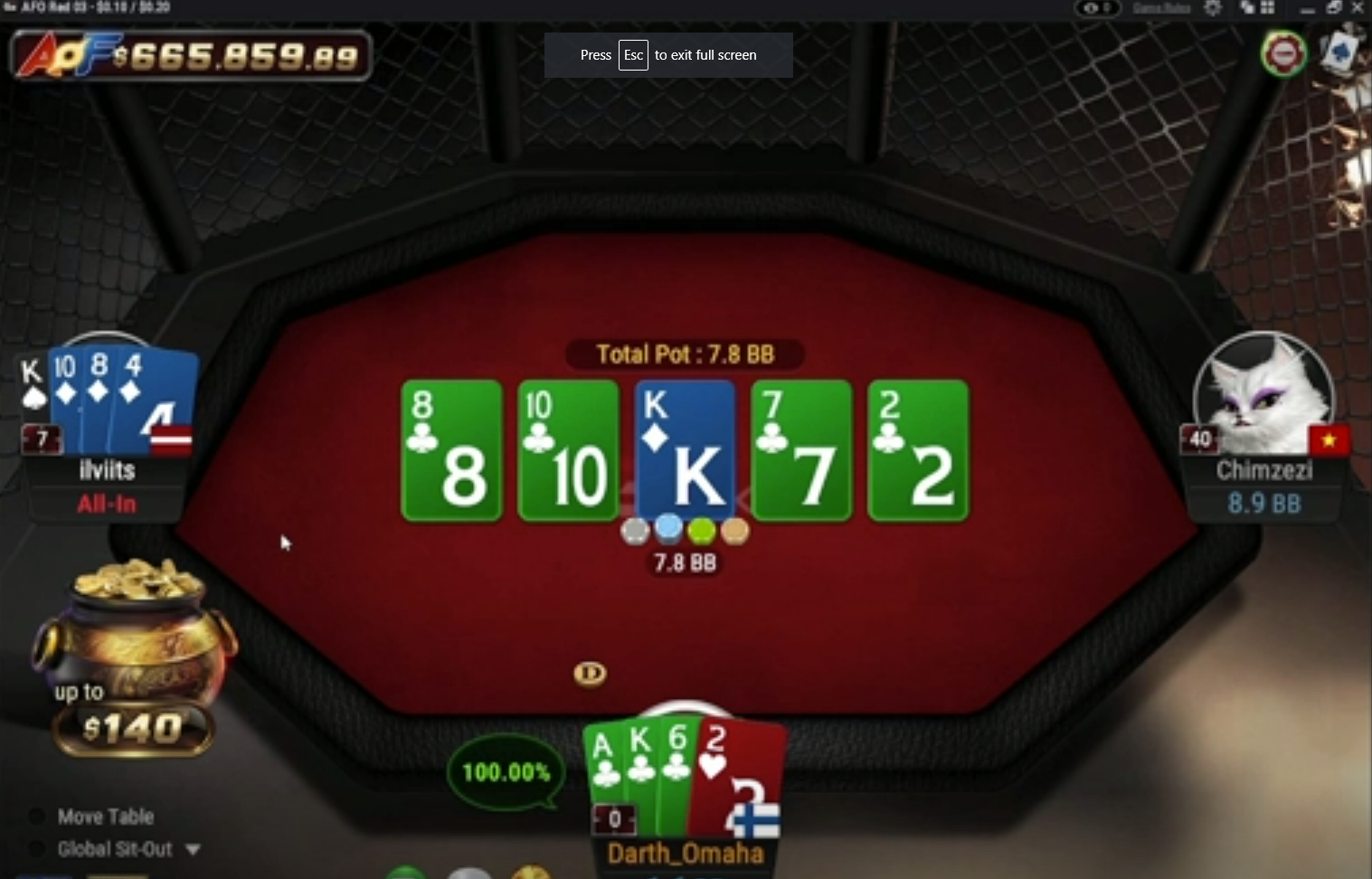
All-in or Fold Omaha from GGPoker is as crazy as the name sounds. You start on the flop with a PLO hand and your only options are check, shove and fold. Players start with just 5BBs.
It's very gambley by its nature but that doesn't mean there isn't value to be had. Not only do many players misplay PLO hands in this format, there are also leaderboards and jackpot promotions that trigger every 50 hands or so.
In this new video our coach gives you the strategy basics, an overview of the promotion as well as playing a few hands.
In addition to that he has written up some hand advice on how to play wet and dry boards below.
Action flops

J♦T♠9♠
This board has multiple draws and most hands will hit at least a gutshot. Therefore we should never bluff this board as pure bluffs, and semibluffs should be done only when SB and BB fold.
SB strategy: We should play quite strong range here, as the chance of pot being multiway (3 or 4 players go all-in) is highest. Straight possibility always changes things in PLO as pairs and two pairs lose a lot of value. Still, we should normally shove around 30% of hands here.
Most of our nut flush draws are all-in hands (we still fold the worst of naked nut flush draws), along with flush draws with at least a decent back up (like open ended straight draw, pair and gutshot etc.). When the straight is already a possibility, we should go all-in with our two pairs only if they have some backup (flush draw or a straight draw).
BB strategy: There are still two opponents left, but there is also 1,5bb dead money in the pot to be collected. We should widen our all-in range a bit here, up to 40%. We go all-in with all of our nut flush draws, and most of our flush draws. We don’t need that much back up for our two pair hands, especially JT and J9.
CO strategy: If blinds fold, we are left with just one opponent and that 1,5bb dead money in the pot. We definitely want to go all-in with quote wide range, but not with everything. On this board we go all-in with about 2/3 of hands. Basically, if we have any hit on the board we go all-in but we shouldn’t bluff with air.
Calling strategy: If we are in a spot where we face one or more all-ins, we should only call with really strong hands. Common mistake is to call here with the same range as we would bet ourselves. To call we need a lot more stronger hand. High straights and sets are clear calls, as JT with a high flush draw. Keep in mind that 87 is often just a fold, even with a low flush draw. That calling range doesn’t change that much on different positions. The only exception is if we are on the Button and we face just one all-in. The later the all-in position is, the more we call. We start to add 87, weaker two pairs and a bit weaker draws to our range. Against CO bet we should have the widest calling range, about 35-40%.
If opponents are tighter or looser than they should be (according to a good strategy) we should also change our ranges sometimes. For example if CO likes to steal a lot, we should defend a bit more. But if he is really tight, we should call with a lot stronger hands.
Dry flops

A♦A♠6♣
This flop has zero draws and against an Ace all naked pocket pairs have really low equity. Still, the chance of someone having an Ace is quite high.
SB strategy: This is simple, we go all-in with an Ace or 66. Nothing more, nothing less. BB strategy: To make things simple, we bet with an Ace or 66. We can add a little bit of KK or QQ with back doors or a case 6. But just a little.
CO strategy: Now things change. Two players have folded, and the chance of last opponent to have an Ace is a lot lower. We bet all our pocket pairs that are over 6, and most of 22-55 anyway. We also bluff with half of our naked K high hands as they have at least some equity against lower pocket pairs. Even if opponent plays with good strategy we should bet here about 60% of our hands.
Calling strategy: Against SB or BB all-in, we call with an Ace or 66. But when we are BTN and face CO all-in, we add all JJ-KK and most of our TT hands. If we thing opponent can bluff with good frequency, we can add just few 77-99 hands (the ones with double pair or back door draws) to the mix.
In both examples we can see that it’s crucial to understand that in push-or-fold games there is a huge difference in betting (all-in) and calling ranges. Also in PLO the possible number of players going all-in has a big impact on our ranges too. The most common mistakes you will see on the tables is going all-in with any draw or any hit. In some situations it is the correct play, but in some situations it’s a costly mistake.
