


The limits of node locking
Barry Carter explores the new node locking feature from GTO Wizard, with a warning on how not to misapply it in your study.
Last week GTO Wizard announced a new node locking feature. This is where you can plug in a player's tendencies to see how a solver would deviate from GTO to exploit them.
The announcement is bittersweet for Yours Truly because while I love the feature, I am really annoyed. Dara O'Kearney and I have just finished a book on this exact topic, and it would have been completed in half the time if this feature had been available a year ago.
I have learnt a lot about the benefits of node locking as well as some of the limitations, which I wanted to share today. Let's look at a node lock to see what we are talking about.
It's 40BB's effective, UTG has opened, the BB has called, and the flop is Q77 rainbow. The BB checks 100% of the time and this is the UTG response:
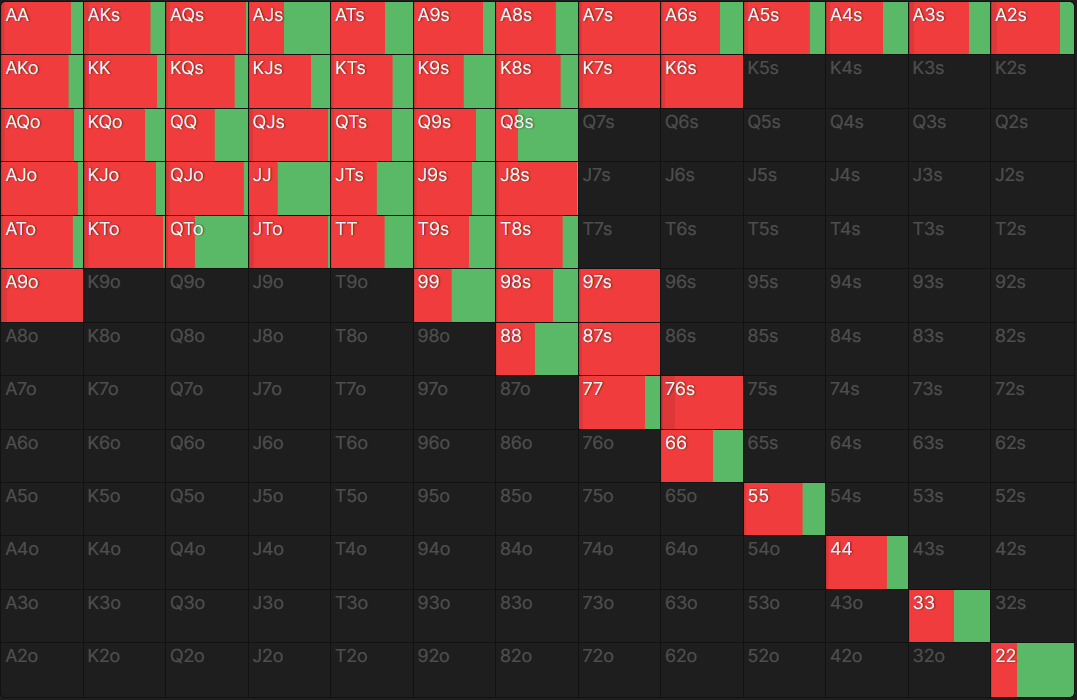
UTG is supposed to bet small 74% of the time here. Typically the preflop aggressor has a range advantage on paired boards where it is harder to improve, but the BB has lots of Qx and 7x, so they don't bet 100% of the time. When UTG does bet, this is what the BB does:

There is a lot of raising here because BB has more Qx and 7x than UTG. The bluffs are mostly backdoor flush and straight draw hands like K9s.
What if we didn't think UTG bet as often as 74% of the time on the flop, what if, instead, this was their response? They checked back most of their misses and weak hands:

The first adjustment may surprise you. Remember I said the BB checked 100% of the time on the flop? Well, when UTG plays like this, they adjust by leading out on the flop some of the time, with this range:

This is an important lesson. Sometimes the adjustment to a leak happens on a different part of the game tree. One of the ways the BB makes money in GTO World is by check/raising, but that is rendered less powerful when UTG is not continuation betting enough, so instead they do the betting for them.
When the BB does check and UTG does bet, this is what the BB does:

They check/raised 25% of the time and folded 42% of the time in the GTO example, now they check/raise 5% of the time and fold 62% of the time, knowing what they know about UTG. This is because UTG has a much stronger betting range this time around, they don't have enough bluffs and medium-strength hands that would fold to a check/raise. This sounds like good news for UTG, but it means their strong hands are not getting paid as often as they do in GTO World.
When the BB does check/raise in the node-locked example, let's see what happens. GTO Wizard has a neat side-by-side comparison feature where you can compare the node-locked solution on the left to the GTO solution on the right:
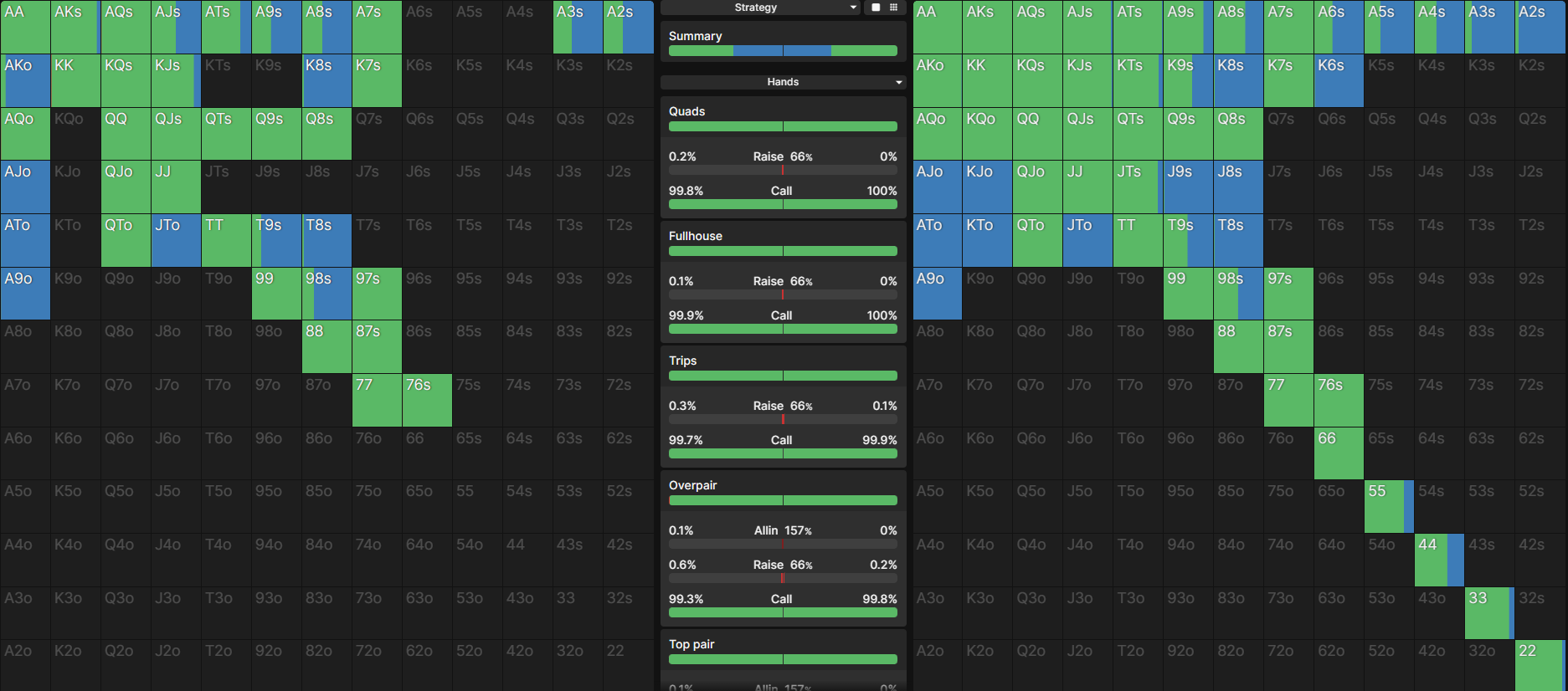
As you can see, in both instances UTG either calls or folds. The BB has a polarised range, so there is no incentive to 4-bet and fold out the bluffs. As you can see in both examples, UTG calls with some weak bluff catchers, some of the time, like A3s and KJs.
This reveals something very important to understand about node locking. In real life, if our opponent is passive like we have assumed they are, do we really think they would know to call with a bluff catcher like KJs or A3s? A timid player would never call a check/raise with a hand like this.
This is the limitation of node locking. Once the solver has deviated from the game tree, it will course correct and play as perfectly as possible thereafter. If your opponent makes a c-betting mistake, they are probably going to make similar mistakes when facing a check/raise, not to mention more mistakes on the turn and river.
This is something important to understand about exploitative poker. You either have to lock multiple streets, which requires a solid understanding of how your opponent plays, or you must accept that the exploits are broad heuristics and to not follow them blindly.
What is GTOWizard?

GTO Wizard is an advanced GTO trainer that shows you how to play against a perfect opponent.
You can play full hands from preflop to river to learn anything and everything you need to know to make your game harder to exploit.
The interface is designed with learning in mind, with custom filters to drill down on important information, dynamic training modes to fine-tune spots, and advanced AI to do your own solves.
You can also upload your hand histories to get your own GTO score and discover where you need to improve. GTO Wizard also has some of the best free strategy content available anywhere in poker.
10% discount on GTOWizard
Using the bonus code PokerStrategy you can get a 10% discount on your first subscription.
There are custom plans for Cash Games, Cash Games with Straddles/Antes, MTTs, Spin & Go and HUSNGs. Each plan has unique features for the game type (for example ICM and PKO solutions for MTTs) but all of them have the following features:
| Starter (from $39/month) | Premium (from $69/month) | Elite (from $109/month) |
|---|---|---|
| Postflop solutions (Most stack depths) | Everything from Starter | Everything in Premium |
| Unlimited practice spots | Postflop solutions (All stack depths) | AI custom solving |
| 50 spots a month to analyse | Blockers score | Dynamic bet sizing |
| Basic aggregated reports | 100,000 spots a month to analyse | 150,000 spots a month to analyse |
| Turn aggregated reports | New features coming soon | |
| Weekly coachings |
Have you used node locking yet? Let us know in the comments:
