


Learning to Learn: Retrieval Practice
Testing what you already know, rather than revising old material, is one of the most effective ways to study anything, including poker.

The way most of us learn formally is by cramming. We read and read and read our textbooks, then hope that when the test comes around, we 'know' the subject.
Retrieval Practice is the opposite of that. Instead of cramming, we should instead be testing our existing knowledge. Retrieval is the act of remembering what we already know. A classic example would be answering questions on a cue card. So if, for example, you were studying the periodic tables. The old method would be to look up what the chemical symbol for gold was, but with this new method, you would attempt to remember and say out loud what it was.
Another example of retrieval practice would be to 'brain dump' - ie. to just write down everything you know about a subject. If you took a class, rather than write notes in the class, go home and write down everything you learned from memory.
Retrieval works for a number of reasons. First of all, studies have shown that cognitive effort strengthens learning, and retrieval is hard. This difficulty is also useful when you need the information under stressful situations. It strengthens the transfer of short-term to long-term memory, and it is said to do that by 'reducing forgetting' more than creating new connections. For me personally the best reason is that it helps identify gaps in your own knowledge that need improvement. When you can't pull out an answer, you know you need to work harder on that aspect of what you are learning.
Don't consume solver outputs passively
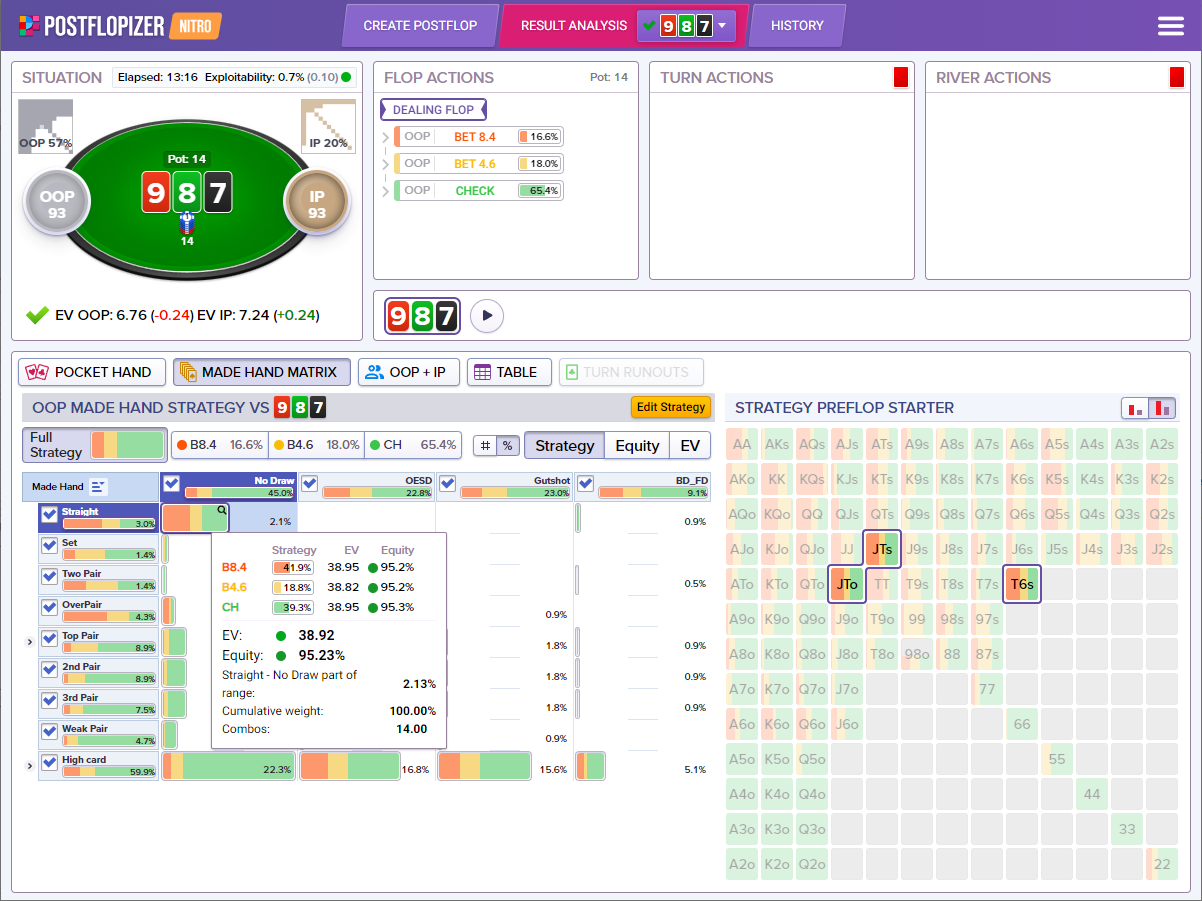
So how have I used this to help with poker study? First of all, I have created flashcards using a tool called Anki. Anytime I struggle with a concept, I make a flashcard for it, then test myself later. For example, one of my flashcards asks me what the best conditions are for a turn overbet in position (something I would not remember at the tables) and after some hard repetition, it has begun to stick.
Secondly, when looking at solvers I don't just look straight at the outputs. I will talk out loud and say what I think I am about to see. For example, I will say out loud "I think the check/raises here will be KK-JJ, top pair and nut flush draws" and only after doing that do I look at what they are. It forces me to take a more active study role and identify which things I am getting dead wrong.
When I am working with a coach, I will articulate what I think the right way to proceed is before they give their input. It's painful because invariably they will correct me, but the pain helps make it stick.
Later on today as I write this I will be watching a video on 3-bet pots. My plan is to write down what I learned afterwards, not take notes during the webinar. Then rewatch the video afterwards when I have identified the stuff I didn't take in.
Be warned, it is a very uncomfortable experience, especially when it is an area you know very little about. But after some initial data gathering, testing what you already know compared to resisting old material is, perhaps, the ultimate learning hack.
Do you do this when you study poker? Let us know in the comments:
