


No stupid questions: What is hand selection in poker?
How do we know what hands to play? What makes a good hand in poker? Our advice for newbies series continues with hand selection.

Last time we answered the question what is a range in poker. Today we look at how to construct that range.
One of the hallmarks of a bad player is that they show no discernment when it comes to the hands that they play. Winning poker requires that you are selective with the hands you choose to volunteer money into the pot with.
Hand selection refers to the skill of picking the right hands for the right situation.
The first consideration is your position at the table. If you are first to act (what we call under-the-gun) you should play a very tight, narrow selection of hands. This is because you have the rest of the table to worry about. You are much more likely to run into an opponent with a better hand if you are first to act. If you are the Button, however, you can play more hands because you only have the Small Blind and Big Blind to worry about.
The action before you also informs hand selection. If a player has bet before you, you need a stronger selection of hands to continue than if you were first to act. These players have signalled they have something strong, so you need something equally strong to continue.
The exception to this is when you are the Big Blind. You can call a raise with a wide variety of hands because you have already put a blind in, so you get favourable 'pot odds' to call. This means the risk/reward ratio is favourable even if you have a weak hand. You also get to 'close' the action, meaning nobody will act after you when you call. You don't have to worry about being reraised and you can move onto the flop.
What makes a good hand?
How do you know what hands to select? This is an Under-The-Gun opening range. The top right hands are suited hands, ie, A3s is an Ace and a Three of the same suit. The bottom left hands are offsuit, so Q7o might be the Queen of Spades and the Seven of Diamonds. The middle hands are pairs, so 77 is two Sevens of different suits.
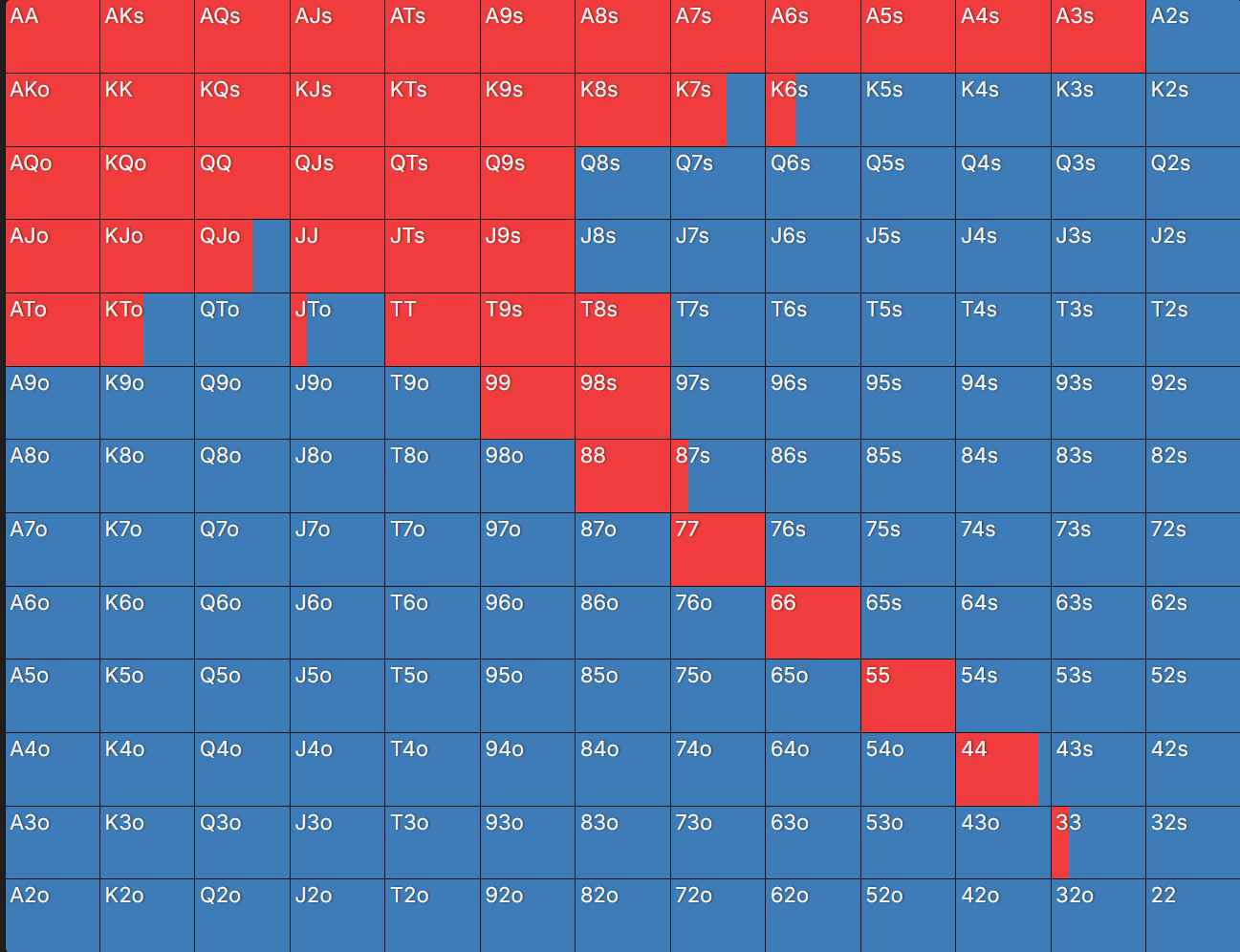
This range shows us a lot about hand selection.
First and foremost, your two cards should be well connected. That means they should either be the same rank, ie. a pair. Or close to together so they could make a straight, like JTo can make a straight when the board comes AKQ, KQ9, Q89 or 897. Or they are the same suit, so can make a flush.
This is because you want to be able to make very strong hands. It's almost impossible to make a straight or flush with K6o, for example, but you can make both with KQs.
Secondly, your cards should be quite strong, ie. high. You don't see 43s in this range even though it can make a straight or a flush. You do see hands like QJs. When QJs makes a straight or a flush, it is almost always the best possible one. When QJs makes a pair it is often the best hand too. When you make a hand with 43s you are never fully confident it is best.
Also, notice that this range of hands is very tight, it's less than 20% of hands. Good players do not play everything, they stick to strong cards that will perform well against other ranges.
As a general rule, when you are new to the game, play tighter than you think you should. While there is a lot of talk about bluffing and mind games, poker is a game of making good hands and getting paid off when you have them. Avoiding trash hands and sticking to strong hands that can win big pots is the way to go in poker.
What is your hand selection method? Let us know in the comments:
