
Skip to forum
Notifications
Clear all

BB defense vs BTN min raise strategy.

28 Posts
12 Users
0 Reactions
14.9 K Views
Coach
LemOn36
Joined: 07.02.2009

What stake?
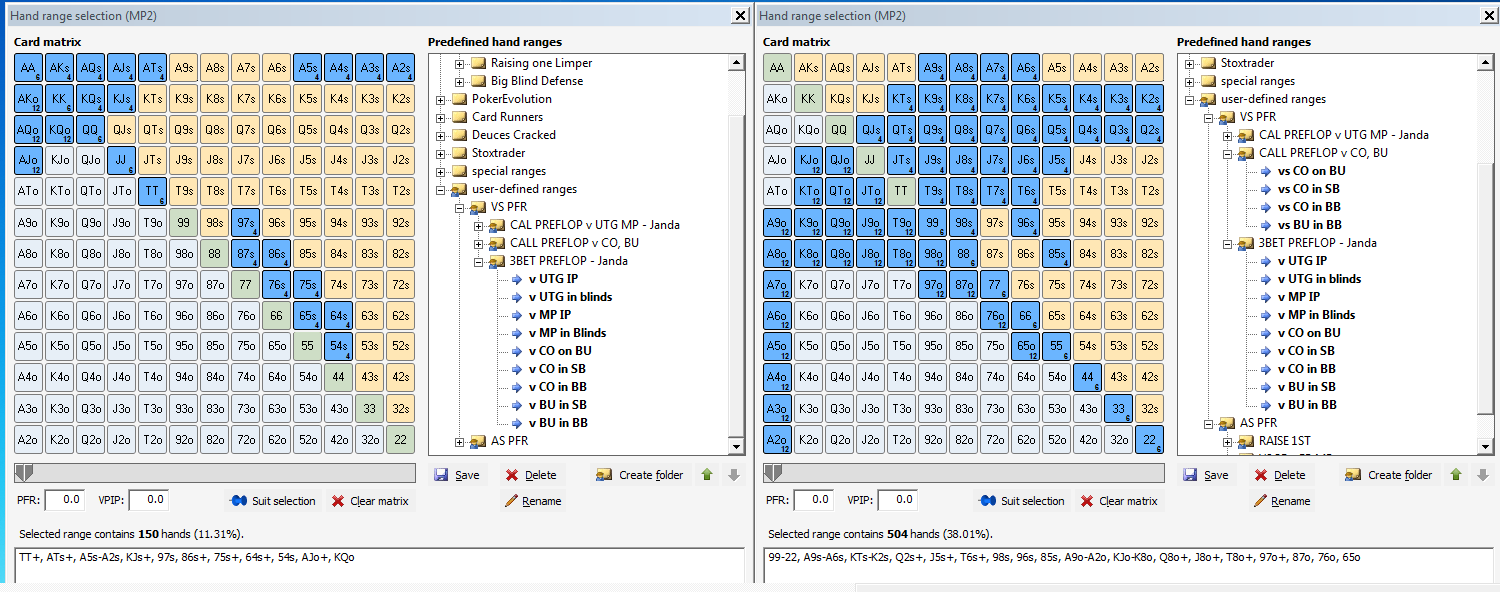
without reads at micros I'd do sth like this
the more reads and better plan you have, the more of your equity you will realize (The variable R).
For the junk hands without reads it's hard to go much above 50%
if you realize 50% equity u'd just defend this vs bu
22+, A2s+, K2s+, Q6s+, J8s+, T9s, A2o+, K6o+, Q9o+, JTo
if you realize 60% it's
22+, A2s+, K2s+, Q2s+, J2s+, T2s+, 95s+, 85s+, 75s+, 64s+, 54s, A2o+, K2o+, Q2o+, J5o+, T7o+, 97o+, 87o

Think 55% is closer for offsuit hands which gives you this
- I saw a spreadsheet and it was around this value from Stuff like KXo
22+, A2s+, K2s+, Q2s+, J5s+, T7s+, 97s+, 87s, A2o+, K2o+, Q6o+, J8o+, T9o

If you combine these and do R=60% for suited hands and 55% for offsuit hands you get this range for a profitable call:
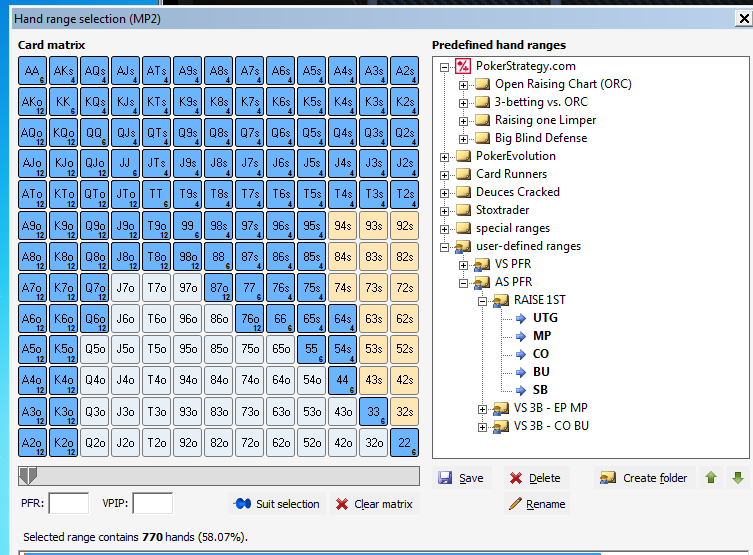
insert the 3b hands that are at top of your folding range and it's pretty much the range the OP suggests, only a tad tighter so it should be pretty sound for your stakes.

The R is irrelevant for the better hands as it'll be higher , it should be higher for suited and connected hands too as with backdoors and draws they'll be closer to the better bluffing hands postflop so you don't have to XF em so much

you can just put the input for R (%of equity you realize) and X (Equity of a hand vs opening range) in 0.XX format and see what you get here:
http://www.wolframalpha.com/input/?i=0%3D-1%2B4.5*R*X

To get raw ranges that have the necessary equity once you input R you can get by using hand range calculator in equilab

The lower the stake, the more you have to trim ranges as the rake will hurt ev of marginal hands

EDIT: I saw you play 400+?
think people will be good enough to exploit you there if you fold too much and rake is way lower.
Like you and sb need to defend 56% minimum+extra % for whatever equity he realizes with crap hands when either of you call.
If sb 3bets some 15-18% 56% should be right about the least you should defend or the BU can just raise any2

How wider to go above that all depends on how well you will play those junk hands and how high your R will be with them vs villain really the def range can even wider than the op suggested if you will play well postflop. Like if you somehow manage to realize 73% equity+ you should defend literally any2 including 72o and 32o


Reply
Quote
YohanN7
Joined: 15.06.2009

Originally posted by holmeboy
V a 50% range it looks really wide. I also think KQ should be a 3b, could go either way with 99. I'd probably defend something like:

But I'm only playing nl20 so take my range with a pinch of salt!

This range is very unbalanced. The 3-bets are heavily dominated by bluffs with suited trash. The button would be right to 4-bet/push 100% if he knew this.


Reply
Quote

Originally posted by YohanN7

Originally posted by holmeboy
V a 50% range it looks really wide. I also think KQ should be a 3b, could go either way with 99. I'd probably defend something like:

But I'm only playing nl20 so take my range with a pinch of salt!

This range is very unbalanced. The 3-bets are heavily dominated by bluffs with suited trash. The button would be right to 4-bet/push 100% if he knew this.

Far from it, its only 55% trash, 45% 'value'. If btn was 4b shoving 100% I could probably fold KQ/AQ and not be exploited. cba working out the maths now


Reply
Quote
YohanN7
Joined: 15.06.2009

Then you have a very different idea about "balance" than I do. Balance is not 50/50 if you believe that.


Reply
Quote

Originally posted by YohanN7
Then you have a very different idea about "balance" than I do. Balance is not 50/50 if you believe that.

If playing 3/4/5 bet game we need to defend 40-45% depending on sizing (iirc) of our 3b range against 4bets. Here I can defend 45% so I'm within the limits of being 'balanced'. This is against an unknown as well which is an important part of the discussion imo.

Perhaps if you explain what you mean, with maths (if necessary), it might help. I'm well open for discussion and I love receiving constructive criticism or people explaining why my thinking is suboptimal, it helps me improve and understand the game better. But just to tell me I'm wrong without explaining or backing up your points is a little frustrating and adds nothing to the discussion...


Reply
Quote
YohanN7
Joined: 15.06.2009

We are probably not at all far apart. I agree that you need to defend a lot against a wide min-raise. But defending can be calling as well as raising. I'll try to come with some math later on, but here is one immediate point: Suppose that your 3-bet was the "last" bet (all in), then you can immediately see that bluffing more than 50% is a loser.

Normally, this isn't the case, but it is still to be considered. Being out of position with a lousy hand in a 3-bet pot is a poor situation. The exact math will depend on the sizing of the 3-bet, and is probably almost impossible to calculate exactly (GTO-wise) since more bets will go in on the later streets.

The "right" answer is probably somewhere in between what I believe is appropriate to 3-bet and what you think.


Reply
Quote
GingerKid
Joined: 05.08.2007

Originally posted by YohanN7
We are probably not at all far apart. I agree that you need to defend a lot against a wide min-raise. But defending can be calling as well as raising. I'll try to come with some math later on, but here is one immediate point: Suppose that your 3-bet was the "last" bet (all in), then you can immediately see that bluffing more than 50% is a loser.

Normally, this isn't the case, but it is still to be considered. Being out of position with a lousy hand in a 3-bet pot is a poor situation. The exact math will depend on the sizing of the 3-bet, and is probably almost impossible to calculate exactly (GTO-wise) since more bets will go in on the later streets.

The "right" answer is probably somewhere in between what I believe is appropriate to 3-bet and what you think.

I understood 0% from what you said. Maybe you can be more specific, give example what your range is. I dont see anything wrong or unbalanced in his 3bet range. He is using polarized range, so off course he will have bad hands in 3bet pot oop.


Reply
Quote
YohanN7
Joined: 15.06.2009

Originally posted by GingerKid

Originally posted by YohanN7
We are probably not at all far apart. I agree that you need to defend a lot against a wide min-raise. But defending can be calling as well as raising. I'll try to come with some math later on, but here is one immediate point: Suppose that your 3-bet was the "last" bet (all in), then you can immediately see that bluffing more than 50% is a loser.

Normally, this isn't the case, but it is still to be considered. Being out of position with a lousy hand in a 3-bet pot is a poor situation. The exact math will depend on the sizing of the 3-bet, and is probably almost impossible to calculate exactly (GTO-wise) since more bets will go in on the later streets.

The "right" answer is probably somewhere in between what I believe is appropriate to 3-bet and what you think.

I understood 0% from what you said. Maybe you can be more specific, give example what your range is. I dont see anything wrong or unbalanced in his 3bet range. He is using polarized range, so off course he will have bad hands in 3bet pot oop.

I think the proposed range is way too bluff heavy.


Reply
Quote