Skip to forum
Notifications
Clear all

Flopped straight to be folded after heavy action from 2 in limped pot?

18 Posts
5 Users
4 Reactions
1,011 Views
Khiiniau
Joined: 21.08.2008

Let's think if this was not PLO2.

GG Poker - $0.02 PL Hi FAST (6 max) - Omaha Hi - 6 players
Hand converted by Holdem Manager 3

BTN: $0.90 (45 bb)
Hero (SB): $2.11 (105.5 bb)
BB: $5.32 (266 bb)
UTG: $2.26 (113 bb)
MP: $2.25 (112.5 bb)
CO: $10.87 (543.5 bb)

Hero posts SB $0.01, BB posts $0.02

Pre Flop: (pot: $0.03) Hero has J♠: 9♣: 7♦: 8♥:
3 folds, BTN calls $0.02, Hero calls $0.01, BB checks

Flop: ($0.06, 3 players) Q♠: T♥: 8♠:
Hero bets $0.06, BB raises to $0.24, BTN raises to $0.84 Hero?

Villains unknown. Flopped straigth and naturally bet. Heavy action starts and heros' straight is very weak, can evolve only to K-high


Reply
Quote
17 replies
BunBun00
Joined: 13.09.2023

Normally you don't want to donk oop with naked straight for this reason. This is limped pot so their ranges should be weaker, so maybe you can bet especially if they call light. I have seen enough craziness in micros that I would call. At worst you're a 2 to 1 dog. I would also fold pre.


Reply
Quote
Mascherano95
Joined: 09.10.2010

with 2 others sticking around it´s pretty safe to assume one has set or flush so I would call and shove on safe turns


Reply
Quote
ghaleon
Joined: 17.10.2007

Maybe fine to call in micros with assumption that they way overplay stuff. Issue though is that versus reasonable ranges you are practically never scooping the pot. That with high chance of set and/or fd being present actually make this very reasonable spot to fold in general.

But indeed as mentioned already we should be somewhat careful with dry nut straight in general. Especially in high SPR spots.


Reply
Quote
Mascherano95
Joined: 09.10.2010

As mentioned, you should know what to do when in doubts.

Spoiler

Pot.


Reply
Quote
BunBun00
Joined: 13.09.2023

Originally posted by Mascherano95
As mentioned, you should know what to do when in doubts.

Spoiler

Pot.

"Bunbun potted through thick and thin." I'm going to have that written on my tombstone.


Reply
Quote
Khiiniau
Joined: 21.08.2008

Microplayers autopilot screamed again POT because normal microplayers never fold a straight, set or fd in that kind of situation. If only 1 3bet I'll called and shoved turm if not paired or :spade: .

I have never thought that it's donking when SB bets first in limped pot?

Spoiler

BTN is typical small stack player in micros. Always limp AA and 3bet if raised, they don't want anybody folds:D . If BB was some of regular aggros he would have raised his hand preflop against limpers and it would have been AI between him and BTN.

Flop: ($0.06, 3 players) Q♠: T♥: 8♠:
Hero bets $0.06, BB raises to $0.24, BTN raises to $0.84, Hero folds, BB raises to $2.64, BTN calls $0.04 and is all-in

Turn: ($1.88, 2 players) J♦:

River: ($1.88, 2 players) K♣:

Results: $1.88 pot ($0.06 rake)
Final Board: Q♠: T♥: 8♠: J♦: K♣:

BB shows Q♥: 7♥: Q♦: 4♣:: (Three of a Kind, Queens)
(Pre 33%, Flop 67%, Turn 75%)

BTN shows 5♠: A♣: 9♦: A♠:: (One Pair, Aces)
(Pre 67%, Flop 33%, Turn 25%)


Reply
Quote
Mascherano95
Joined: 09.10.2010

Originally posted by Khiiniau
Microplayers autopilot screamed again POT because normal microplayers never fold a straight, set or fd in that kind of situation. If only 1 3bet I'll called and shoved turm if not paired or :spade: .

I have never thought that it's donking when SB bets first in limped pot?

Spoiler

BTN is typical small stack player in micros. Always limp AA and 3bet if raised, they don't want anybody folds:D . If BB was some of regular aggros he would have raised his hand preflop against limpers and it would have been AI between him and BTN.

Flop: ($0.06, 3 players) Q♠: T♥: 8♠:
Hero bets $0.06, BB raises to $0.24, BTN raises to $0.84, Hero folds, BB raises to $2.64, BTN calls $0.04 and is all-in

Turn: ($1.88, 2 players) J♦:

River: ($1.88, 2 players) K♣:

Results: $1.88 pot ($0.06 rake)
Final Board: Q♠: T♥: 8♠: J♦: K♣:

BB shows Q♥: 7♥: Q♦: 4♣:: (Three of a Kind, Queens)
(Pre 33%, Flop 67%, Turn 75%)

BTN shows 5♠: A♣: 9♦: A♠:: (One Pair, Aces)
(Pre 67%, Flop 33%, Turn 25%)

I mean as long as you don't fold you can't misplay nuts in general.

In your particular setup you are pretty much up against the best stuff villains hold here (nutflushdraw and set components). It´s not deep and it´s not fullring so we are not trying to outmaneuvr some very improbable nut+redraw combos like nutstraight+flushdraw etc. You usually have 33% equity for sure with your naked nutstraight which is break-even and for this sufficient to stack-off in an 3way ramble at any SPR possible with effective stack-sizes. So if someone ever goes slightly out of line (which results in nutflushdraw vs flush+sv but nobody has set or the other way round) they block each others component and we become favourit in a huge pot. You'd lose money specifically with lines that invest first but then abandon the pot vs increased aggression.

The question here is only, what´s more profit.. calling or shoving? Shoving obv. has easier playbility but you can "save" some money by folding bad turn-cards against straightforward player (if one of em is nitty enough to always have a nuts or redraw to nuts: set/flush and on my stakes there are plenty of such players).

You can have the nutdraw aswell when calling and villains usuallly do not donk bluffshove oop so you do not have to worry about getting outplayed or sth. He´d has to reveal his handstrength by trying to gii on turn or river oop with some weird line otherwise allowing you to check-back realizing your straight SDV. This detail in playbility has a big impact on our flop tendency to flat-call when in position and rather coming over the top oop. So to make a call flop - fold turn line you'd need reads about player tendencies, otherwise risking a bad fold ott - which can be a significant mistake in EV. Just calling the flop without clear equity edge (I´d want to have more than 33% in a 3way with perceived low FE) the standard play I use since I know them inside out is the passive calling and on top I am also capable of delay river bluff selectively with key blockers at ultra-low SPR. Vs unknown or on Micros though I guess there could be easily someone (unknown fish) overplaying his hand, so you might better just reshove and protect your equity, maybe squeeze out the third guy even generating some FE (hence "when in doubt - pot").


Reply
Quote
Khiiniau
Joined: 21.08.2008

Thanks Mascherano95 for giving you time to make good explanation because I post these hands here to learn something.

I think shove or fold were only options here because BB who has already 3betted seeing that there is a straight on table would never fold when small stack shoved, I put him to set+fd, those small stacks may shove just for fun.

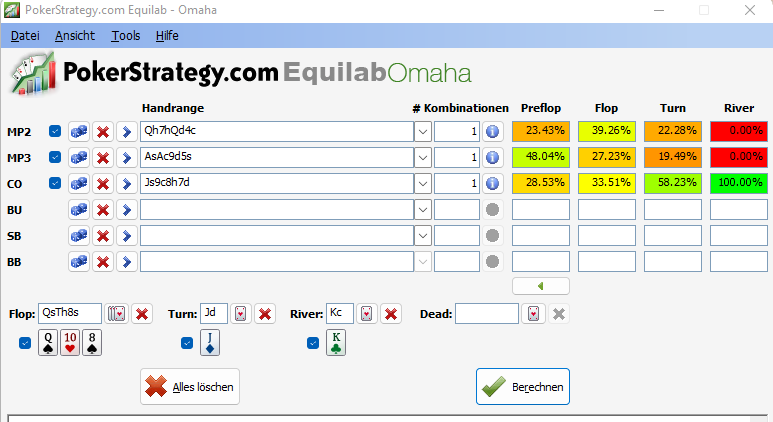
I had totally forgotten that Equilab is free for us, have to install it.


Reply
Quote
ghaleon
Joined: 17.10.2007

I did actually miss BU not being 100bb deep. Anyway to me deepness of spot is mainly about SPR which is deep. Its actually pretty rare to have multiway spot with SPR 35... At least in game where limping is not very common. Now opponents might not think in this fashion but more of actual money amount etc. which might make them more eager to gamble. Both opponents basically overplay their hand in this so we probably cant go wrong in micro limits to always continue if these sort of plays are expected. E.g. SB would need at least like QQJJ to be raising flop. He should be careful with dry top set. BU on other hand has nfd and top set draw which is nice but on other hand his AA is never good in itself and he has to improve to win hand. So in practice it would be better to just call and try to keep hero in the pot more often to improve his pot odds. 1

Problem in this sort of spot versus somewhat reasonable players is that its quite rare to not be versus another nuts. Especially more so if BU is also 100bb deep. If we look of good scenario in this spot:

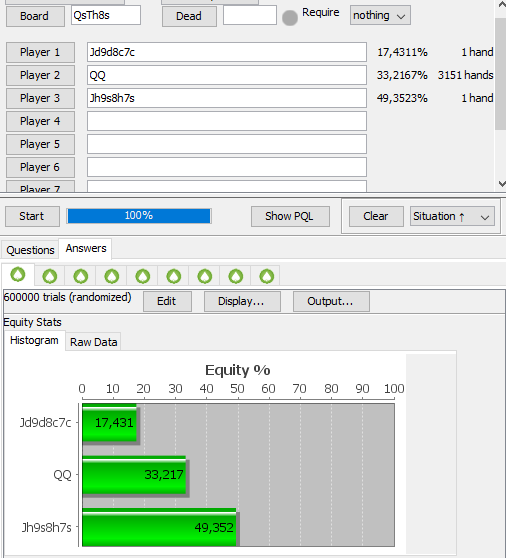
Spoiler

So I gave one player all QQ combos and another nuts with bdfd. But if we add either player a fd situation gets bad as we are only winning half pot at best.

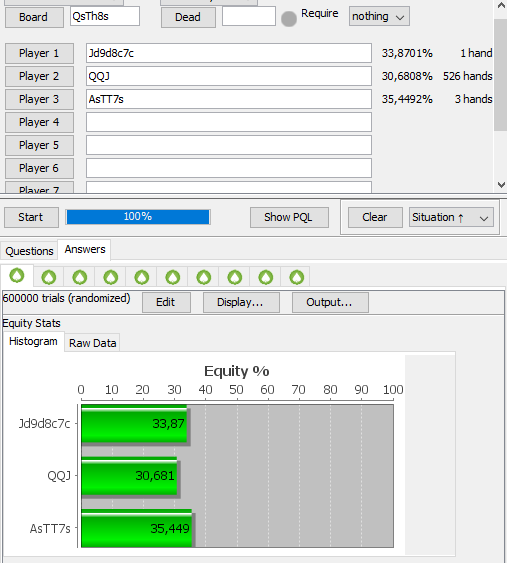
Spoiler

If we look of reasonable spot versus raise, raise without being vs another nuts it could be something like:

Spoiler

Gets bit better of course if QQ player has spade as well.

Overall I would not say its nitty at all if BU practically always have nuts with redraw or set+fd in such spot. Facing pot lead and pot raise make ranges extremely polarized and to cold 3bet in such spot just require extremely high equity range as you cant really expect to get both player to fold. Versus reasonable players its also bit problematic to use pot size lead in first place as it just allows opponents to fold so much straight away.

Now we would not be in this spot in first place with good players. But it could very well be BU open and both blinds calling. If I would lead in SB shoes (which make lot of sense on QT8 hitting SB call range heavily) I would use half pot as default sizing.


Reply
Quote
BunBun00
Joined: 13.09.2023

Got a couple of questions:
" If someone ever goes slightly out of line (which results in nutflushdraw vs flush+sv but nobody has set or the other way round) they block each others component and we become favourit in a huge pot."

flush+sv, what is sv?
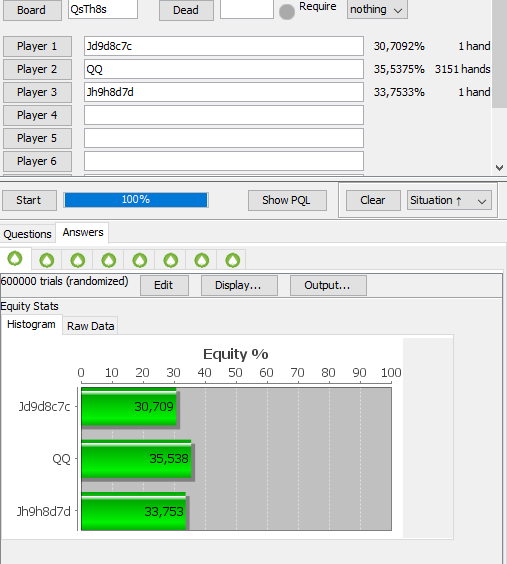
also I see you're using Equilab Omaha. What do you guys recommend Equilab Omaha or PPT, any differences that stand out.
Lastly if it goes all in 3-way OTF, which is a real possibility, then you need 25% equity to stack off.


Reply
Quote
ghaleon
Joined: 17.10.2007

Not sure where you are getting 25% equity requirement? If everyone are 100bb deep it would still require probably around 35% with rake taken into account.


Reply
Quote
BunBun00
Joined: 13.09.2023

SPR1,
Player 1 shoves, you need 33% equity. But if player 2 calls/shoves SPR becomes 0.5, you (player 3) need 25%.


Reply
Quote
Mascherano95
Joined: 09.10.2010

Originally posted by BunBun00

1. " If someone ever goes slightly out of line (which results in nutflushdraw vs flush+sv but nobody has set or the other way round) they block each others component and we become favourit in a huge pot."
flush+sv, what is sv?

2. also I see you're using Equilab Omaha. What do you guys recommend Equilab Omaha or PPT, any differences that stand out.
Lastly if it goes all in 3-way OTF, which is a real possibility, then you need 25% equity to stack off.

3. SPR1,
Player 1 shoves, you need 33% equity. But if player 2 calls/shoves SPR becomes 0.5, you (player 3) need 25%.

1. With SV I mean side-value. Side-value is often important in PLO as you can block other combinations to shift equity towards your favour or make certain combinations less likely. So for example when it is marginal to call with a certain handstrength, a somewhat hidden gutshot in your hand can make a difference.

2. I´d rather recommend PPT. It costs a few bucks but beside the equity calculation included in equilab you can also set up different kind of questions like equity distribution, frequencies of specific combos or ppt-syntax supported range analysis etc. It is the first and cheapest tool to get beside a tracking software.

3. Yes, but if someone raise-shoves you actually need more equity because the dead money is little and you try to take that possible line into account before bringing in the bet. There are break-even thresholds you should memorize, like at SPR 2 you need 40% to break-even. Together with estimating FE it helps you to figure out where a bet-call can become profitable within a hand-vs-range scenario or if shoving yourself might be better.


Reply
Quote
ghaleon
Joined: 17.10.2007

Originally posted by BunBun00
SPR1,
Player 1 shoves, you need 33% equity. But if player 2 calls/shoves SPR becomes 0.5, you (player 3) need 25%.

In this case there is already lot in the middle. In this hand there is basically nothing in the middle.


Reply
Quote
BunBun00
Joined: 13.09.2023

I wish there is information/sources on PPT out there on the internet, on how to get the most out of it. About range inputs in PPT, I'm reluctant to use % because lets say for example I open EP and BU 3bets, BU 3bets range is 6% according to solver right. But the problem is 6% range in PPT is not similar to solver 6% 3betting range. For example 6% in PPT will not include $ds rundowns, or hands like TQ64$ds, so that's why I'm reluctant to use % in PPT. I feel like the input would be very different form reality.


Reply
Quote
Mascherano95
Joined: 09.10.2010

Originally posted by BunBun00
I wish there is information/sources on PPT out there on the internet, on how to get the most out of it. About range inputs in PPT, I'm reluctant to use % because lets say for example I open EP and BU 3bets, BU 3bets range is 6% according to solver right. But the problem is 6% range in PPT is not similar to solver 6% 3betting range. For example 6% in PPT will not include $ds rundowns, or hands like TQ64$ds, so that's why I'm reluctant to use % in PPT. I feel like the input would be very different form reality.

That´s a good point because top-ranges are not ideal. you might make some of the ranges manually in the range analysis. Kyyberi had some ranges with ppt-syntax too, you might ask him.


Reply
Quote
Coach
Kyyberi
Joined: 09.07.2010

PPT Oracle is free at the moment, at least until December I think. I use old Pokerjuice opening and 3bet ranges, they are very close to solver ranges so quite useful.

You can find the file and instructions in this thread: https://forums.pokerstrategy.com/forum/thread.php?postid=3472922#post3472922


Reply
Quote