This week I've been studying a lot a situation in which BTN opens and BB defends by calling. It is one of the situations in which players' ranges are at their widest and it makes for a very interesting range vs range analysis, which to be honest is my favorite type of studying. Maybe it's not the most efficient way to learn at microstakes, but combined with other methods of learning, I think it can greatly improve one's understanding of poker and will be very useful down the line on the higher stakes. Let's take BTN vs BB situation and break down players' ranges on a random flop.
Preflop
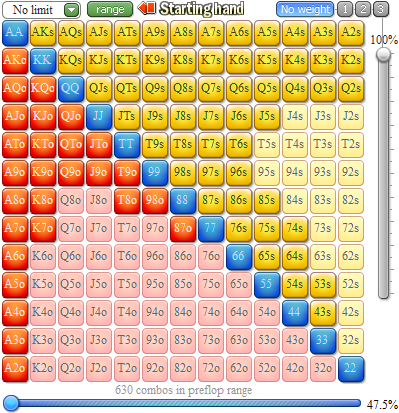
BTN’s opening range to 2.5bb: AA-22,AKo-A2o,KQo-K7o,QJo-Q9o,JTo-J9o,T9o-T8o,98o,87o,AKs-A2s,KQs-K2s,QJs-Q2s,JTs-J5s,T9s-T6s,98s-96s,87s-85s,76s-74s,65s-64s,54s-53s,43s (47.5%)
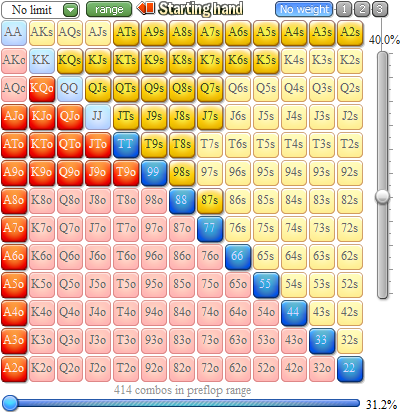
BB’s calling range: TT-22,AJo-A2o,KQo-K9o,QJo-Q9o,JTo-J9o,T9o,ATs-A2s,KQs-K5s,QJs-Q7s,JTs-J7s,T9s-T8s,98s,87s (31.2%)
Flop
A♥:8♥:7♣:
BTN
Has a slight range disadvantage (~1%). Has more nutty combos, but less in % because his range is much wider. Still, it shouldn’t be too difficult to play on this board in position, he should be able to make a cbet very often on such a board and bluff quite frequently. In fact I think it is one of the easiest boards to play.
Total combos: {533}
• Strong bets: 88(3), 77(3), A8(9), A7(9), 87(9), A9-AK (60) {93}
• Medium bets (for protection): 99-TT (12), 8x(48), 7x(33), 22-66(30) {123}
• Draw bets: FD(37), OESD(24) {61}
• Weak bets (bluffs): GS(44), backdoor clubs(47), KhQ-8x(15), QhJ-9x(9) {115}
• Checks: AA(3), A2-A6(60), JJ-KK(18), air(60) {141} – 26.4%
Summary: Turns out that BTN has less bluffs in his range than I expected. Given that he is in position, I figured he would have at least 2 bluffs for every value hand, but taking into account strong draws he has about 1 bluff for every value hand. He is also checking back only 26.4% of hands, majority of which are hands that can call 2 bets on later streets. I would bet with weak pairs, 8x, 7x and also 99-TT because these hands are pretty vulnerable and don’t want to see any overcards on the turn and we would like to fold out hands like KQ, KJ, QJ etc, denying our opponent free shot at outdrawing us. Overall I think it is a pretty easy board to play on the button.
BB
On the first glance this board shouldn’t be too difficult to play on the BB. BTN gave us pretty good pot odds preflop, so we shouldn’t be too crazy about defending too wide to prevent him from getting auto-profit with his worst hands. We shouldn’t check-call with our strong hands on this board because it is quite drawy and if some draw completes on the turn we may lose our ability to check-raise for value and would have to check-call instead. But we also should consider that if we check-raise with our strong hands, they will be outdrawn quite often on the turn or river, so we shouldn’t have too many bluffs in our check-raising range. Maybe about 1.5 bluffs for every strong value hand. But it’s hard to say.
Total combos: {353}
• Strong check-raises: 88(3), 77(3), A8(9), A7(9), 87s(2) {26}
• Weak check-raises (bluffs): JT(15), J9(15), Kc9c(1), Kc6c(1), Kc5c(1), QcJc(1), QcTc(1), Qc9c(1), Kh9x(3) {39}
• Draw check-raises: FD(6) {6}
• Check-calls: FD(9), A2-A6(60), A9-AT(24), AJo(9), 99-TT(12), T9(15), 8x(15), 7x(9) {153}
• Check-folds: 22-66(30), air(99) {129} – 36.5%
Summary: We are check-folding to BTN’s cbet about 36% of the time, which I find pretty reasonable. I wouldn’t worry too much about the fact that we don’t slowplay any monsters on this flop, because we have a lot of top pairs and draws that can improve in our range, which will allow us to calldown against an aggressive opponent if necessary. We don’t fold too many hands and our check-raising range is pretty balanced. This game plan for BB’s range seems good and on the first glance I can’t find any serious ways how our opponent on the BTN can exploit us.
I would like to add that those are mainly my thoughts and I can be completely wrong about these ranges and how to play them  But for the most part I got a big chunk of theory, for example value to bluff ratios, from Matthew Janda, who I respect a lot.
And here is a quote from Haseeb's book, which I find very appropriate:
Some players, especially ones who are mathematically inclined, have a rosy conception of how poker works. In their minds, poker is just a mathematical construct— a puzzle, with a definite solution. They imagine that, if locked in a room for 20 years with a calculator, they could develop a poker game so robust that it could take down the best player in the world.
These players imagine poker consists merely of figuring out a set of strategies, as though writing them out on a note card—“ how to play poker”— and having the right stuff written on your note card will make your game impregnable. Of course, that’s not how poker works. Poker must be learned; you must absorb that learning into your bones. Your brain must get conditioned into the right network, which takes many hundreds of thousands of hands. You needn’t worry about mapping out all of your strategies, or obsessing over the mathematics. Focus on getting the learning into your fingers.
Qureshi, Haseeb. How to Be a Poker Player: The Philosophy of Poker.










 minimum you win is 50bb... would be a shame if it got raised and everyone folded as you have to win it postflop