

So, here is my weekly update:
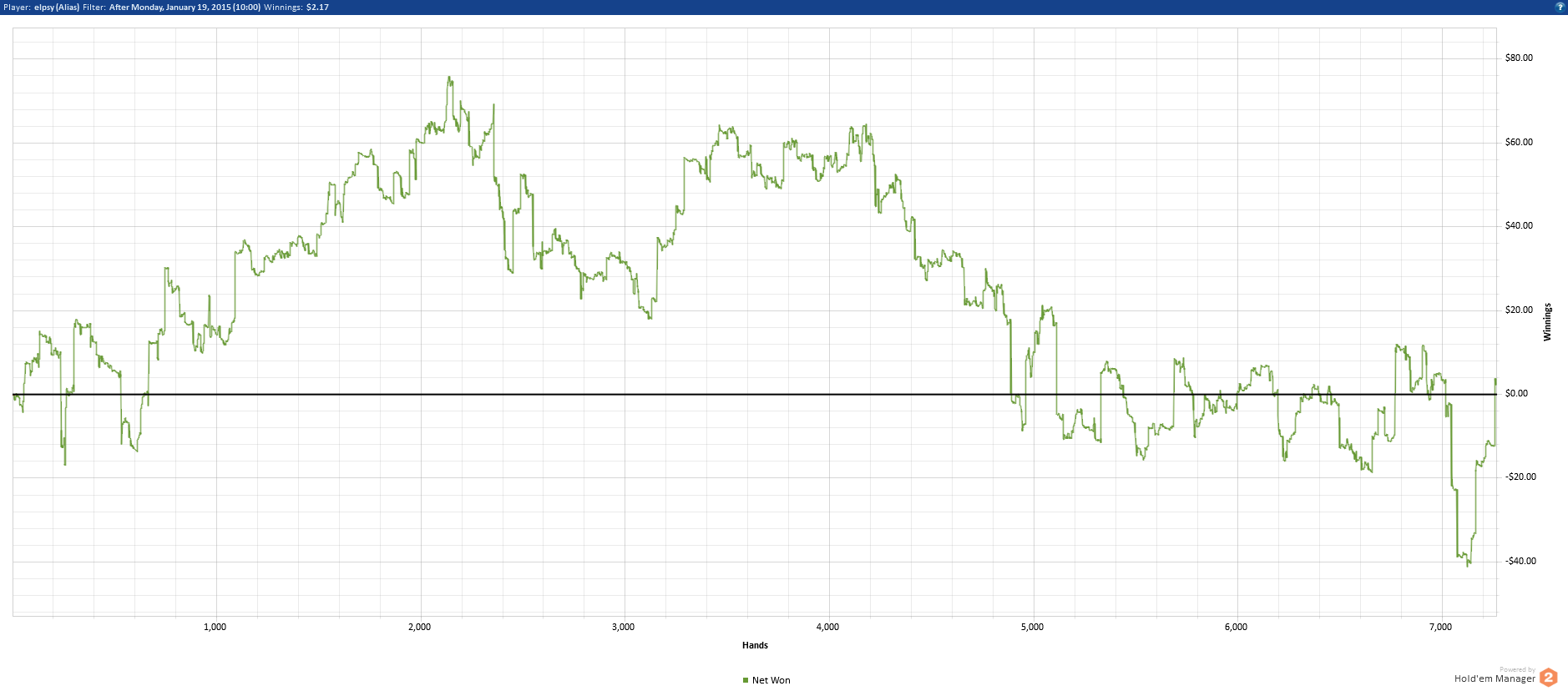
Hands: 7,670
Result: -$9.41 (+Omaha)
Rakeback: +$10
Total: +$0.59
Bankroll: $968.63
This week, despite the swingy Holdem, it was my microstakes Omaha8 ventures that did it for me. It feels like in that game there are stretches when you just can’t win (as in any poker game I suppose), and even if you find yourself in a good spot, you can’t win back a lot, because of a limit structure. But that’s fine, it’s still a fun game and I’m just starting to learn it. The one problem is that there are very few tables around, and sometimes it can take ages to start a session. During one of those downtimes I even played some PLO, and that, as far as I can remember, was the first time I played it outside of mixed-games rotations. It always was my weakest game, because, to be honest, it really scared me. But those were the days when losing two buy-ins in a Holdem game could totally ruin my day and throw me off my game. Now that I have a much better understanding of how variance works, I really enjoyed PLO and even managed to cover some O8 loses. Maybe I will play a few tables of PLO now and then, and see what comes of it. But enough about Omaha, let’s talk Holdem!
Well, there was some more studying and some more playing of course. It’s quite fascinating about poker that the more you learn about it, the more interesting it becomes, and your attitude towards it changes as well. Well, it’s like that for me at least. I also found that studying technical part of poker helped me improve my mental game. If you know that your play was correct and it yields you some EV in the long-term, why would you tilt if your bluff got called? Why would you be scared to fire that third bluff barrel, or check/raise river as a bluff, if this play makes sense. When you play without some research and theory to back your decisions, it really constrains you in a lot of ways. You can stick to some concepts that are very comfortable and familiar to you, such as setmining, c-betting, light 3-bets, because you know that they are profitable, but that’s just a tiny part of poker. There is a whole world of unexplored possibilities (at least for microstakes players), which we don’t even think about, or are scared to try out, because we don’t know if it would be a right play, or just because we are not used to doing certain things. Knowing what lies behind those concepts and what is required for their successful application can really remove a lot of constraint from your game and hopefully take it to the next level. And suddenly bluff raising rivers or check-raising turns or pushing for a thin value is not so scary anymore. Suddenly, where there was fear and doubt, there is now creativity that feeds the love for this game and makes you want to work even harder to fully enjoy poker for what it is and what it is meant to be.
Poker, at its highest level, is an art form. Traditionally, the notion of art is restricted to things such as painting, music, and the like. Yet, you will occasionally hear people speak of a beautiful baseball swing, or a sublime mathematical proof. In poker, we also speak of beauty, though we sometimes use different words for it—“sick play,” “a soulread,” and so on. What we apprehend as beauty in poker, I would argue, is the masterful demonstration of creativity.
Where does creativity in poker come from? What role does creativity play? And how can we be more creative?
In a sense, it’s natural to be creative. When you first began playing poker, just about everything you did was creative. You experimented, you made plays you’d never made before, and you were unafraid. It was only over time, after you learned what you shouldn’t do, that your creativity began to be stifled. By the time you become a fully capable and disciplined poker player, you are no longer even aware of just how restricted you are by your conditioning— at that point, you can no longer even see all of the available possibilities.
Qureshi, Haseeb. How to Be a Poker Player: The Philosophy of Poker.




 But I will try my best!