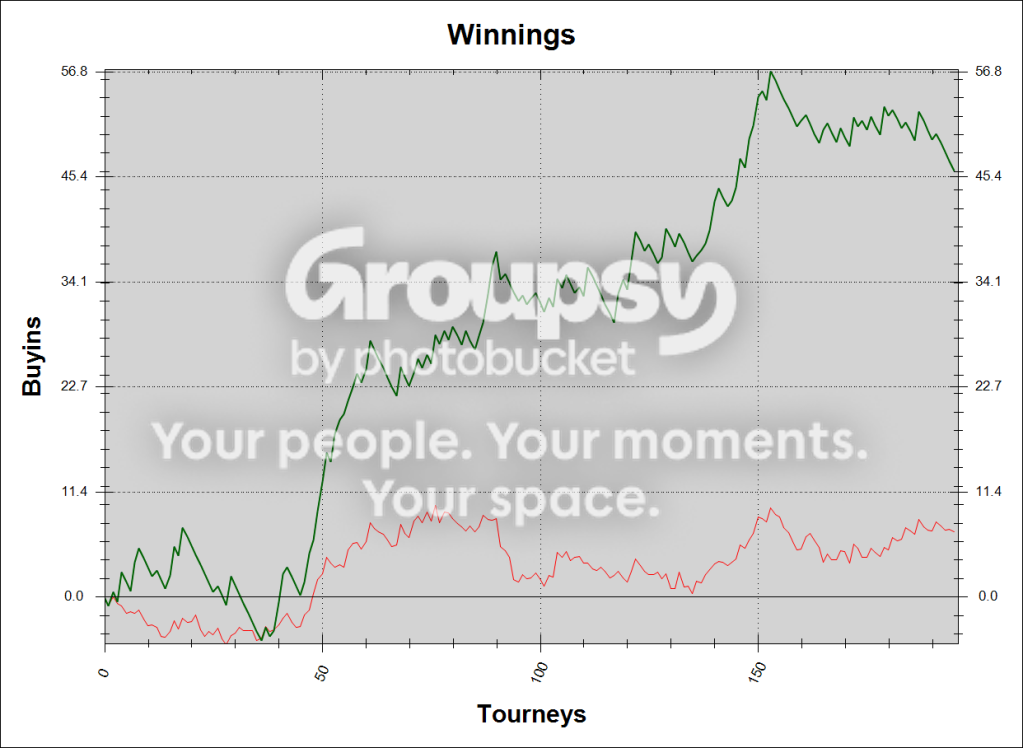
Hi!
I read some really interesting strategy posts from 2+2 today. One thing i should certainly think about is when to deviate from "correct" icm play, i. e make an -ev play or skip an +ev move. The main argument is that sometimes its better to make such plays because those deviations from icm open up opportunities in future situations which compensate the lost or missed equity.
One of those theories is presented by 2+2 superstar Gigabet in his Gigabet Dilemma or Gigablock Theory (a post from Gigabet himself: http://archives1.twoplustwo.com/showflat.php?Cat=0&Number=2610396&page=0&fpart=1&vc=1 , this post is pretty hard to grasp, but he def has something). The theory basically claims that sometimes its good to make -ev play to get a chance to have a greater edge on future hands. For example, when you're one of the bigstack with other 2-3 players (belonging to the same stacksize "block" with those players), then you cannot benefit from the situation as much as you could when you'd have enough more chips than they to haul yourself up to higher stacksize block. So it might be profitable to take an -ev shot against shortstacks in case when losing that confrontation doesnt increase the stacks difference between you and other bigstacks significantly, but winning that confrontation opens you to an opportunity to get a runaway chiplead.
I think it's a valid point, but is there some more solid justifications for deviating from "correct" icm play and for giving up an edge sometimes? Some claim that you should never give up an edge, that you should take every +ev move you can. In what follows, I'll try to show mathematically, that sometimes you should skip +ev play.
Here's a situation from 9-man 10$+1$ hyper turbo stt with 10bb starting stacks. Its a first hand, everyone folds to BU who pushes exactly 30%.

It seems that hero should call here with A7s. Hero's edge is 0.18%, which means that calling should increase expected winnings by 0.162$ (90$*0.0018) on average. So should hero make this call?
Let's see, what's the A7s equity vs wiz 30% range (22+, Ax+, K4s+, K8+, Q9s+, K8+, QJ, JTs):
%win = 49.73%, %lose = 50.27% (ignoring ties)
50.27% of times hero busts for 0.162$ and 49.73% of times hero doubles with expected winnings of X$ + 0.162$ where X$ is expected winnings after doubling up. Lets take hero's ROI 10% and lets assume for now that doubling up doesnt increase hero's ROI. So X$ = 11$*0.1 = 1.1$
So the expected winnings if hero makes the call:
0.5027*0.162$ + 0.4973*(1.1$+0.162$) = 0.70903$
BUT if hero does NOT make the call, his expected winnings with 10% ROI are 1.1$ (!)
In order to this call to be profitable we must assume that hero's ROI is not the same after calling, but has increased due to bigger stacksize which gives him advantage in future situations. Exactly how much hero's ROI has to increase to make this call?
We simply have to solve the following equation:
0.5027*0.162$ + 0.4973*(X$+0.162) = 1.1$
X$ = 1.886
So hero's ROI has to increase around 1.7 (1.886/1.1) times. If hero is a good player and he feels that his edge increases at least that much over the field, then he should make this call. Otherwise it should be a fold.
Its plausible that hero's ROI increases after doubling up, but that kind of a supports the argument in the beginning of this post: we cannot only take into account hero's direct expected value in a given situation provided by SNGWizard, but we have to consider future opportunities aswell (for example, believing that bigger stack will increase our edge in future hands (i e our ROI)). Those considerations should make us sometimes skip +ev play or take a -ev shot. Now, the real question is, how to recognize those spots in a game?
Some good reading on the subject:
http://forumserver.twoplustwo.com/36/stt-strategy/3-5k-post-edge-really-edge-743669/
http://forumserver.twoplustwo.com/36/stt-strategy/minimum-edge-theory-100959/
Any comments are much appreciated.





 ) ready


 I suspect that HM2 has something to do with it...

 , 9
, 9 , 2
, 2 , 4
, 4