What would you do on this NL5K turn?
We're in good shape with Kings and a nut flush draw on this high stakes turn. A decision at this level is never easy - will you find the right one?

This week, our latest high stakes hand involves only three players. The protagonists are OBORRA, OtB_RedBaron and Katya_18, with OBORRA taking the role of Hero and leading us to a very tricky decision on the turn. Again, our German coach ironpumper will help out with analysing the crucial spots and questions.
This time, there is no weak player involved in the hand. In fact, it's quite the contrary: All three players can be counted amongst the best on the highest limits. OtB_RedBaron and Katya_18 have been playing on top for years and OBORRA started crushing the highest stakes roughly two years ago, yet to some extent he's still being regarded as a newcomer on the scene.
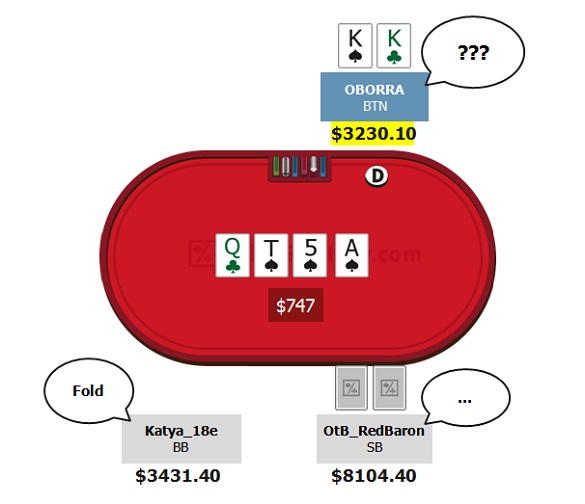
The hand kicks off with a 2BB open raise by our Hero OBORRA on the button. On lower limits, min-raise stealing as the Button was considered the standard for a long time. Nowadays the approach does change back to button steals of 2.5 or even 3 times the current big blind, though.
That's because there's considerably more rake to be paid on lower limits, forcing you to play those 2BB steals with a wide range against good opponents for a lot of small pots. Therefore, it makes more sense to choose a larger steal size with a tighter range in order to generate easier spots without losing any EV. However, due to the rake cap that cohesion doesn't make any difference for the range a solid regular can play in those spots on NL5K. It doesn't matter whether the Button steals with a 2BB or 3BB raise, therefore clearly making the 2BB size the better choice on the high stakes.
Diving into the action
 Hero grabs the second best starting hand with
 and raises to 2BB. Both Small Blind and Big Blind decide to call that raise.
On lower limits it's often advised to follow a 3-bet-only strategy in the SB, meaning to either 3-bet or fold whenever you're confronted with a raise. If you follow that strategy well, you're capable of achieving a high EV while never being confronted with big issues. So this strategy definitely has a right to exist.
However, you will never achieve the maximum possible EV with that approach. Therefore, basically all the players on the high stakes also have a calling range in the SB. Still, this range highly depends on the player who kicks off the initial raise.
Good news on the flop
The flop reveals 

 . That's a very favourable combo for the open-raiser. He almost certainly still has the best hand while his opponents will stick to a lot of weaker hands that they can't fold on the flop right away. Hands that beat Hero here, QQ or TT, will rarely be a part of the opponents' range since those would have been 3-bet preflop.
If Hero was heads-up on this flop, a high c-bet frequency with a small bet size would be the best choice. It's a different situation 3-handed, though. You will not always be able to realise the showdown equity of your overpair against two opponents. Additionally, you have to take into account that the SB or BB could be on a draw. Therefore, Hero chooses a higher bet size in order to ensure his opponents won't be able to see a cheap turn.
The correct play on the turn
After the SB decides to call while the BB folds, the turn brings the  and the nut flush draw for Hero. OtB_RedBaron responds with a check and we're confronted with the decision whether to check back or to bet.
Checking would give us a free river while also avoiding a check/raise by our opponent. We wouldn't be getting any value from weaker draws, though. If we instead decide to go for a bet, there's an endless range of bet sizes we could choose. To keep things simple, we're only going to focus on 1/2 potsize and 2/3 potsize.
The advantage of betting half the pot is that we would keep our opponent's range wide, thereby ensuring that we would get value from more weaker hands. On the downside, we wouldn't be getting the maximum EV from stronger hands in the opponent's range that we're still able to beat. Of course, this issue is simply reversed when choosing a bet of two-thirds the pot. In the end, your decision depends on which range you're putting Villain on in this spot. And now it's your turn...
Last week’s poll results
Last week we asked you what you would do when faced with the same call/fold decision that this hero had to make here.
We received almost 800 votes, the majority of which preferred to fold. Of these, 56% folded in France while in Hungary that figure spiked even higher to 71%, deeming it to be the smart move.
That said, in Poland over half of those polled, 53%, thought it was better to call while the Italians were split 50/50. But what about SpinLegends?
“First of all, villain hasn't got a lot of Ts in his range. He would probably have raised pre-flop AT and he wouldn't potbet most of the T on the flop. The turn gives us further information; here he would raise JT or T6 in order to swell the pot, so we have just a few combos left like T9 (but would he bet the pot with this?) or T8.
The size of the river gives us even more information; unless he has a very unlikely QT, oppo knows that with that with this size he would just split with T without getting any value from other hands. There are also some busted flushdraws, way more than the Ts in his range. Even if at first glance the call can appear "extreme", in this case it's perfectly reasonable.”