How well do you perform out of position at NL5k?
We're back again at the high stakes, this time dealing with an out of position turn spot after a preflop 4-bet. Can you find the best line?
In the third hand of our current batch of high stakes reviews there's no need to get into a lot of details about the players involved. We've talked about them all before in previous hands.
Lately, MMAsherdog developed a tendency to dive into reg battles more frequently, while still maintaining an average winrate of 4BB. Of course, that's quite an impressive result on the limits we're dealing with here.
Still, our Hero in today's hand will be jinmay, known for his quite aggressive and uncommon approach, something we're also going to witness in our analysis below.
Pass_72 is regularly playing at NL5k and can be considered to be amongst the better players there. His results on highstakesdb.com currently might show a loss of roughly $60,000 but we have to take into account that neither all the limits nor all the sites he's playing at are tracked in their database. Instead, it's quite safe to assume that he's up in total and playing profitably.
Diving into the action

 has become a hand that players like to add to their 3-betting range, even at lower limits, in order to make it less transparent and potentially add some monsters to the range on low or drawy boards.
Due to his position, the Big Blind counters the Small Blind with a small 4-bet. He can virtually ignore the open-raiser on the button in this spot because, being stuck in a sandwich, that player would have to play very honestly and can almost only continue with monsters after the action he witnessed. Of course, getting odds like that, Hero definitely has to call the 4-bet though.

A flop with pros and cons

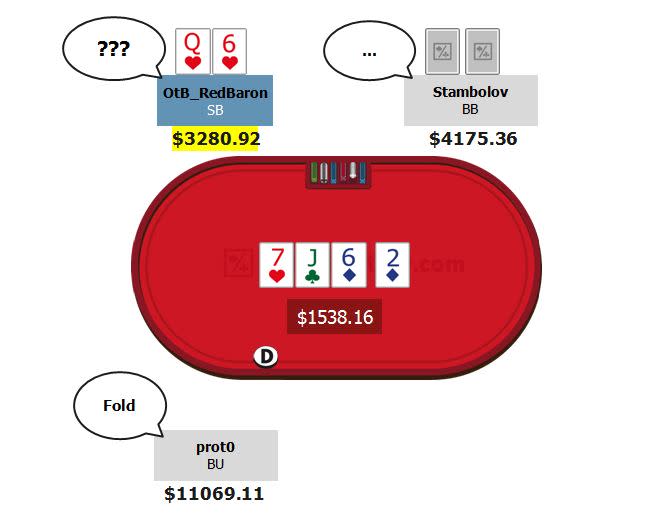
The flop dealt cuts both ways for Hero. Clearly, the  is a drawback since it will have hit the opponent's range quite well. In turn, a plus for Hero on this flop is that he was able to hit an open-ender and a backdoor flush draw.
Considering our overall range, despite only having a couple of outs, this board is perfectly suited to play a check/raise all-in. That move is also the most prominent line recommended by the current solver tools on the market.
At first, jinmay seems to be aware of that, checking to his opponent, but then he goes on to pick a smaller than recommended raise size against Villain's bet. By raising three-fold, it appears he still would like to keep some wiggle room for himself on turn and river. This is quite the unusual line, but as we know, history and reads could always be a factor in such a spot.
Out of position on the turn, what now?

After our check/raise has been called, the question now is how we should continue after the  hit on the turn. One option would be to push all-in since, after all, we've shown quite a bit of strength with our check/raise on the flop that we could manifest now.
A different approach would be a direct check/fold. The doesn't add anything for us and we can't really expect to have a lot of fold equity with less than pot-size left.
Lastly, we could also consider the almost forgotten block bet from ancient times. We would bet roughly $1,000 in order to see a cheap river, allowing us to take a peak and if needed still find a fold.
//
Our solution for the last high stakes hand
We held a weak mid-pair in the last high stakes hand we had a look at and, just like today, the question was how to continue on the turn.
Since the usual move is to first check with your entire range, we wanted to know whether you would fold, call or raise against a subsequent bet by the opponent.
Almost 50% of voters picked a fold as the preferable line. However, in our opinion, that's not the correct answer for that spot. Of course, we're only holding a weak mid-pair but it's still quite well suited for a bluff check/raise, allowing us to balance our value range.
We also have to take into account the blockers we're holding: QQ, QJ, 66 and 67 are all blocked by our hand. Additionally, we're not blocking any straight draw combos, further supporting a bluff as the best possible decision on that turn.