


GTO Poker Theories: The Pareto Principle
Barry Carter continues his series where he shares insights from Economics and Game Theory that could help you as a poker player.
One of the real gifts poker has given me is that it has been a great jumping off point to learn things from other disciplines like economics, AI, psychology and Game Theory. So here is a series of articles where I bring some of the most interesting things I have learned from other subjects outside of poker which are applicable in this game we know and love.
One of the reasons I started this new feature was so I had an excuse to write about one of my favourite economic principles, The Pareto Principle, or the 80/20 rule. This is a rule that states that in a wide ranging number of events, 80% of the results come from 20% of the causes.
It was first observed by Vilfredo Pareto who noticed that 80% of land in Italy was owned by 20% of the people. Since that one observation, a multitude of similar distributions have been noticed including:
- 83% of GDP in 1989 came from the richest 20% of the population
- Microsoft observed that 20% of the most reported bugs fixed 80% of errors
- Health and safety experts suggest 20% of hazards account for 80% of injuries
- In language around 20% of the words account for 80% word occurences in speech and text (very useful if you are learning a language)
- In the US around 20% of the hospital patients use up 80% of the hospital resources
I could go on but I really do implore you to look into this yourself, because it’s fascinating. The Pareto Principle is similar to the Matthew Principle which explores why success begets more success.
Focus on the 20%
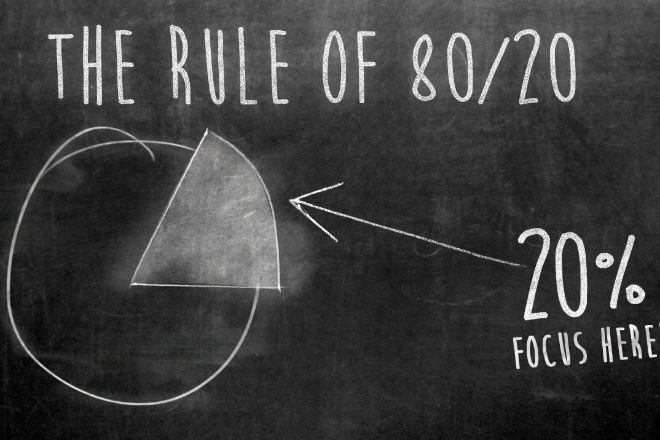
The useful thing about The Pareto Principle is that it allows you to spot where something has a disproportionate impact on your results, positively or negatively. It’s really useful for both personal and business productivity. If you are spending 80% of your time dealing with 20% of your most demanding clients, you might discover you are better off just serving the clients who don't waste your time. Likewise if 80% of your sales come from 20% of your clients, you would be better off focussing more time on them.
The distributions don’t have to be 80/20, there just has to be a big gap between input and output, an unqual distribution. It could be 75/25 or 90/10 or even 90/20 (It doesn’t have to add to to 100, 90% of your sales could come from 15% of your staff, for example). It’s just about spotting areas of disproportionate impact.
When you get sold on the 80/20 rule you start to notice them in real life everywhere, for example my friend runs a chain of cafes and he told me something like 70% of meals bought in pubs is the burger option, which in his case was one of about six main meals on his menu, so 17% of his meals account for 70% of his sales.
Pareto Principles in poker databases
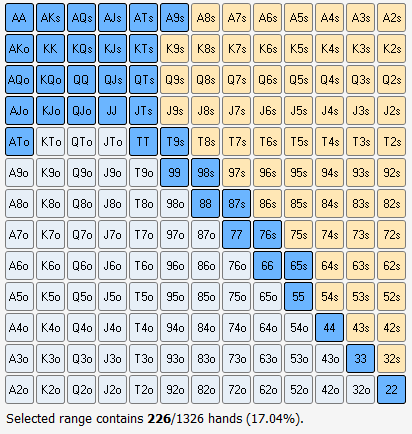
So how does this apply to poker? I’ve actually noticed the 80/20 rule in lots of fun ways, and a good place to start is your database.
Of course this varies based on your ability and your opponent’s ability, but if you look at your poker database you’ll probably notice that around 20-25% of your hands will produce something like 80% of the positive results. This intuitively makes sense, as the top 20% of hands tend to be the easily playable ones like big aces, broadway hands, pairs and suited connectors.
Likewise, if you took a look at your database, you would probably discover that 80% of your profit comes from a very small percentage of the players you have played against. Again, don’t get too bogged down on the specific 80-20 ratio here, but take a look at your own results and you will probably see a similar unequal distribution.
One more look at the database and you’ll probably see some fun distributions where it comes to table position. If you play six max games, I’d wager that the times you are playing on the button contributes to a high percentage of your overall results.
So just in case it needs explaining, the 80/20 rule is a good reminder to play in position, play strong hands and game select well.
Over the years I have seen some pretty reliable statistics to show that around 15% of the players generate 80% of the rake at a poker room. This will be the high volume regulars, not the depositing players. This distribution may have changed now that high volume play is less rewarded, but it will still be something similar. I’ve also seen similar figures to show that about 15% of players are winning all the money in poker, with a small percentage of those winners winning enough to be a professional.
Look for unequal distribution everywhere
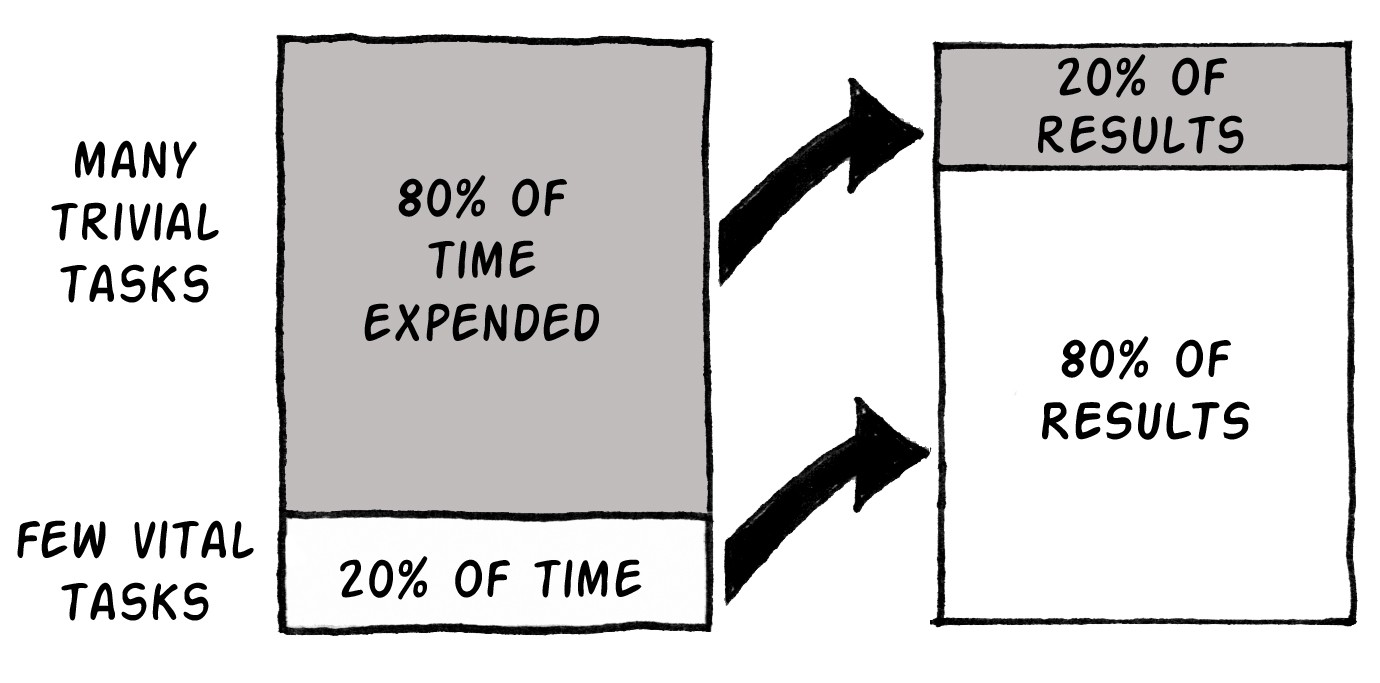
More than anything I would say that you should creatively use the 80/20 principle to identify where your best results are coming and then do more of those things. I, for example, noticed that my best work is always done in the first two hours of the morning, so I always prioritise my most important work for then. Let’s say you learn poker by getting coaching, visiting webinars, posting hands on forums and watching videos. Ask yourself which of those methods has the most impact. If the webinar always really sticks and the videos you often forget, get more webinars in and scrap the videos.
A common issue for people learning about the Pareto Principle is getting too bogged down in the ratios and looking for them to be perfect. In my mind it is just an imperfect but useful way to ask yourself what is working and what is not, so you can do more of the things that are helping and jettisoning the things that don’t have an impact.
What theories from outside of poker have helped your game? Let us know in the comments.
Related articles
