


Poker Basics - Hand Reading
Another one for the newbies and those wanting a strategy refresh - 4 tips on how to put your opponent on a likely range of hands.
Tip 1: Avoid Mirror Thinking
Many players wrongly assume that their opponents play the same way as they do. This is called "mirror thinking". For example, if they often bluff in a particular spot, they expect their opponents to do the same.
You shouldn’t project your range in a particular spot onto your opponent, but rather orientate your gameplay based on the majority of the players at your limit.
Have a look at the following example:
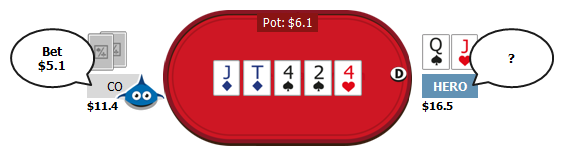
You are on the BU and call the open raise of a LAG in the CO. After betting the flop and turn, he over bets on the river.
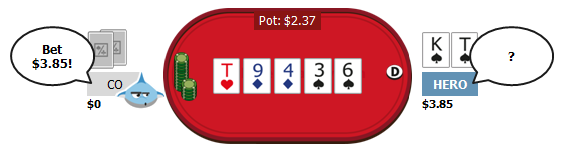
A lot of players estimate their opponent's range in this spot to be like their own. If they often over bet as a bluff, they assume their opponent will do so as well and therefore make the call.
If however they seldom over bet as a bluff, they put their opponents on a set or better hand and therefore fold.
Do not make this mistake, but rather orientate your gameplay to the tendencies of the players at your limit. Most players hardly ever over bet as a bluff and therefore have a strong range here, consisting of sets and straights. You should therefore fold.
Tip 2: Bet sizing tells
The bet size of your opponent gives you information about their hand strength. Usually the following is true: the bigger the bet, the stronger the hand.
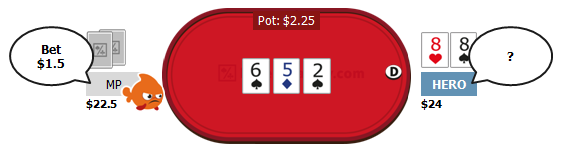
The maniac in MP has open raised pre-flop and you have the following information on them: with a set or over pair on similarly drawy boards, he has bet $2 or more up till now. As he has only bet $1.5 this time, these hands probably aren’t in his range.
Therefore the value range of your opponent decreases, and his betting range in total is weaker.
The most common bet sizing tells
There are many players who have very consistent bet sizing tells. If you know with which hands your opponent chooses a particular bet sizing, you can estimate his range far more precisely.
A lot of players make their bet sizes depending on absolute hand strength:
- With a middle strong hand like top pair weak kicker or second pair, they bet 1/2 to 2/3 pot size
- With a strong hand like an over pair or top pair top kicker they bet 2/3 pot size
- With the nuts, they bet nearly pot size or more
If you notice such a bet sizing tell by one of your opponents, you should immediately make a note of it, and raise more when he bets small. With a weaker range, he will more often fold against your aggression.
Tip 3: Timing tells
A timing tell is the information we get from the speed with which an opponent acts. The most reliable timing tells are the snap-call and the snap-raise, which mean a quick call or raise of a bet.
Other timing tells, as for example the speed with which an opponent 3bets pre-flop, are less reliable. Some players purposely 3-bet slower with AA or quicker with a bluff.
The snap-call
The most common timing tell is the so-called snap-call. This refers to the quick call of a bet or raise, which usually implies a weak to middle strong hand.
Have a look at the following example:
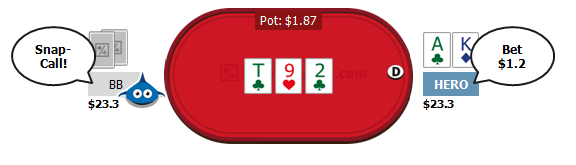
Only very rarely will your opponent have a strong made hand like two pair or better, or a strong draw. With these hands, he would take longer to think about his different options: should he raise on the flop? Should he just call and let you keep bluffing on the turn? With a weak made hand like top pair or second pair however, his decision is easy; fold or raise are out of the question, so he can only call.
The snap-raise
If your opponent raises quickly, this usually implies a strong hand.
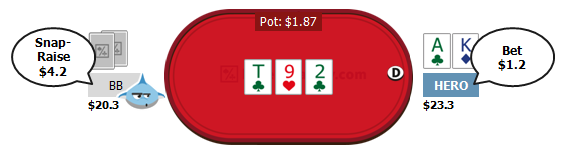
His quick raise implies an easy decision with a hand like 99 or queen jack of clubs (QcJc). With these hands your opponent doesn’t have to think long or weigh up different options. With a bluff like ace jack offsuit (AJo) he would have to think longer and estimate if you fold often enough.
Additionally his raise size is very big, which also points to a strong hand. You should therefore fold.
Tip 4: River bluff frequency
On smaller limits like NL25 and below, many TAGs, nits and LAGs don't often bluff on the river. This is especially true when a couple of draws miss. You should therefore often fold against river bets and raises.
At this point, players differ widely. Pay attention to how often your opponent bluffs on the river. Especially interesting is the way your opponent plays when a lot of draws from his range miss.
The value range of your opponent will consist of KJ or better (#46), therefore he must bluff #23 for you to be able to call. His bluff range consists of #24 missed flush draws as well as OESDs like KQ and 98 without a flush draw. Together that makes #49.
You would have a profitable call if your opponent bluffs with half his draws on the river. A lot of TAGs on NL20 however check on the river and don't bluff. If he bets big on all three streets, that speaks for an even stronger range. You can therefore easily fold.
To learn more about the basics of hand reading check out this article or watch the video below:

Related Resources

Mind Readers
Our regular Twitch coach LemOn36 makes hand reading fun in this four part series
_227efd42.jpg)
Get our free software
Our Equilab tool will teach you everything you need to know about range analysis
