


When should you do swaps in a tournament?
In the absence of doing a 50-way chop the best way to reduce variance in an MTT is to do late swaps with players you trust.
I often get asked about when is the right time to propose a deal in the final stages of a poker tournament. I think a lot of players, amateurs and professionals alike, see asking for one to be a sign of weakness. Nothing could be further from the truth.
Anytime is the right time to discuss a deal, especially when you are deep in one of the biggest tournaments you’ve ever played. Once the money becomes significant to you to the point where you’d prefer to remove the variance, or indeed if there is an amount of money that could change your life (by giving you a bigger bankroll, paying for something major or even getting you out of makeup) then propose a deal.
A lot of people think that wanting to deal is weak and that they should play for the win. Let’s say they have $1,000 locked up at the final table of a $55 MTT and the winner gets $15,000, they act like they are freerolling off a $55 buy-in with a chance of six-figures. The reality is that you are now playing a different tournament. Your equity in the tournament might now be $2,500 and with $1,000 locked up, you now have $1,500 riding on a single event.
A 50 way chop?
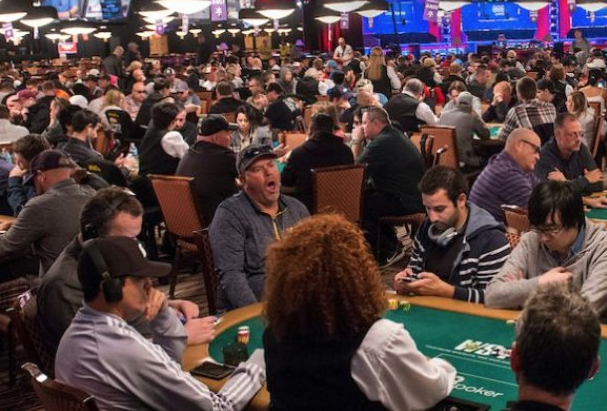
If you have ever played live in the UK or Ireland you will often see people trying to arrange ‘saver’ deals where the bubble boy gets their buy-in back, and even sometimes wanting to chop the tournament with more than the final table left in the field. Again, some people view this as weak but I would certainly do a 50 way chop in a tournament like the WSOP Main Event. Your equity in that event might be $800,000 with 50 players left. If you had a $100,000 bankroll, you would then have $900,000 of equity and only $100,000 realised. Again, you would not play in a 50-runner MTT with an $800,000 buy-in, so you want to do everything you can to reduce your exposure, even if that means losing $50k of equity in a deal to guarantee $750,000.
In reality we are never going to see a 50-way chop in the Main Event but there are other things you can do to reduce your variance, in particular swaps. I do friendly swaps at the start of the tournament with friends who would expect me to rail them if they made the final table. I’d need a few percent of David Lappin if I was going to be forced to watch him showboat at a final table. When I get deep in an event I will look around at the other players remaining to see if there is anyone I can do a percentage swap with.
I look for players of similar ability and probably most importantly players I can trust. If the stack sizes between the two of us are different you can do 10% for 12% swaps or similar, by working out what you have both locked up, then doing a ‘Chip Chop’ split based on our stacks.
Who to swap with?

When swapping late in a tournament, the biggest thing I look for in somebody in terms of their ability is whether they understand ICM. I would take a 45-man SNG regular over Phil Ivey when we get to the 30BB effective stacks end game part of a tournament. By that stage it is all about not making big mistakes rather than being able to make fancy plays (which are usually just punts that get there).
How big a percentage of yourself you want to swap is entirely dependant on how much of your net worth you want in play. If you don't want more than $500 of yourself in any tournament then you should swap 50% of yourself in a $1,000 MTT and 75% of yourself in a $2,000 MTT. You'll know how exposed you want to be at any one time.
I should probably end by repeating the most important factor is that the player you swap with is trustworthy. Unfortunately you only find this out once you have done swaps with them a few times. Probably best to find some likeminded friends to swap with in smaller events before you do the same in big ones, and certainly do not swap with complete strangers or people you just met.
Dara O'Kearney's book Endgame Poker Strategy covers deals and swaps in more detail.
