


Self Study: What's the logic behind a massive overbet?
Barry Carter doesn't understand why a GTO range advocates 3-betting to 42 BBs, so he asked poker pro Dara O'Kearney to explain why.
We return to our series where Barry Carter tries to plug a leak of his with the help of a professional poker player.
In a recent study session I saw some preflop ranges from a solver where a Big Blind with 42 big blinds is facing a 29% open raise from a Lojack opener who has 52 big blinds. This is at a final table where these two players are the two chip leaders by quite a big margin.
This is the range, the green hands are calls, the yellow hand is a reraise to 9 big blinds and the red hands are open shoves for 42 big blinds:
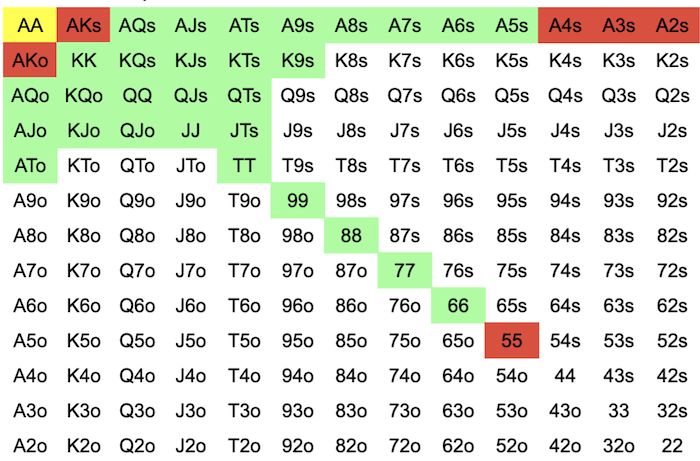
I understand why we call so much here, we can close the action as the big blind and because we are covered in an ICM influenced scenario we have to be very careful. I also understand the split of hands we shove with, the small suited Aces are bluffs because they have they have Ace blockers but can make a straight or flush if called, the 55 is flipping against some of the calling range and can make a wheel when the Ax hands flop a pair.
I don't understand, however, why we open shove 42 big blinds with AK? I have seen good players do this and have never understood quite why we commit so many chips when the pot is so small, against the one player who can bust us. So I asked Unibet Pro Dara O'Kearney why the good regulars open shove 40+ big blinds here?
What do we want to do with AK?
Barry Carter: What is the function of the shove here?
Dara O'Kearney: When we do shove he will fold about 91% of the time and the calling range is AK and QQ+. Against this range we are flipping three quarters of the time and crushed one quarter of the time, but we heavily block the hands that crush us.
Barry Carter: In a way, shoving is actually low variance given they fold 91% of the time?
Dara O'Kearney: When you are covered, 3-betting to a smaller amount ratchets up the ICM pressure on yourself because you make it likely you will be facing an all-in bet by the river. That's why we call so much here with the rest of the range, to keep the pot small. You will leak chips post flop if you have to over fold a lot in a 3-bet pot. Much better to put the ICM pressure on the chip leader instead by shoving.
Barry Carter: It suits me because against the chip leader I just want to get the hand over with anyway and avoid these tough spots.
Dara O'Kearney: It's a function of the stack sizes and ICM pressure. If the stacks were closer the Lojack would open less and we would 3-bet more. The chip leader can hurt you so you have to play this way.
Barry Carter: This hand just really surprises me how many chips are commited preflop with a 'premium hand' that in theory should be well ahead.
Dara O'Kearney: A lot of what the solvers show us how to play final tables looks like how a donkey would have played a few years ago. Here I like to just rule out the other options, what do we want to do with AK?
Folding is off the table. If we call we miss the flop 2/3rds of the time out of position and he will be able to force me to fold what will often be the best hand. 3-betting a smaller amount is bad too because if we get shoved on, we are going to have to fold. AK is not a call here. So by process of elimination shoving is best.
Do you like the shove? Let us know in the comments:
