


Asymmetric upside and game selection
Playing in games where your potential upside is greater than your downside risk is a good way to benefit from positive variance.
Earlier this month Nick Jones of pokerfuse revealed that GGPoker is about to account for 50% of global cash game traffic and had more daily players than the next five poker rooms combined. A huge story, something we never thought possible and a massive wake up call to PokerStars.
One from me on @pokerindpro today - @GGPoker's cash game traffic is now higher than the next five online poker rooms combined, and will very soon represent 50% of the entire dot-com online poker market.
Read if you have access, some highlights below 👇https://t.co/xNFrbIa2QS
— Nick Jones (@pokerprojones) August 10, 2022
There are many reasons why this is the case, the biggest one being that GG have taken a really innovative approach to poker and the rest of the industry is playing catch up. But one reason I would put forward as it pertains to the cash games specifically is that they have a couple of features where the potential upside is huge.
Those features are cash drops and bad beat jackpots. Neither feature is original to GGPoker, but at every other site bad beat jackpots have exclusive tables outside the regular liquidity, but every regular cash table is part of the BBJ at GGPoker. Cash drops are available at all fast fold tables. So generally speaking this features are more widespread at GG than elsewhere.
Cash games are a steady way to make a living but you never have a chance at making a huge score in a single session, the way you do in a tournament. These two features mean that you can play your regular cash games, not risk anything additional (except perhaps more rake) and potentially have a single score that can set you up to play much bigger games.

Asymmetric upside
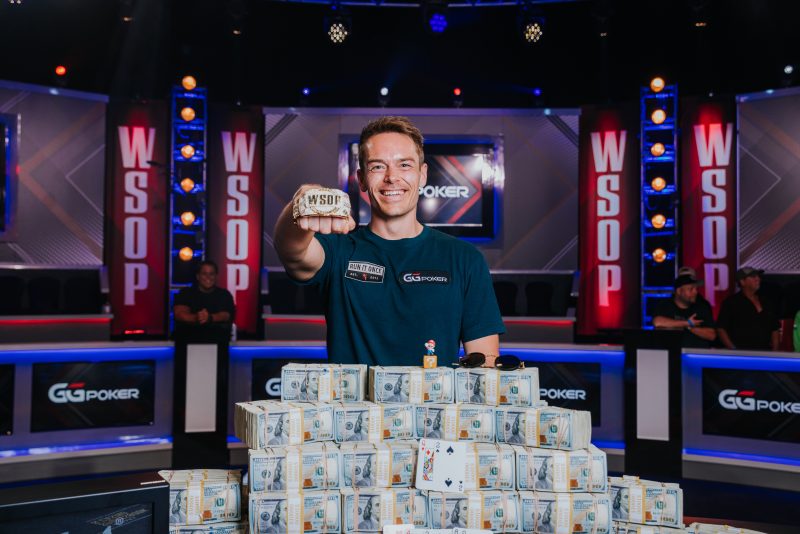
This is an example of an asymmetric upside, which is when an investment strategy has a much greater upside potential than a downside risk. It is very important to understand in investing and a massive consideration in poker game selection.
Poker tournaments are a brilliant example of an asymmetric upside, you have a floor on how much you can lose (unless you are Scott Seiver this year in the WSOP Flip & Go event) but potentially a very high ceiling for winnings. If you play a $10 MTT you only risk $10, but you might win $1,000 if you win the whole thing, or even $100,000 if it was something like the Sunday Storm Anniversary.
As a tournament player, if you use bankroll management, your biggest winning day should always be much bigger than your biggest losing day.
Allow yourself to maximise a lucky break
Spin & Go is another example of an asymmetric upside, because in any one moment you could find yourself in a maximum multiplier. A few years ago we did a variance calculation using SwongSim that highlighted this.
We simulated 10,000 Spin & Go tournaments for a player with a win rate of 36%, and using SwongSim we have did 1,000 simulations:
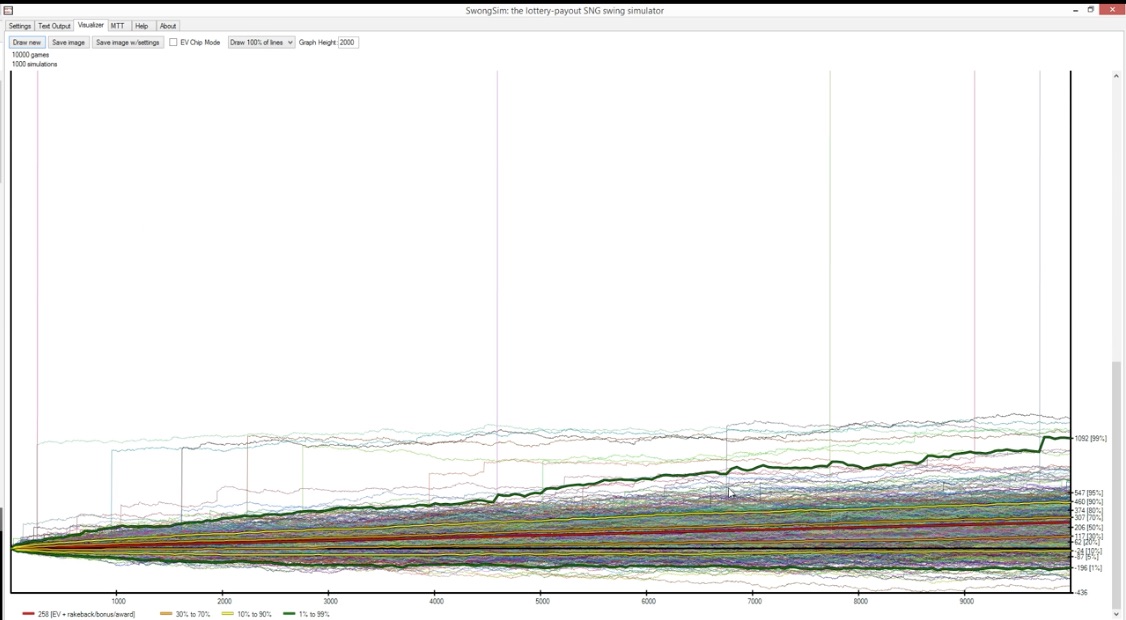
Don't worry if you don't understand what you are seeing, we'll give you the cliffs.
Most players won between -24 and +460 buy-ins using this simulation. The middle 30% of players won between 117 and 307. 1% of players lost over 200 buy-ins and those random vertical lines you can see are the players who won a massive multiplier game where they won thousands of buy-ins in a single game. So the spread between most of the players is well in its hundreds of buy-ins.
The takeaway from this simulation is that the players who are above EV are VERY above EV, but while most players are under EV, it is not by a huge amount. It's easy to be 10,000 buy-ins over EV in Spin & Go but realistically you will only ever be a few hundred buy-ins under.
Some players might think that suggesting you look for asymmetric upside games in poker is a form of gambling. Buying lottery tickets has an asymmetric upside, after all. That is not the case, the point is to find games that are profitable even if you never have the life-changing score. If you are going to be playing these games anyway, it is better to put yourself in a position where getting very lucky has the biggest upside.
Do you consider this in your game selection? Let us know in the comments:
