


Poker mistakes we used to make - set mining
The solvers have shown us that we may have overrated set mining, says Dara O'Kearney.
Last week I wrote about how GTO solvers have shown us the error of our way with formerly sound modern poker thinking and modern online poker strategy. I started by talking about worrying too much about domination, today I wanted to touch on another big one - we really overrated set mining.
Things elite poker players used to believe (pre solvers)
1. Worried far more about domination than they should have
2. Overrated set mining
3. Blockers weren’t a thing in NLH (only PLO)
4. Backdoors didn’t matter much
5. Limping always terrible (especially from small blind) pic.twitter.com/KqYh8pBtva— Dara O'Kearney (@daraokearney) September 28, 2022
Set mining is still a very good strategy, especially against sticky players. A set is very hard to spot at the table which is why it is so powerful. We have seen, however, that the solvers do not set mine anywhere near as much as we did back in the day.
Other ways to play small pairs
Let's look at some GTO ranges to give us an idea what I am talking about. This is a GTO approved 40BB range for the Big Blind against a Button open.

The old school wisdom used to go that you need to have roughly 8-1 implied odds to set mine, because your odds of hitting a set on the flop are 7.5-1. A min raise open with effective stacks of 40BBs meets this criteria, but look what all the small pairs do here. They all raise or shove.
The solvers have shown that you will make more, on average, by playing a small pair aggressively here. Against a wide range you figure to be best or a coinflip a lot of the time. It's much better to shove and win the pot a lot of the time than to flat and check/fold a lot of the time.
This is the same range for the Big Blind when it is up against an early position open, with 40BB stacks.

Now we set mine all the time with small pairs. This is because an early position open is a much stronger range, when we hit our set we are much more likely to get paid off. The Button misses most of the time so we are out of luck often when we hit our set.
So there is no doubt still a place for set mining, it is not just the default strategy we thought it was.
Hard to play when you miss
Let's look at a post flop example to explore this further. This is a single raised pot, Button vs Big Blind. The flop is K95 and the Big Blind has checked.
This is the Button's range, the brown squares are bets and the yellow squares are checks.
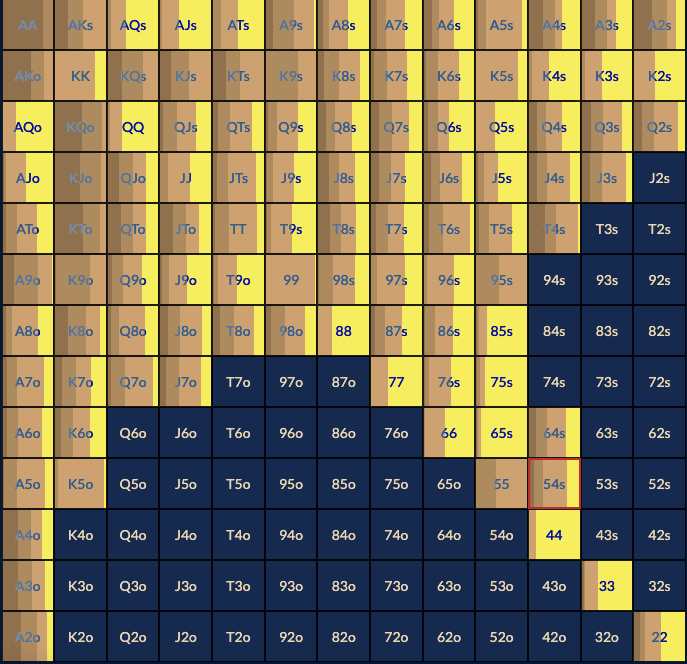
You can ignore most of it, but look at how the small pairs (88 and below) act compared to random 5x hands. Most of the underpairs on this flop check back whereas hands like 54/T5/K5/A5 all bet most of the time. 88/77/66 are all stronger hands than bottom pair, but the solver prefers betting these hands, why?
The reason is that a small pair is in 'No Man's Land' when it misses the flop, it only has two outs to improve. A hand like T5 or 54, however, can hit five cards to improve to two pair or better. They are much more robust on the flop than a small pair.
All of the hands we have discussed in this example are the bottom of your range, but the solvers have shown us that bottom pair with a kicker is much more playable than a small pair, even if it is ranked higher.
Set mining remains a very profitable strategy, especially against an opponent who is likely to pay you off. But the solvers have shown us it is not the only strategy with a small pair.
Dara O'Kearney's latest book Endgame Poker Strategy is out now.
