


GTO Poker Theories - Buridan's Ass
Can a philosophical paradox about a donkey teach us something about ICM? Barry Carter tries his best to do just that.
One of the real gifts poker has given me is that it has been a great jumping-off point to learn things from other disciplines like economics, AI, psychology, and Game Theory. So here is a series of articles where I bring some of the most interesting things I have learned from other subjects outside of poker which are applicable to this game we know and love.
Buridan's Ass is a famous paradox in philosophy, one that powerfully highlights the challenges of decision-making under conditions of equivalence. Attributed to the French philosopher Jean Buridan, it is a conceptualization that is as simple as it is profound.
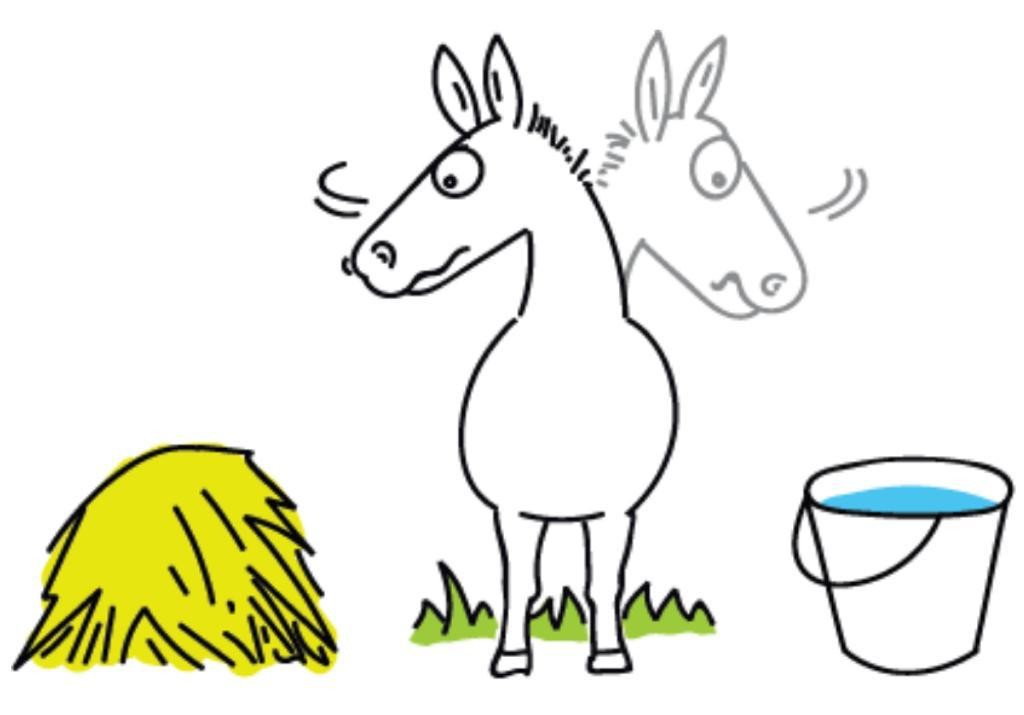
The paradox presents an extremely hungry and thirsty donkey that finds itself exactly equal distance from a pile of hay and a bucket of water. Assuming the donkey always goes to whichever is closer, it cannot make a rational decision about where to go first, since both the hay and the water are equally essential and equally near. The consequence? The donkey dies of both hunger and thirst, frozen in indecision.
While it may seem an unlikely scenario, the paradox is less about donkeys and more about illustrating a critical flaw in the assumption that rational agents always act in their best interest. If two (or more) options are equally appealing, rationality alone cannot provide a basis for decision-making.
The ICM Dial
This may be my most left-field poker analogy yet, but the paradox reminds me of something interesting we discovered regarding ICM and PKO tournaments. Dara O'Kearney coined a term - the ICM Dial - which is a visual representation of the effect of ICM and bounties.
You have ICM (ie. payouts) which tighten a range, pulling the metaphorical dial in one direction, and bounties which widen a range, that pull them in the opposite direction. For example, in the table below we have a ChipEV range for calling an UTG 10BB shove as the HJ. Everyone has 10BBs at the table. Then we have the same spot, but it is the bubble of a tournament, and finally the same spot at the start of a PKO:
| Situation | Range |
|---|---|
| ChipEV | 10% 55+ A9s+ ATo+ KQs |
| ICM | 3% JJ+ AK |
| PKO | 64.5% 22+ Kx Q2s+ Q4o+ J2s+ Q4o+ J2s+ J7o+ T2s+ T7o+ 93s+ 97o+ 84s+ 87o+ 84s+ 74s+ 76o+ 63s+ 53s+ 43s |
The exact same spot, but three very different ranges. The ICM range is way tighter than ChipEV and the PKO spot is much much looser (FYI the first hand of a PKO you should be playing very wide ranges because you cover everyone at the table).
What about when we are on the bubble of the same PKO? In the same everyone-has-10BBs scenario, this is the HJ calling range:
| Situation | Range |
|---|---|
| PKO & ICM | 9.7% 66+ A9s+ ATo+ KQs |
The competing forces of ICM and bounties have brought the calling range very close to what it was in the ChipEV scenario. I won't lie, I had to fudge the bounty sizes a few times to get it this close to ChipEV, but generally speaking, this is what the impact is. The percentage of hands stays close to ChipEV on PKO bubbles, but suited high card hands make up more of the range and small pairs less of the range.
Visually I just thought of this ICM Dial metaphor when I heard about Buridan's Ass. It seemed like a scenario where ICM and bounties were equally compelling forces, and in the face of two competing incentives, the GTO response is to do nothing. Just like a Donkey stuck between a pile of hay and a bucket of water.
What theories from outside of poker have helped your game? Let us know in the comments.
Related articles
