


Drop down in stakes or play less tables to reduce variance?
Once again we are testing some assumptions about downswings, this week should you play lower stakes or fewer tables when running bad?
Last week I wrote a piece about reducing variance, where I argued that improving as a player, rather than increasing volume, is the better way to avoid downswings. I did this using the excellent free variance calculator at Prime Dope.
It's such a useful tool I wanted to do some more experiments where I challenge the conventional wisdom about variance in poker using it. This week I wanted to compare two pieces of advice we hear about downswings. That you should either drop down in stakes when you are running badly or you should play fewer tables.
Both make sense intuitively. Dropping down in stakes reduces further loss and you enjoy a better winrate usually, so in that respect, it is similar to last week's advice on improving as a player. Likewise reducing tables means you have more time to concentrate on each one, also increasing winrate.
Let's say we are a $100NL grinder who plays four tables at once with a winrate of 3BB/100 on each table. We play 200 hands an hour (50 on each table), for three hours a night, five days a week.
In a year this is what 20 random samples in a variance calculator looks like:
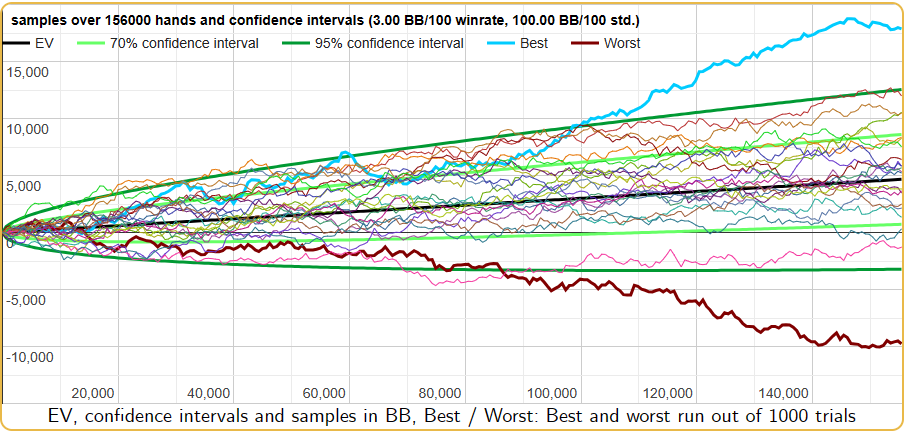
In the best scenario we can win $17,861 in a year, in the worst scenario we could lose $9,756. On average we would make $4,661, but we have a 12% probability of having a losing year. We would need a $5,000 bankroll to avoid going broke.
Playing fewer tables
What if, instead, we played three tables instead of four? That would reduce our volume to 150 hands per hour. However, it is a fair assumption that we would play better with the increased focus on each table. Instead of winning 3BB/100 per table, let's assume that our winrate becomes 4.5BB/100 per table.
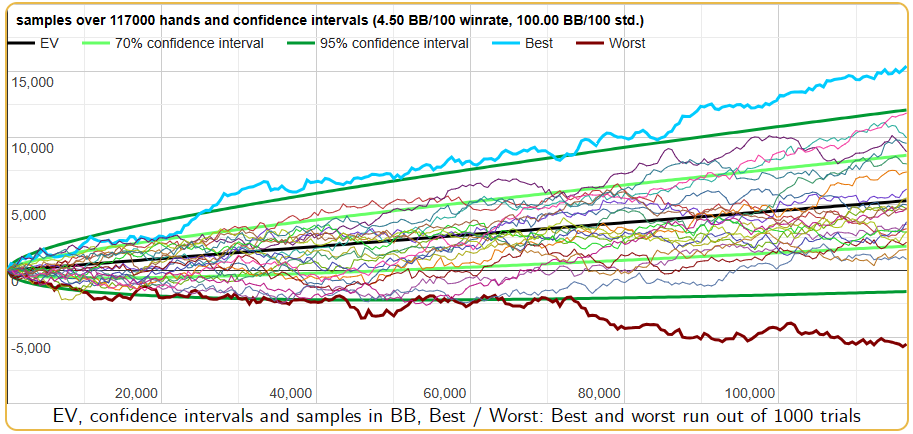
In the best-case scenario, we make $15,366 in a year, which is more than $2k less than the first example. In the worst-case scenario, we lose $5,535, which is much less severe than in the first example. On average we make $4,491, which is barely different to the first example, but our probability of loss has halved to 6% for the year. We need a bankroll of $3,400 to avoid going broke.
In this experiment, it seems a much better option to reduce our tables than to carry on as we were doing, on average we make almost as much because of the increased focus and our chances of going broke have reduced significantly.
Playing lower stakes
What about if we dropped down in stakes instead? We played four tables still, so 200 hands per hour, but we play at $50NL where we have a much bigger edge. Let's assume we make 8BB/100 at this stake.

In the best-case scenario, we make over 23,000 BBs in a year, which would be $11,891. Our worst-case scenario sees us lose just $184. On average we make $6,215, which is actually higher than at $100NL, and our probability of loss is 0.08%. We only need a bankroll of $936 to avoid going broke.
I was pretty shocked at this, but it seems that dropping down in stakes and keeping the same number of tables looked like the best option. We never go broke and the increased winrate is competitive against the lower winrate at double the stakes. This would suggest that the sage advice is to find a game you crush and put as much volume as possible in, rather than to keep moving up the stakes just because you have the bankroll.
Of course, the big 'but' is that we have made some speculative assumptions about how our winrate changes when we drop down in stakes and/or play fewer tables. It might be the case that dropping from NL5 to NL2 is not a big change in terms of expectation, but dropping down from NL200 to NL100 is monumental. What I would advise is you play around with PrimeDope yourself to make your own conclusions.
Do you lower stakes or reduce tables during a downswing? Let us know in the comments:
