


Why we slow down on monotone boards
Dara O'Kearney explains why we bet less often and bet smaller when all three cards are the same suit.
Monotone flops give my students the biggest headaches, and rightfully so, they are perhaps the trickiest boards to play in poker.
For example, this is how the BTN should act, when checked to, on a 9♥7♥5♥ flop:
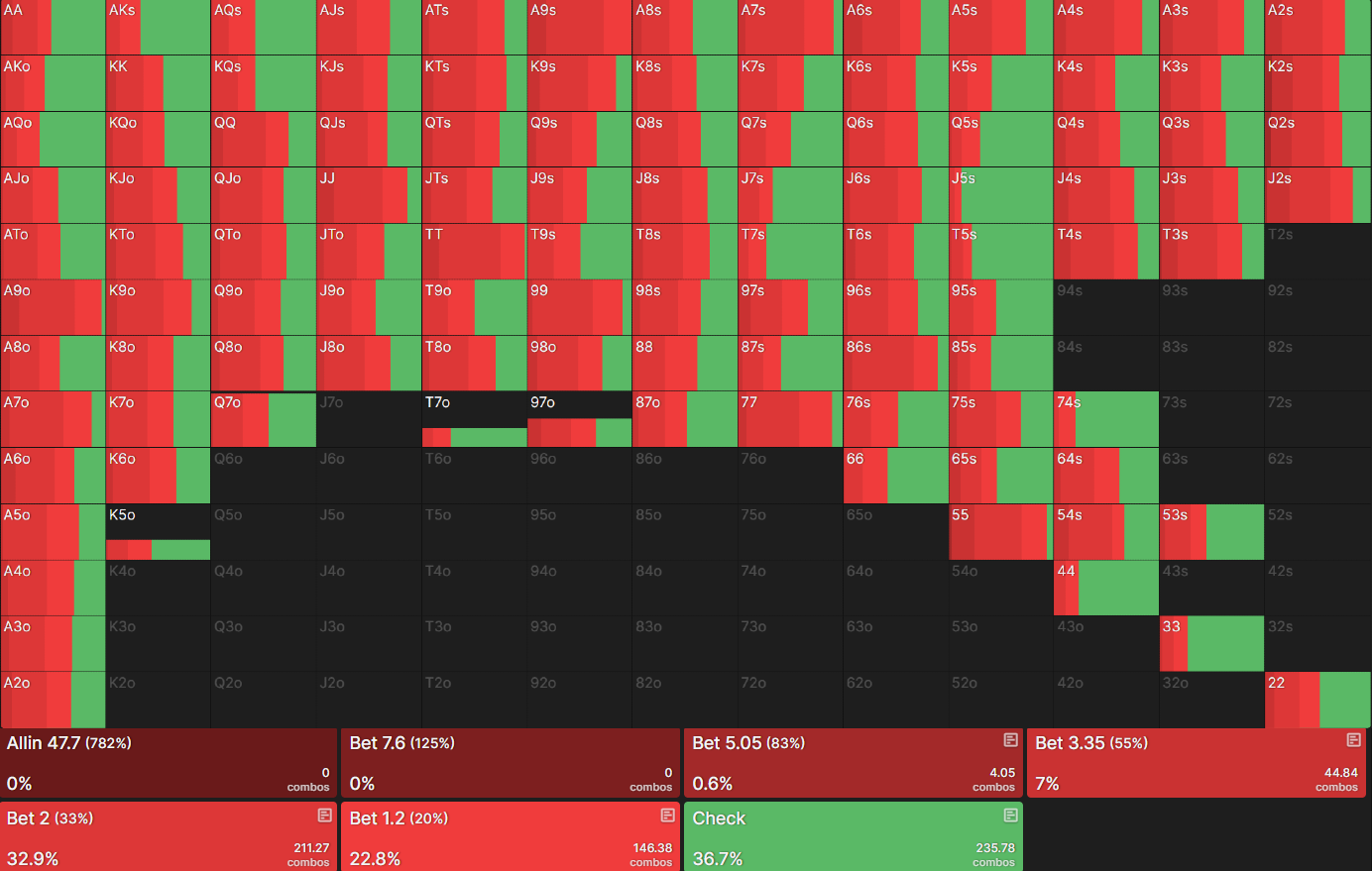
This strategy is typical of what we see on monotone flops. Some broad characteristics I have identified are:
- There is no leading from the BB
- Bet sizes go down
- There is much more checking
- Most hands mix
To simplify, monotone flops see us play poker "with the handbrake on" where we take less aggressive actions, build the pot less, and largely try to get to showdown more.
Playing with the handbrake on

Why do we play more timid when all the cards are the same suit? The main reason is that we could already be betting into a flopped flush. Our top pair might be no good and our flush draws could already be dominated by a made flush. When we bet big we are not getting flush draws to fold, we are just bloating the pot when we could already be crushed.
In addition, there are so many board-changing turns and rivers. In the example above any heart will completely change how the rest of the hand plays. Pairing the board or bringing in a connected card that can complete a straight will also have a similar impact.
The natural impulse on monotone boards is to play careful anyway, and in this instance, it's good to follow your instincts. Monotone boards are under bluffed spots anyway in real life. Keep the pot small, try to get to showdown with the weaker portion of your range and keep the handbrake on.
You can get Dara's free book on effective poker study by joining his mailing list.
