


The best exercise for your poker skills
Do you want to play every hand better than the previous? All you need is one really effective exercise...
Let's start with an example. At a 6-max table, the MP raises to 3 bb, and you call with KsJs on the BU. All other players fold. The effective stack size is 100 bb. On a flop of 9d7s3c, your opponent bets 70% of the pot. You call. After the Qd on the Turn, he bets 70% of the pot again, and you fold.
Was your play good or bad? To answer this question, let's look through all the streets and see if we can do something with our hand.
For your convenience reading further, I recommend you open the PokerStrategy.com Equilab and enter the mentioned combos into it. This will help you to comprehend the ranges.
Pre-flop
Below is a playable range for cold calling pre-flop:
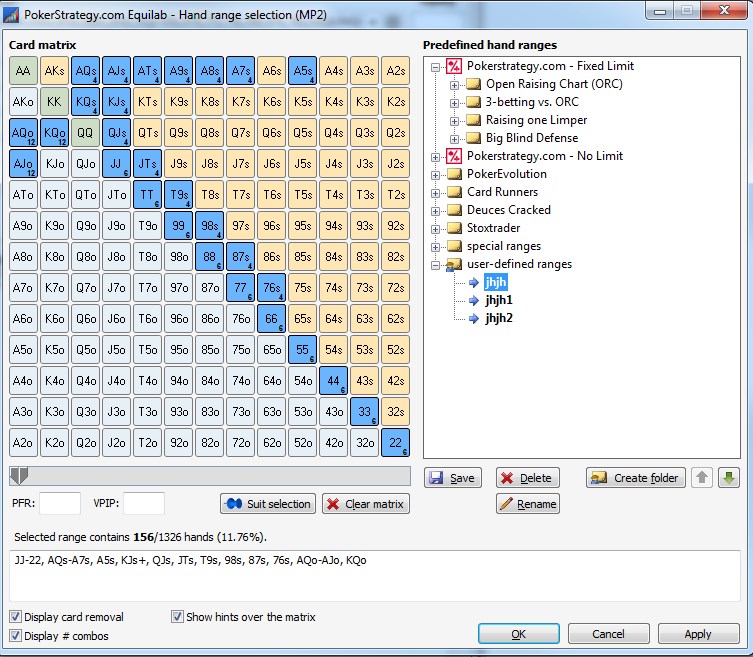
It's approximately 12% of all hands, or 156 combos. It can be widened, narrowed or expanded depending on the situation, but this is a good starting point. Theoretically, KsJs can be moved into a 3-betting range, but for this I'd prefer hands like KJo instead.
Flop
The flop is rather dry, and there's a high probability of an overcard coming out next. In this spot, considering our odds, we can reasonably defend in 70% of cases or even more. By defence I mean a mixture of both calling and raising, although when a board is that dry there's no need to have a raising range. So let's suggest that our range is a calling range entirely. Due to the card blocking effect, we now have 141 combos of 156, while 70% of that gives us 99 combos. OK, let's start building our range.
Obviously – sets, overpairs, top pairs, second pairs: 99, 77, 33, JJ, TT, A9s, T9s, 98s, A7s, 87s, 76s (39 combos). If we'd always defend with those hands only, we'd fold in 72% of cases! This is too much.
Then I would add 88, gutshots and stronger aces: 88, AQo, AJo, AQs, AJs, ATs, JTs. This is 46 more, 85 in total.
Still not enough. For the rest, we could include 66, weaker aces and overcards with backdoor flush draws: 66, Ad8d, As8s, Ac8c, KdQd, KsQs, KcQc, KdJd, KsJs, KcJc. Now we have 100 combos, so we can discard one combo of pocket sixes.
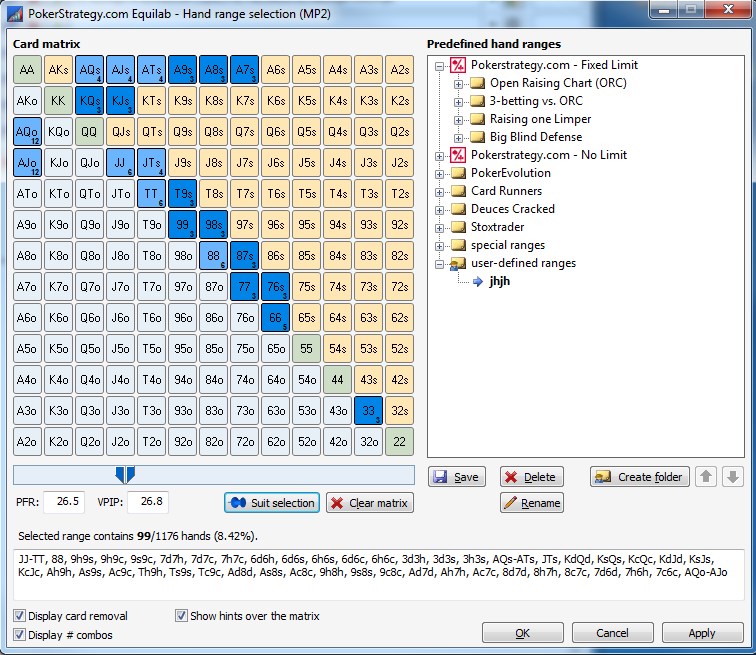
Do you fold most of these hands? Well, you fold too much then!
Turn
At first, it seems that this card suits the pre-flop aggressor better. However, as you can see, our range contains many Queens. But since there are more Queens in the aggressor's range, I'd suggest 65% for a defending frequency.
With the card blocking effect, we have 94 combos left. 65% means 61 combos.
Start with top pairs and better, plus flush draws: 99, 77, 33, AQ, KQ, AdJd, KdJd, AdTd, JdTd, Ad8d, Ad7d, 8d7d, 7d6d. Many players defend with these hands only. That means they fold 66% of combos! Against them, you can bet the Turn with random cards and literally print money!
The range is widened with JJ, TT, 9Ñ… and OESD (non-diamond): JJ, TT, JTs (non-diamond), Ah9h, As9s, Ac9c, Th9h, Ts9s, Tc9c, 9h8h, 9s8s, 9c8c. This is 24 more combos, 56 in total. This is how much a regular can defend. They will fold approximately 41% of their hands. Thus against many regulars you can second-barrel 70% of the pot with your whole range and be break-even.
The other 5 combos can be filled with gutshots (2x KJs) or 7Ñ…. I prefer gutshots as they have more potential to connect for a strong hand. The final range looks like this:
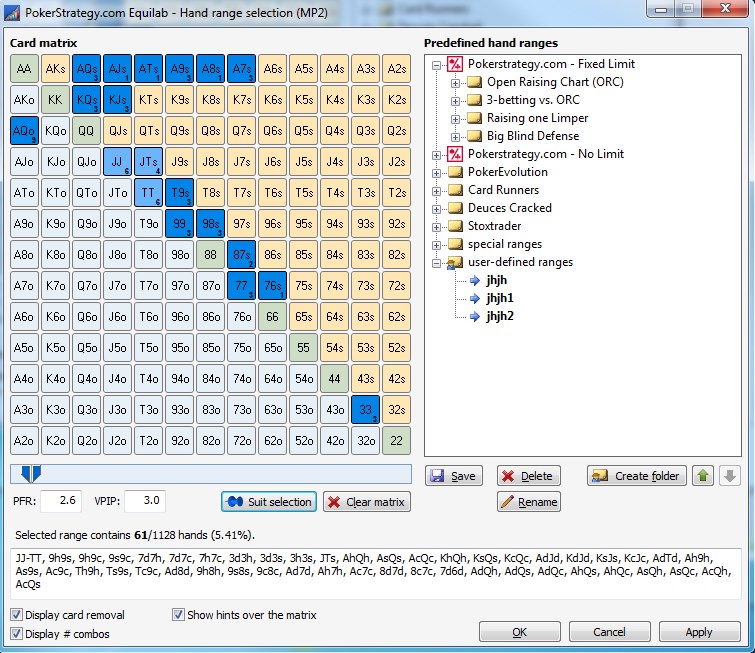
So, was our fold on the turn with KsJs a good one? We made a mistake. It's not big, but it's still a mistake. If we'd prefer to defend with additional combos of 7x instead of KJs, that wouldn't substantially change our EV. But as soon as we start folding both KJs and 7Ñ…, strong regulars will start hunting us down.
I recommend you try doing this exercise 3-5 times per day. Your hands of choice don't have to be about huge pots you've lost. You can start with 3-5 random hands and then, after you're sure about your betting/calling ranges, you can start to include spots where you had doubts. Believe me, it will help you progress much faster.
