Genius, madness or just routine at NL5K?
We continue our analysis and reveal the whole truth about that one call with A4s at the high stakes.
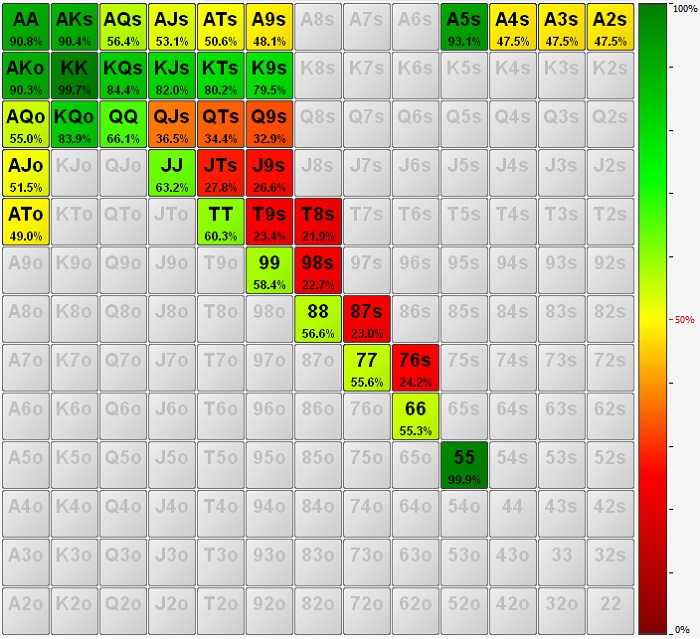
In the first part we discussed the general approach of the players and focused on their preflop ranges. Now the battle is on postflop and Also11 is first to make a decision regarding his range.
He can choose between two options:
Option A is the mainstream solution. A c-bet frequency of 80% to 85%, roughly betting 1/3 of the pot. That doesn't confront 1nvoker with huge problems, still it also makes life easier for Also11. He doesn't have to divide his range and is able to keep together any hands that are worth something on this board. It's a good, popular and boring approach.
Option B is similarly solid but distinctly more complicated. He conti-bets with a frequency of 50%, slightly betting above 50% of the pot.
This makes it really difficult for 1nvoker to find the correct call spot for his range on the flop. However, the disadvantage for Also11 is that he has to come up with a subtle checking strategy by deciding how to divide his range into check hands and c-bet hands. Because even if both players now check the flop, Also11 still would have to win some hands. Objectively, this approach isn't really the better option but it makes the hand tougher to play for both sides since there's definitely more room for mistakes.
Different bet sizes are out of the question. If he bets too small, Also11 completely gives up on his continuation bet and the hand turns into a 100% check scenario with a slightly bigger pot. If he bets too big, 1nvoker is able to get rid of tough mediocre hands right away on the flop and Also11 would still be confronted with difficult spots in the check scenario.
5 questions regarding the c-bet range construction

What exactly does a c-bet range of 50% look like? In order to find out, the following five questions need to be answered:
- What equity and what playability do my hands have?
- How many combos are included in my range? The answer is #191, therefore we need roughly #95 for our conti-bet.
- Which hands do we want to bet for certain?
Hands that are played for value:
- 55 to 33 are easy value bets
- A5 as well
- AA doesn't block any kings in the opponent's range and is therefore also a hand that you never want to check in this spot
- AK has three value bets, even when the blocker effect is a bit annoying and Kx hands become less likely for the opponent
- KQ often has three value bets and can also become handy as a value hand in subsequent check scenarios on turn and river
Hands that are played as a bluff:
- A2s to A4s have some equity but not a great playability when checking since we are drawing on weak bottom pairs
- 66, 77, 88 just have awful playability when checking
- 67s, 78s have a low equity so that folds of the opponent become more valuable, connection with some turns possible as well
Which hands do we definitely want to check?
- KK blocks most of the opponent's Kx hands and would not get a lot of payoff
- KJ to K9 never have three value bets, don't need any protection and are more useful in the check range than in the bet range
- QQ to 99 only have one wish: Get to the showdown as cheap as possible to bag the big equity share
- T8s, T9s, J9s, Q9s are simple: They're just too weak. With a bit of luck they could win a consolation prize in double check scenarios on the flop.
For which hands are both options viable? Any hand that's still left.
Now, we have to put our range together and check if our strategy also makes sense in the big picture:
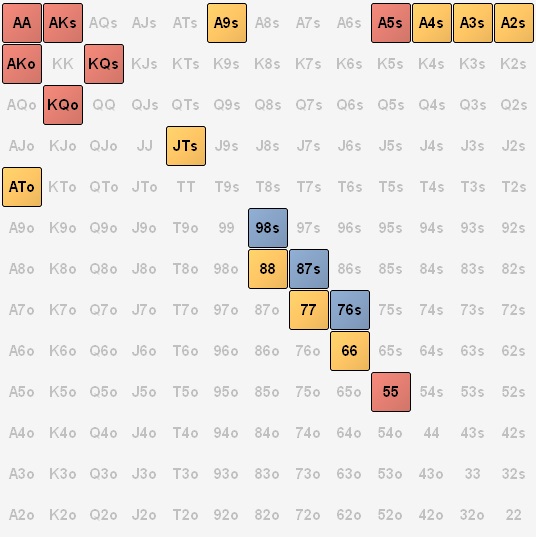
- Red is our value range (#33), blue (#12) and yellow (#50)
- The rest of the hands are either included in the c-bet range to get to 50% (AJ, JTs, A9s) or don't have good playability without initiative on the turn (A2s -A4s, 66-88)
Now it's 1nvoker's turn

The ball is in 1nvoker's court. The good thing for him is that he only has to come up with a call and fold range since he simply lacks the very strong hands in order to raise. This is how this spot looks from his perspective:
He's getting odds of 26%. Unfortunately, you can't just call for equity in such a spot. Instead, you have to assess your equity realisation, meaning which share of the pot on the flop are you really getting when taking into account the turn and river?
Attention: Do not simply call for equity!
The reason:
Imagine the pot is at $100 and your opponent bets the pot size on the flop, turn and river with 66% equity. You're getting odds of 33% on each street while also having exactly 33% equity. Nonetheless, you would be losing a lot of money if you called. You would have to pay $100 (flop) + $300 (turn) + $900 = $1,300 for a pot of $2,700 but would on average only get $871 (33% of the pot) on the river. If poker was that simple, nobody would actually play it.
How many hands are you actually winning at what cost?

The task is to decide how many scenarios are still going to occur later on in the hand and how much our equity is actually worth. We know that Also11 has a lot of bluffs in his range that will partly have to give up their equity on the turn. Additionally, we are in position with a backdoor flush draw, enabling us to continue if a spade hits.
We also hold an ace, turning us into a huge favourite if we're able to hit. Therefore, 1nvoker decides to defend his range in this spot with an equity realisation factor of 1 and GTO tools like PokerSnowie agree with his decision.
Snowie even assumes that you should call with 22 to 44 in this spot on the flop. Surely, we're in better shape in position than out of position, still I would be really reluctant to call with these hands here. Therefore, I've removed those out of the call strategy and replaced them with Q9s instead.
If he folded too often, 1nvoker would make life very easy for his opponent. Also11 could simply bet 100% of his hands on the flop, rejoicing at 1nvoker giving up so much equity share without a fight.
It's definitely a very interesting flop spot and if you didn't fully comprehend parts of the analysis, I recommend to reread those paragraphs again. At first sight, it simply looks like 1nvoker was calling for equity on the flop. However, that's rather a coincidence here and the logic "enough equity = call" would surely hurt him in the long run.
With that, we've reached the turn and will discuss that part of the hand in the next article. We'll analyse why 1nvoker has to bluff and can't simply check behind after Also11's check. Because if he did that, he indeed would have only called for equity on the flop and that wouldn't play out well for him.
Do you agree with KTU's range analysis here? What do you think about the play of the high stakes regulars? Let us know in the comments!