Calling ranges against a blind all-in l Strategy with Barry
How wide should your range be when you take a stand against a player who is punting all in every single hand?
One of the reasons why people are against events with lots of re-entries is that they believe that professional players can gamble recklessly to build a big stack. This is certainly the case for "Texas Mike" Moncek, who has gone viral a few times this year for hands where he went all-in blind while chasing leaderboard points.
Texas Mike Went All-in Blind the First Hand
While still playing in the $50,000 Poker Players Championship, @TexasMike2014 bought into the $2,500 No-Limit Hold’em event, then immediately shoved all-in blind on the very first hand. pic.twitter.com/36W0GhAhRv
— WSOP - World Series of Poker (@WSOP) June 23, 2026
A lot of people don't like this because they don't like such overwhelming variance in the game. Others lick their lips in anticipation of an easy spot. But what exactly should our calling range be when an opponent goes all-in blind?
You have to beat half their range
As it would happen, this occurred recently at a table Dara O'Kearney was playing at. A player in another event arrived at a late reg table where everyone had 33 bbs and announce he was going all-in blind first hand.
It folded to Dara on the Button, and he later asked me what my calling range would be.
Fortunately for me, I have looked at spots like this before with Dara, so I had a reasonable idea of what the answer was. I know that if somebody goes all in with 100% of hands, then a good calling range would be roughly 50% of hands. However, we are on the Button and we have two players left to act to worry about. There is also a very small ICM influence in hand.
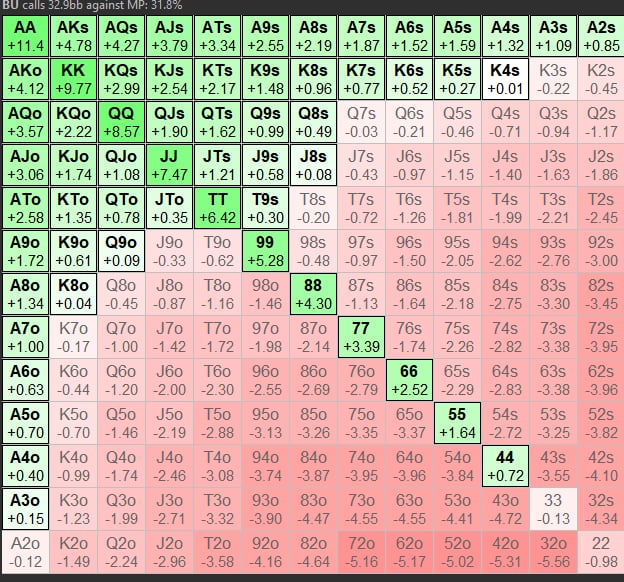
So my guess was the top 35% of hands calling all the aces, all the kings, all the pairs, and all the suited broadway.
I ran the hand afterwards in Hold'em Resources Calculator, and I was pretty close. It was actually 32% of hands, and the shape of the range was like this.
If it folded around to the Big Blind, then this is what the calling range would be:
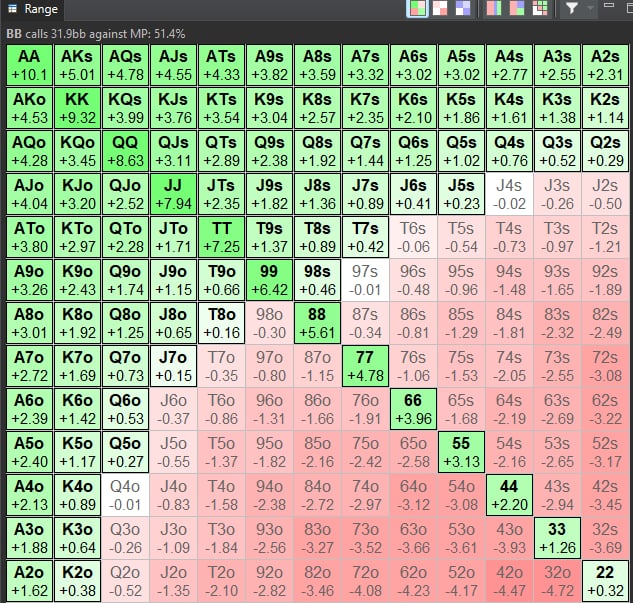
The Big Blind does not have to worry about anyone else left to act, and they've already invested money in the pot, so it's actually profitable to call with more than half of your hands here.
Not many players get this right. They get caught up in the all-or-nothing nature of the spot rather than what is actually profitable.
Obviously, there are other factors too. If you believe you have an edge at the table, you should probably tighten these calling ranges. Likewise, if you think your opponent is going to do it again and again, then there is a case to be made that you can wait for a better spot too, as their range will be predictable.