


Do you risk your tourney life with AQ in this situation?
In a Sit & Go, it is always a tough decision to put your tourney life at risk. Take a look at the following situation, where you face the decision for all your chips with AQ.
Quite often you'll find yourself in a situation, where you are confronted by an all-in and are quite sure to beat the range of your opponent. Even so it is not always clear if the call would show a profit from an ICM-perspective. Probably you just take a look at the pay out structure and on the pay jumps and then decide, if it is worth risking your tourney life there. But what about the precise assumption of an opponents range and how could you measure it?
Here is an example for such a situation: You are playing in a 6-max SNG with a standard pay out structure (65%, 35%) and put your opponent on a range of top 33.6%: 22+, Ax+, K4s+, K9o+, Q8s+, QTo+, J8s+, JTo, T7s+, 97s+, 87s, 76s.
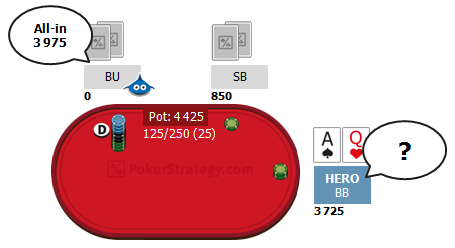
Do you call or fold? Let us know what you think in the comments!
In what kind of Sit & Go would you call the all-in? Which factors are important? How does the chip equity needs to be to make it profitable? And how do you calculate the overall equity you need for a call?
All answers to these questions you can find in the following thread - we would be happy if you share your thoughts with us:
To learn more about the chip value in SNGs, please take a look at the following lessons:
| SNG: Chip Value | Video | Forum |
 The principle of diminishing chip value The principle of diminishing chip value |
 |
 |
| The fundamentals of the Independent Chip Models (ICM) |
|
|
| Application of the ICM |
|
|
| The risk premium concept |
|
|
To improve your preflop skills - like callings all-ins - take a look at these lessons:
| SNG: Playing Preflop | Video | Forum |
 Open raising Open raising |
|
|
| Entering an opened pot |
|
|
| Calling an isolating all-ins |
|
|
| Unconventional plays |
|
|
