


Playing Preflop (1): Open Raising
The first street, or first round of betting, in every poker hand is preflop. This is the round of betting that takes place before any community cards are dealt.
In SNGs, preflop situations you will face vary a lot, due to changing stack sizes and tournament phases. There are certain stack sizes and plays that go together well, and some that do not. There are some bet sizes which are great in one spot but suboptimal in another.
In this lesson, you will learn what actions you should be considering preflop when all players before you have folded and what factors are the most relevant when it comes to making these decisions. You will also learn theoretical foundations for constructing your preflop ranges in unopened pots.
Entering an unopened pot
When you are first to enter the pot and decide that you have a hand worth playing, you may choose between limping - which means calling the big blind - or raising. In general, limping is not advised. It is almost always better to raise in order to gain initiative and a chance to win the pot outright if everyone folds.
There are few possible exceptions to this rule. The most frequent one, typically met at microlimits, occurs in a loose passive environment where you can limp high implied odds hands like small pocket pairs and suited connectors.
Therefore, every time you enter an unopened pot, you want to be raising. Your raise size should depend on three factors: the effective stack, your position at the table, and your opening range in a given spot (which is a function of position and reads on players behind you).
Have a closer look now at how, when and why you should differentiate your open raise sizings.
Effective stack size
The single most important factor when considering possible preflop actions is the effective stack. Your stack limits your possibilities. It is not only your stack that matters, but the effective stack.
For example, assume you have 100bb, but everyone else still in the hand has less than 20bb. It makes little difference if you have 20bb or 100bb in that case, so it's unreasonable to treat your stack – in terms of possible actions – as a 100bb one.
Take a look at how to define you effective stack size. If all players left in the hand have you covered, your effective stack is simply equal to your stack. If some players have smaller stacks, your effective stack is the smaller of the two: your own stack size and the average stack of players left to act. When the stacks of three or more players yet to act differ substantially, it is advisable to disregard the smallest and largest stacks when taking the average to avoid skewed results.
Take a look at some examples of calculating effective stack size according to the method:
| Stack in BBs |
Opponent 1 | Opponent 2 | Opponent 3 | Opponent 4 | Opponent's average stack | Hero's effective stack |
|
Hero: 10bb |
20 | 30 | 25 | 15 | (20+30+25+15)/4 = 22.5 | 10 |
| 6 | 6 | 12 | 12 | (6+6+12+12)/4 = 9 |
9 | |
| 2 | 6 | 10 | 20 | (6+10)/2 = 8 |
8 |
Open raising small
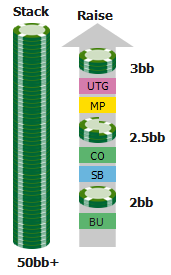 In general, a wide open raising range sizes smaller than a tight open raising range. This dependence is based on the fact that in general, your opponents don't adjust to open raise sizing properly. It can be said that against small bets they fold more than they should and against large bets - less than they should.
That is why with a tight and strong range you want to get value and protect, whereas with a wide range you want to steal cheaply. Remember that it's your range that matters here, not your current hand, so as default you shouldn't differentiate your open raise sizing based on your current holding.
In the early stages of SNGs (assuming no ante and stacks over 50bb), when your range is relatively strong, it is recommended to use 3bb raises from early and middle positions. From the cut off and the small blind, it is advisable to raise to 2.5bb and minraise (2bb) from the button. In general, button and small blind sizing should stay the same regardless of stacks.
As your effective stack goes below 50bb, you should start to lower your sizings from early, middle and cut off. It is best to lower them gradually as stacks drop from 50bb to 25bb. Under 25bb effective, your default small open raise sizing should be minraise from every position other than the small blind.
Presence of antes has not much to do with the appropriate raise sizing. However, preante you have less of an incentive to steal, so your ranges are tighter, and to get value and protect that range, your sizing should be larger than with antes in play.
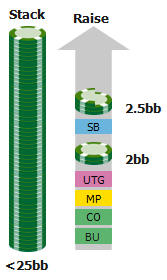 In most cases, introduction of antes coincides with effective stacks dropping under 50bb and lower, so this is already accounted for in the guidance set out in this lesson.
Sometimes, after opening with a hand that is part of your raise/folding range (this notation is used to denote raising with a plan to fold to further betting action) a short stack pushes over your open.
In this case, it is important to check whether you should still fold. You might be committed against the short stack: the odds offered to you by the pot warrant a profitable call. In the next lesson, you will find more information regarding this concept.
This possibility might require you to make small alterations to your open raising ranges, such as including more high cards and less low suited connectors.
Open pushing (push-or-fold)
Small open raises, which you should apply from the very start of the tournament, are optimal as long as the effective stacks are not short (over 20bb).
If your opponents call your minraises very infrequently and employ a strategy of going all-in or folding, you should minraise as long as the effective stacks are not too short to be able to minraise/fold. If, after a minraise, you are already committed to the pot, you should not minraise/fold with any hand. When this point is reached depends on the exact circumstances, but typically the threshold is around 8-9bb.
When these circumstances are not in place, that is to mean your stack becomes too short and/or your opponents flat call too many of your minraises, there is another approach you can resort to.
This approach is called push-or-fold, which means going all-in whenever you decide to enter the pot. That way, you avoid being flat called by hands that you might not be comfortable playing against postflop, and you maximize your folding equity. The only downside is push-or-fold can only be used with a short stack, to not let the risk-to-reward ratio become too high.
When your opponents call minraises a lot, push-or-fold strategy can be safely applied up to 14bb effective stack, and in high risk premium circumstances - for example on the bubble - even as deep as 20bb.
 |
With stack under 8-9bb effective, you should normally only push or fold. Over 20bb, you should only enter the pot with a small raise, and never open push. |
Constructing your open raising range
Anywhere in between 8 and 20bb, you can choose between open raising small and open pushing. This choice depends not only on your opponents' tendencies, but also on your hand. Ideally, you want to have a split opening range, which involves an open pushing range and a small open raising range. The latter consists of two separate parts – raise/calling range and raise/folding range.
You should start the process of constructing such ranges with building your pushing range. As default, you should push as narrow a range as possible. With your bluffs (raise/folds), you want the steal attempt to be cheap, and you need to play your best hands (raise/calls) the same way to avoid being exploited. Otherwise, opponents could play back at your minraises as they would always be raise/folds.
One consequence is that your pushing range is capped. This means it doesn't include the top of your range. It is important to only push with a range strong enough where being capped cannot be exploited, and at the same time weak enough where you profit by getting your opponents to fold rather than to call. Most typically, this is a small group of hands, including low-to-mid pairs, broadways, mid-to-high suited connectors or gappers, suited aces, and mid-to-high offsuit aces. Note that in high risk premium spots it is often best to push your entire opening range.
When you have your pushing range, the rest is simple. All hands above (that is, better than) the pushing range constitute your raise/calling range. From the next strongest hands, which you would otherwise fold, take the largest amount of hands you think won't result in your opponent adjusting correctly by repushing wide, and make them your raise/folding range.
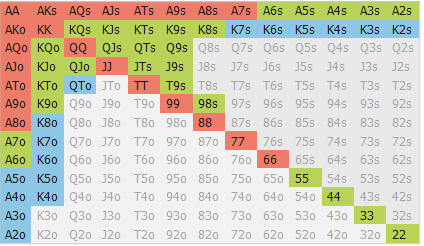
Below is an example of an open raising range, split between open pushing and open raising small:
 |
||
| Raise/call: 66+, A7s+, A8o+ (#154) | ||
| Raise/fold: K7s-K2s, A5o-A2o, K8o-K4o, QTo (#144) | ||
| Open push:55-22, A6s-A2s, K8s+, Q9s+, J9s+, T9s, 98s, A7o-A6o, K9o+, QJo (#176) | ||
Summary
In this lesson, you have learned:

- When you want to enter an unopened pot preflop, your default play should be to raise.
- Sizing of your raise depends on your effective stack, your position at the table and your opening range.
- You should play push-or-fold with a stack under 8-9bb, against flat calling opponents up to 14bb, and under high risk premium up to 20bb.
- If your opponents are not flat calling your minraises, exploit them by making the pushing range as narrow as possible, and the raise/folding range as wide as you can get away with.