


Don't mess with your poker autopilot!
Let's find out what helps you the most on your way to success.
Our total result in the long run is determined not by our best game (A-game) but by our average game (C-game). Your C-game takes over when you stop filtering every poker decision through your conscience.
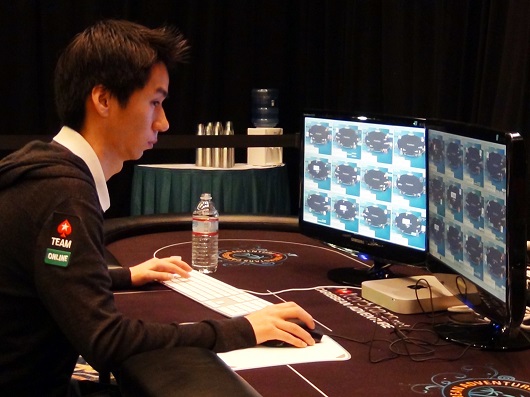
Many times you were advised to start your sessions only with high concentration and only if you're absolutely willing to play. Of course, this is an ideal mindset. But in reality, you'll eventually have to play when you don't want to even look at a poker client: after all, you still want to be making step towards your goal. And at times like this, when you can't play your A-game, it's obvious that you have to rely on your poker autopilot.
By the way, Jared Tendler (the co-author of a well-known psychology book) often says that you should work on your C-game even harder in comparison to your A-game.
Table practice is just the mechanics
Playing a lot of hands suggests a huge volume of decisions. You have to deal with lots of possible outcomes. If you think over each and every one of them, then it's like a stress test of your psyche. Very few people can really handle it. That's where an autopilot comes in handy, the same kind of automatic thinking that helps you make a decision for the decision's sake. And this is how it actually happens: you open some tables to carry out decisions of pre-defined value.
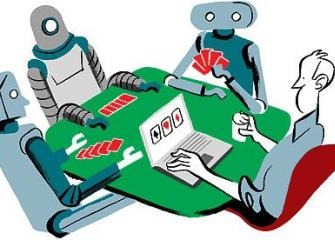
Practice is just the game's mechanics. The real poker game runs outside the tables, inside your analysis tools and during range evaluations. Those who try to figure it out during the game have less chance to succeed than those who do it outside the tables.
If you have to question the profitability of your decisions right on the spot, it means you came unprepared and didn't do your homework. Pretty much every poker decision is repeated often enough, so you can (and should) calculate its expected value in advance.
Autopilot is the best way to spot leaks in your game
If you analyse your decisions at the tables, you can't be right every time. In other words, the mechanism of your strategy would be constantly shifting gears, and after a significant losing streak you wouldn't know which exact parts of it are malfunctioning. And that's the answer to the question on how to effectively find leaks in your own game.

We have all met players with obvious leaks. Let's say, Player A has played some volume with his big leak, and now he's into analysis. Having finished it he realises where he loses money and fixes this leak.
Now let's review Player B with no solid strategic model, although he can analyse the profitability of his decisions on the spot. A certain situation has happened 10 times. In 8 of them Player B took correct decisions, in 2 of them he was wrong because of different factors (tilt, concentration loss, lots of action at other tables, etc.); 8 correct decisions gave him 2 bb/100 each, 2 wrong ones took 8 bb/100 each. So now he's break even and has no idea what's wrong, unlike Player A.
Autopilot doesn't impede your progress
This headline may seem contradictive because autopilot can be viewed as a strategy. But if you don't play on autopilot, it'll be much harder to upgrade your strategy. New things are called new for a reason: they require time to become intuitive, to get used to. Imagine how hard it is to change one's game, if one can't concentrate on a single aspect of it.
I'm not saying you should give up thinking. Just don't think about things you can analyse beforehand. While sitting at the tables you're taking a test, and you should be prepared to tick the correct boxes.
