


How to construct Small and Big Blind defence ranges
You are probably not flatting enough as the Big Blind and probably flatting too much as the Small Blind, says Dara O'Kearney.

I was teaching a student recently about the right hands to defend an open with from the Big Blind and how the strategy is vastly different from defending in the Small Blind.
As a general rule, you should defend very wide from the Big Blind and I think the biggest leak players make is not defending wide enough.
However, a second leak that is almost as costly is when you assume you can defend widely from the Small Blind, because you are getting a reduced price to call an open.
The difference between Big and Small Blind defence ranges really is the difference between night and day. Let's look at an example I ran through with my student.
Amazing odds and closing the action
These are both 60 big blind defences against an UTG min raise. You can assume for the most part that when there is a pair or big hand in the top left corner that is greyed out, that is because the solver would 3-bet that hand instead.
This is the Big Blind defence range

And this is the Small Blind defence range:
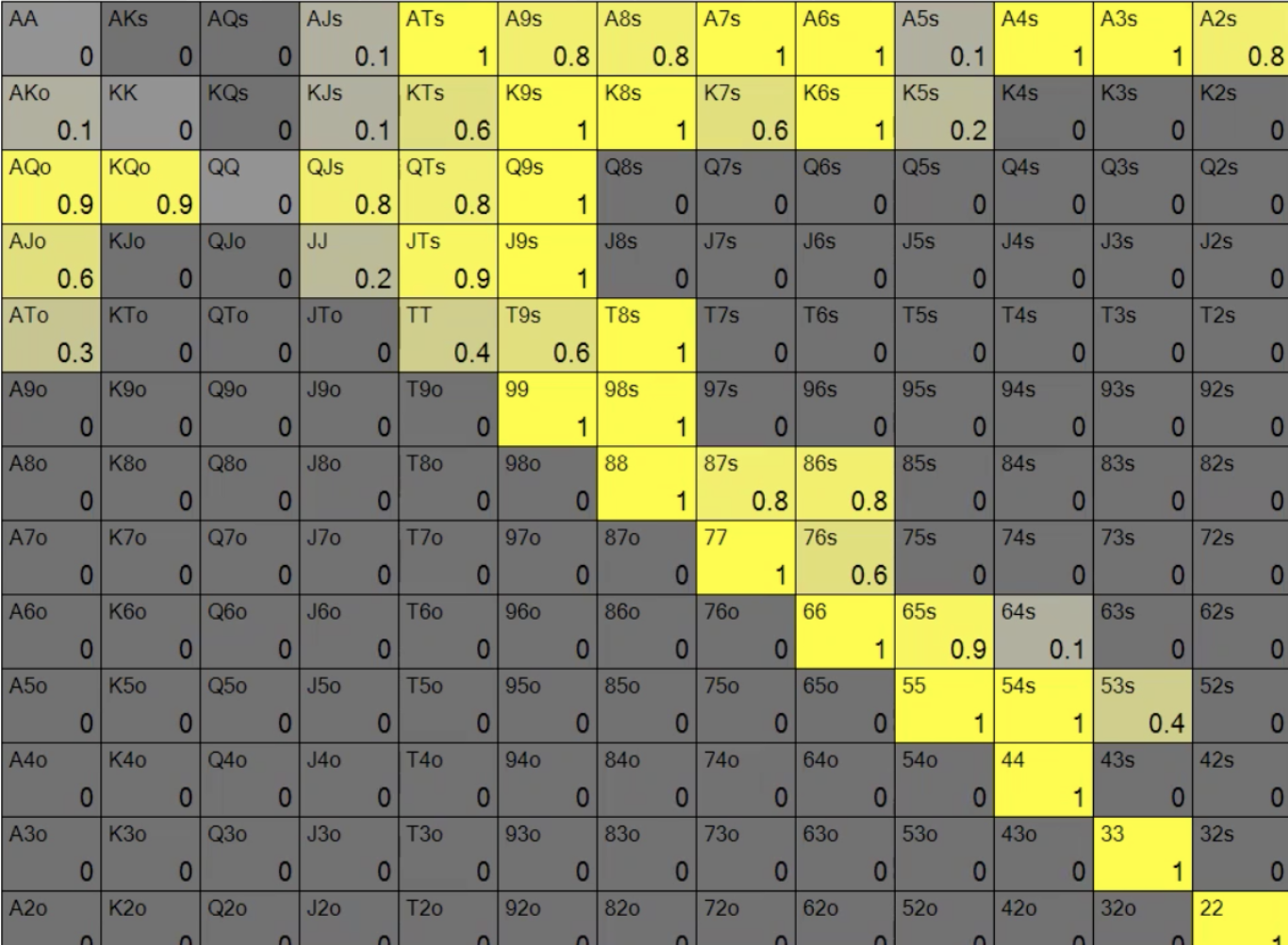
Looking at them side-by-side they almost look the inverse of each other they are so different. We flat almost everything as the Big Blind and play a very wide range, but we 3-bet a bigger percentage of our hands and play much less of them as the Small Blind. The Big Blind in spots like these will defend about 50% of hands and 3-bet 15%, the Small Blind will 3-bet 15% of hands and flat 10-15%.
We flat almost everything as the Big Blind and mostly 3-bet our biggest hands for value. Our 3-betting range is basically a linear range. We do throw in some light 3-bets with offsuit Aces and broadway hands (any hand in the grid above with a number less than 1 in it signifies a mixed strategy). We pick these hands for board coverage and to use them as bluffs. We use the offsuit Ax hands for bluffs because they work well as blockers but we flat the suited Ax hands because they flop well.
With the Small Blind you'll notice the 3-bet bluffs are much stronger and includes suited Ax and broadway hands. They need to be stronger because the Small Blind has the Big Blind to worry about as well as UTG, so we need to block more hands and have suited outs when we get action.
The Big Blind 3-bets more small to medium pairs for value because those hands have good raw equity against an opening range. The Small Blind flats more of their small pairs because that raw equity decreases massively against two players, but plays well as a set mine against two players.
The reason we flat so much with such a wide range as the Big Blind is because it is always incredibly profitable from a pot odds perspective and we get to close the action. We can flat with a funky hand like Q7s because we are getting good odds to call and we are not worried about being squeezed.
The Small Blind, however, has to worry about both UTG and the Big Blind preflop, not to mention being out of position to both players after the flop. As such the solvers prefer to play a much tighter and more aggressive strategy to compensate for all these disadvantages. When you are at a positional disadvantage then you mitigate that shortcoming by making the Stack to Pot Ratio smaller.
If you want more insight like this, Dara has a regular newsletter where he gives free tips like this all the time.
