


How to improve multi-tabling
CuAt69UsdSng from SmartSpin is back with tactical, physical, and mental advice for playing lots of tables at once.

In previous articles, we talked about why it is essential to focus on quality and that each ch/g drop affects our win rate a lot. Today, we will discuss how to improve our multi-tabling skills to maximize the potential of playing more tables and minimize the negative effects of spread concentration between a greater number of tables.
One thing is to play many tables. Another is to do it while maintaining high quality! Keep in mind that often, we could have seen mass-tabling HU players playing crazy 6/9/12 tabling matches against each other. It doesn’t mean that we should do the same playing in a different environment with different players. It’s way easier to play six tables vs. the same opponent against whom you have a game plan than to play three tables vs. three different opponents.
The main aspects that make us better at multi-tabling are:
- Taking care and improving our current effort so it’s less and less absorbing
- Regularly and wisely adding more tables to push our concentration
It’s a common misconception that the transition to more tables is drastic. One day, you play two tables; another day, you wake up and decide to play 3 or 4 tables. The transition should be smoother, allowing you to adapt to new efforts. You don’t need to play the same number of tables all the time. You should vary the number of tables depending on factors such as the current zone, daily rhythm, etc.
Understand and prepare your grind day zones. We should use two multitabling methods in different situations. It’s worth understanding the differences and why we should approach these situations differently. Our brain is a muscle. Everyone has experienced these situations in the gym: there are days when you are fully energized and ready for maximum training and when you should praise yourself only for your presence in the gym. With grinding, we should approach ourselves similarly, following our body.
Intervals
There are days when we feel fully concentrated, pumped, and willing to fight. These days are to set challenges, shoot higher stakes, and use the energy. At the same time, these days can often lead us to be overconfident, limiting our deep thinking processes. We need to adjust our warm-up to calm down our minds. We should prepare for a challenge to add another table or two during optimal moments.
Cardio
On the other hand, there are days when we are tired and don’t want to play. Still, often playing is better than not, so unless we are way ahead of our monthly/yearly goals (usually related to rakeback status), we should approach ourselves differently. We should adjust our warm-up to wake us up and pump blood into our brains. We mustn’t consider using multitabling to maximize our win rate but rather maintain a comfortable volume, perhaps with slightly greater hours.
Understand the optimal daily rhythm
During a grind day, we want to create a rhythm that will allow us to warm up and maximize the potential out of our focus.
- Warm-up - Low focus - fewer tables
- Deliberate practice - Very high focus - a few tables
- Prime time - Optimal focus - optimal number of tables
- Challenge - Optimal focus - challenging number of tables
- Capitalization - Low focus - optimal number of tables

Warm-up

At the beginning of our grinding day, we won’t be able to start on the highest gear immediately. Like in a car, we must begin with the first gear to turn our brain into poker thinking. The best way to do it is to start with a strategy video material/coaching that will turn on our poker thinking in a safe environment and inspire us to introduce new moves in upcoming practice.
Warm-up is a moment to review our session goals and notes on the knowledge we want to practice. Sneak peek into the poker room and observe currently running tables. That way, you can spot regs who are currently grinding. Refreshing game plans before we open tables will optimize the effort we need to put on tables when encountering players we already know how to play against. Prepare a playlist for the beginning of the session. You should know which songs to play depending on your current zone - to calm down or pump (I will explain that later).
Deliberate practice
After attending coaching, we must practice it to make learning efficient. The most effective way to put theory into practice is by commenting on your game out loud while playing! It's tough, I know. The beginning is always hard, but you will see the magic happen after you better synchronize your theory with the practice. You can start on lower stakes on fewer tables. The main goal of this session is NOT to make money right now. It’s to improve your performance in future sessions. Don’t skip it or fail it by adding tables or doing other things on the side. We want to play little tables with extremely high focus.
Prime hours
Prime hours are a critical moment. We can play on a very high level during this phase for a long time. We often refer to our “normal play” in this phase. If your focus is high, I recommend taking breaks only when you have urgent needs. We want to use our prime time to the maximum. During this phase, we can very smoothly introduce one more table than usual in temporary situations, like:
- We have a very shallow stack on very high blinds, so there’s little chance of deep post-flop hands.
- We play HU against the same player on most tables and know exactly what to do against him.
- A fish just busted, and you expect him to reg another game.
A common mistake would be to run more games if you already have a lot of fish on your tables. Playing vs. different fishes demands way more focus than playing vs regs. Another mistake would be adding tables because we feel “bored” or want more action. WAKE-UP! That’s a sign you stopped noticing details, and your focus dropped. An hour ago, your focus was greater; somehow, you didn’t want to increase tables. Our brain, when tired, often wants to put effort into quantity with more straightforward decisions instead of playing fewer tables with A+ games. When we feel signs of tiredness, it’s a critical moment to not mindlessly fire another table. It’s time for a challenge - but with the additional effort put into maintaining high-quality concentration. After you bust another game, don’t instantly add another table. Wait for an appealing circumstance mentioned above. We should keep playing our standard good game and not introduce any challenges until we feel the first signs of being tired.
Challenge

These days, when we feel pumped and desire, challenges are special for us. The optimal moment to put pressure on us is not when we feel perfect but when we reach our current limits. During the challenge, we can add a table for the whole challenging period - 30-90minutes. It shouldn’t be too short so we feel the effort, but it shouldn’t be too long, so we lose focus and play brainlessly.
Test your durability and adjust your challenge for the next day so it’s 5 minutes longer than your limit. We have to make an additional effort to stay focused right now. This challenge can feel challenging and uncomfortable. We have to feel the pain of trying to remain highly focused! No pain, no gain! Prepare and accept this uncomfortable effort!
Capitalizing session
So after we are already 4-6 hours into the session, we have had our prime hours, finished our challenge, and can still play - whether because we need to or want to because the tables are perfect. We mainly play our B game during capitalization, relying on our habits. This is a moment when you can pick two ways:
- Play fewer tables but on your main stake
- Play a challenging number of tables but on lower stakes
You may start feeling bored or tired. It is the only moment I could accept adding a podcast/video in the background, but only if we would have already finished our grind without it.
Tips & Tricks - Acustom your eyes
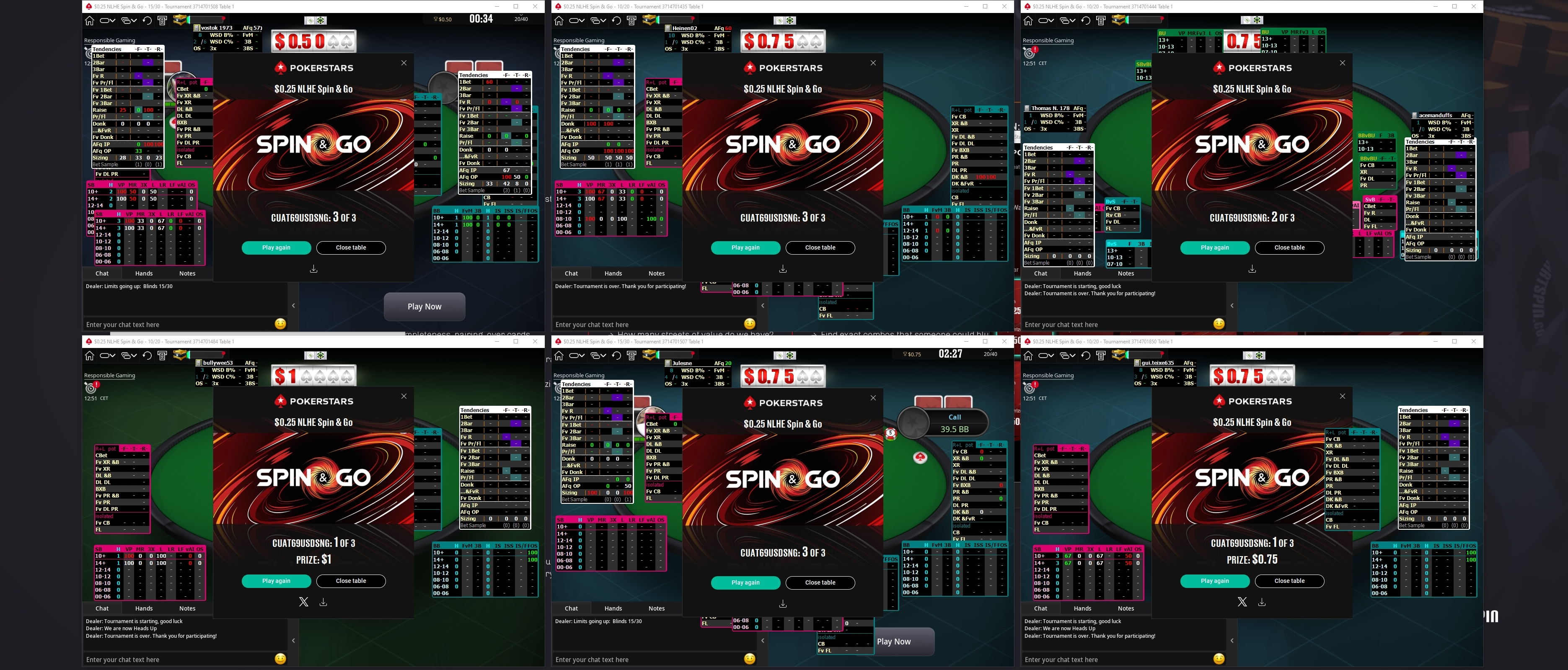
One of the most challenging multi-tabling improvements happens when you want to add 3rd and 5th table playing tiled tables. Notice that tables change size to fit another row/column of tables. Tables get smaller, the HUD on tables changes its place, and numbers get smaller. In fact, not only must we put more attention to the greater amount of hands we have to process, but we also have to put way more concentration into spotting tiny details on our screen - often moved to a different place, so our muscle eye habit no longer exists. We have to look for a desired table deliberately.
How do you prepare for this transition? Before you add the 3rd or 5th table, start with sessions on 2 or 4 tables but play on smaller window sizes, adjusted to their future positions. Start games, and when you finish a game, add another table without shutting down the previous table windows. That way, when you click “play again,” you can play fewer tables in desirable different places on the screen — a recommended way for your warm-up.
Make sure your HU HUD is more or less in the sample position, whether your opponent sits on the left or the right. It’s worth having panels on the same side of the table - i.e. HU SB panels on the left and HU BB panels on the right.
Cool down
As you noticed, manipulating the number of tables depends greatly on your current focus level. Knowing your different states and focus levels is the greatest skill that will help you maximize the value of multitabling. Mind your focus. After you finish your grind day, write down in your mindset journal when and what signs in your body or thoughts you recognized that make you understand you reached a particular level of focus.
This article is written by CuAt69UsdSng, who has been a full-time MTT pro who transitioned to Spin & Go's, where he won more than $1M+ in EV+RB. He is a High Stakes Player, a coach, and CEO of Smart Pool - an EV Pool for Spin & Go's players providing protection from the variance. You can find more about it here .
