ICM is broken in PLO tournaments l Strategy with Barry
There are spots in PLO MTTs where in theory you should fold the nuts, is this a sign that we should ignore ICM?
I remember once seeing Shaun Deeb deep in a PLO tournament when his opponent called off most of their stack pre flop but had to fold a very unfavourable flop, leaving him incredibly short, because it was the bubble.
Deeb commented to his opponent that he likely made the right decision and that ICM in PLO was broken. I never really knew what he meant at the time, but since then, I have done a very deep dive on ICM, and I'm starting to take my first steps into the world of Pot Limit Omaha.
PLO endgame is broken
The reason why PLO does not make a natural tournament variant is that the equities run close together in this game, compared to Hold'em. No matter how strong and dominating your hand might appear in PLO, it's never a huge favourite.
This presents a conundrum in the endgame stages because correct GTO strategy dictates that you sometimes have to play only very strong hands.
Take, for example, this table of Risk Premiums for a bubble:

The premiums go as high as 18.7%, which, in layman's terms, means that a hand would need 68.7% break-even equity to justify calling an all-in before you factor in the chips already in the pot and pot odds. In Hold'em, this might mean having to fold a strong hand like Pocket Jacks for your tournament life on the bubble. But a hand like Pocket Aces is usually going to have more than 80% equity against any range. So that still would be a call.
No hand in PLO is ever really going to have that much equity. For example, look at this match-up where we have AAKK doubled suited, against a weak holding:
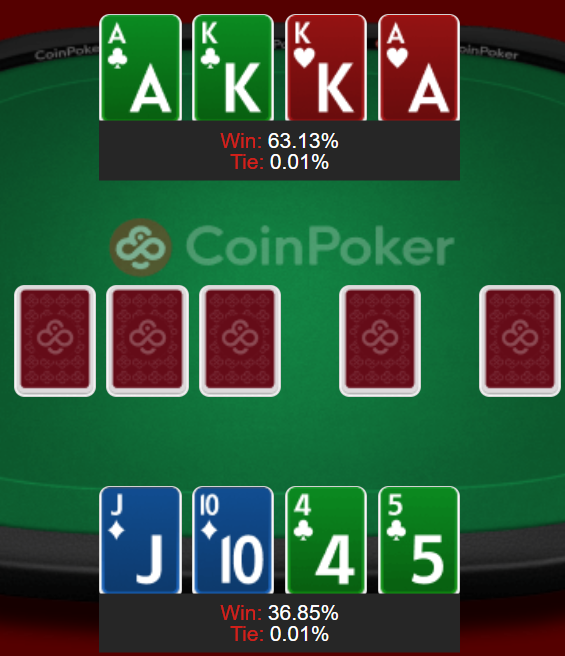
We are up against a trashy hand, but if we were the short stack at that bubble table, it would suggest that the preflop nuts are actually unplayable in our seat position. If we can't beat this garbage hand, how well are we going to perform against a stronger range? Or two opponents?
In theory, this means we should be able to be very aggressive as the chip leader in the end game stages of a PLO tournament. Because we can't immediately force an opponent all-in, it would also suggest that the best strategy for a medium stack is to pot control.
In practice, the average PLO grinder is probably blissfully unaware of the extremities of ICM in these scenarios. If we were the short stacked player, it would likely mean we have to throw caution to the wind and ignore ICM to some extent in an attempt to get back into the game. If not, then we risk blinding out, which is something that ICM doesn't account for.
You get the same impact in target stack satellites, where, in theory, it's correct to play incredibly tight when you are close to a seat. However, you have to still get to the target stack, which means at some point you have to ignore what an ICM solver would tell you. I think the same may be true for short stacked players in PLO.