


Interview with ICMIZER creator 'Qicmizer'
We chat with Qicmizer, better known as 'Q', about his new ICM analysis tool ICMIZER which promises to be one of the best ICM software on the market. Try it now for a 20% discount.

Make sure you gain from our current 20% discount on the ICMIZER - simply enter the promo code PS2013 during the checkout and save 20% when purchasing the ICMIZER. Promo code is only valid until 20 October.
 PokerStrategy.com: Tell us a little about your background in poker.
qicmizer: I started playing in early 2007. Back in those days I worked 9-to-5 as a software developer, and then I went home and spent six more hours playing poker.
Games were very easy back then. Few players took the time to work on their game, and even regulars who showed a profit would make crazy mistakes every now and then. Those were the sweet days. I started from $5 stakes and by the end of 2007 reached $50 10-max SNGs.
Around then my part-time income from poker play caught up to my salary as a developer, so I quit my job and turned pro. Eventually I got up to $500 nine-max and six-max turbo games, competing against some of the world’s best regulars in those structures. Growing bored of the constant SNG grind, I switched to hyper HU SNGs in late 2010, which turned out to be one of the most enjoyable structures I’ve ever played.
Then Black Friday happened; you know the rest. I stopped playing poker and concentrated my efforts on developing ICMIZER.
"I wasn't satisfied with the other products on the market"
 PokerStrategy.com: Did you create ICMIZER because as a player you felt there was things missing from the products already on the market?
qicmizer: It made a lot of sense to combine my college education and job experience with my skills as a professional SNG poker player. Given this mix of expertise, developing software for SNG players was a no-brainer.
That said, choosing the ICM calculator niche was a risky choice. But as a SNG player, I just wasn’t satisfied with the capabilities of the other products on the market. It was pretty frustrating not to be able to edit ranges. You just couldn’t do some simple things like adding or removing a hand from a range. I knew there were a lot of players like me who needed this, so that was the first checkbox I crossed out. When ICMIZER first came out, it only had a few features, but it did allow complete control over opponent ranges.
One other problem with the other products on the market is they provide slightly inaccurate results in certain situations. It effectively ignores tie spots in two-way all-in confrontations, meaning that instead of win-tie-lose, it considers only win or lose. Due to the nonlinear ICM effect, this accumulates to a significant discrepancy in all calculations. The error can reach 0.2% of the total prize pool for a single hand, and sometimes more. It doesn’t seem like it could make a real difference, but hey, these days an ROI of 0.2% can be considered pretty good in some structures and limits. I can’t speak for every player out there, but for me, a single-hand error shouldn’t exceed the entire expectation of playing the whole tournament.
Note that in six-max structure for example, an error of 0.2% represents 0.2% * 6 = 1.2% ROI in a single hand! If you are curious about how accurate ICMIZER results are, you’re welcome to read some detailed articles about that on my website at www.pokericmcalculator.com.
"No other software offers this flexibility"
 PokerStrategy.com: What are the key differences with ICMIZER and the other products on the market?
qicmizer: Nothing would make me happier than ICMIZER becoming the top-choice tool for tournament preflop analysis. Of course, that’s easier said than done. Software has to be user-friendly, helpful, with an easy learning curve—basically it has to outmatch the competition in every way.
Here are the key differences of ICMIZER with the other products on the market: a) unrestricted range editing, b) the most precise ICM calculations, and c) a built-in Nash ICM calculator, as opposed to a simple table-based range assignment.
But that’s not it. ICMIZER goes further and offers some totally unique features: a) MTT ICM calculations for pre-final table spots, and b) a flexible interpreter of preflop poker rules. This interpreter allows any preflop spot to be analyzed: it can include limps, raises, re-raises, all-ins, or any combination of the above.
To my knowledge, no other software offers this kind of flexibility. So, for some spots there simply aren’t any alternative ways to find the correct preflop decision, other than by using ICMIZER.
"I really wanted to add ICM calculations for MTTs"
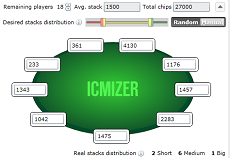 PokerStrategy.com: Tell us more about the function to do ICM analysis for up to 60 player situations.
qicmizer: I really wanted to add ICM calculations for MTTs, because that would be a great addition to the software. MTT is becoming faster and faster nowadays, and the push/fold game plays a big role in many tournaments. So, having a tool that would help you make the right decision would really benefit players who choose these fast MTT structures.
I’ve discussed this problem with some very smart people. As a result, ICMIZER is using a special algorithm for ICM calculations for more than 10 players, which has reasonable performance for up to 60 players instead of the traditional 10 players. It doesn’t provide precisely the same values as the usual ICM algorithm (it just cannot be used for spots with many players due to complexity), but approximated values are very close to the traditional algorithm.
It turns out that the results are superior to the only alternative traditionally available for MTT players — Chip EV calculations. ICM calculations take into account the payout structure and the tournament situation. Bubble, far from bubble, satellite, or any other factor which influences our tournament decision are taken into account, unlike Chip EV calculations which assume that the bubble factor is 1.
"The value to MTT players is obvious"
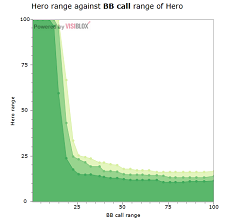 PokerStrategy.com: How important is ICM when there is still 60 players left – shouldn’t we always be playing ‘for the win’ at this stage, given most tournament prize pools are top heavy?
qicmizer: Well, the only structure where you should be playing for the win would be a winner-takes-all tournament. While MTTs are more top-heavy than some SNGs, the first place rarely gets more than 25% of the total prize pool.
When you play ‘for the win,’ you make a couple of assumptions: the first place gets the entire prize pool and there will be no bubble, just heads up for the first place finish prize. Neither of this is the case in MTTs, and Chip EV calculations ignore the tournament situation and prize pool and assume that the first place will get all the chips.
For a long time tournament players simply had no choice, so what they did with preflop calculations was running some Chip EV based calculations first. Then they would tighten up some ranges based on their own guesstimates and understanding of the bubble factor and the tournament situation.
With ICMIZER, you don’t need to guess anymore. By using ICM formulas for converting chips into their expected dollar values, this mathematical approach provides you with adjusted ranges based on your tournament spot.
How important is this? In MTTs, even a fraction of the entire prize pool, say 0.01%, could represent a big part of your buy-in, and it could represent a reasonable ROI value too. With fast-paced MTT and SNGMTT structures of 2013, ICM will help you make better decisions not only on the final table, but also on the bubble, on the pre final table, etc.
The value to MTT players is obvious. Instead of basing their play on sub optimal chip EV calculations, they can make more informed decisions, use different ranges, and thus outperform other players who base their pushes and folds on feel only.
"Real-world players don't limit themselves to two options"
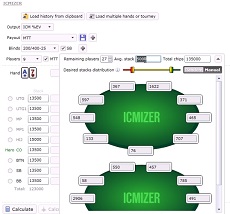 PokerStrategy.com: Tell us about the complex preflop spot analysis, can you give an example how this would work for less ‘committing’ actions like limping and raises?
qicmizer: Real-world players usually do not limit themselves to just two preflop options in tournament poker like push or fold. They do raise, limp, re-raise etc., and leave some chips behind. While the majority of spots in certain structures do not include many VPIP actions other than all-ins, it is important to play accurately in those other spots too.
A simple example: if you don’t know how to play against steals or limps, someone who does will easily outplay you. ICMIZER allows you to study those spots too, to be prepared for any potential traps from limpers or aggressiveness of the button.
There are also times in a tournament when preflop action gets hairy: someone limps, someone raises, another guy pushes, and now you are sitting with AJs on the big blind wondering what to do.
With ICMIZER’s flexible preflop bet interpreter, you can analyze those curious spots too and figure out the correct play. Like I said earlier, this feature is unique to ICMIZER. Also note that setting up a complex preflop is very easy: you just enter the players’ bets. Even a complex spot takes less than 30 seconds to set up.
Once you’ve set up the spot, you will need to take some time assigning ranges for your opponents. This is the part of using ICMIZER that requires some skill. It can get challenging at times, but the better you are at putting your opponents on ranges, the better results you will get from the program, and the better your strategy will become.
PokerStrategy.com: Thanks very much Q. If you have any questions about ICMIZER then visit our forum:

What is ICMIZER?
ICMIZER is an ICM calculator software for Sit & Go/tournament play which will help you to analyse ICM-based situations in your tournament poker game.
 |
Learn to improve your preflop strategy in shortstacked tournament spots |
|
Improve your evaluation of push/fold spots in SNG tournaments |
|
Learn how to resteal and react to resteals properly |
|
Get an MTT edge with ICM calculations for up to 60 players |
|
Find the optimal strategy with Nash equilibrium ranges |
|
Quickly load single hands or entire sessions for analysis |
|
Additional equity models (ICM, Ben Roberts) |
|
Flexible, fully editable ranges |
|
Available for Windows or Mac, in your browser online or in a downloadable version |
