


Mystery Bounty math
Like the look of the new Mystery Bounty format but not sure how to work out what a random bounty is worth? It's actually very simple.
PKO tournaments have dominated online poker for a few years now but have not had the same impact live. This is for logistical reasons, it is not as easy to track the progressive nature of the bounties in a live poker setting compared to online. There have been live bounty tournaments but the bounties never increase, so they become less enticing the deeper you get in the event as the standard payouts are much bigger.
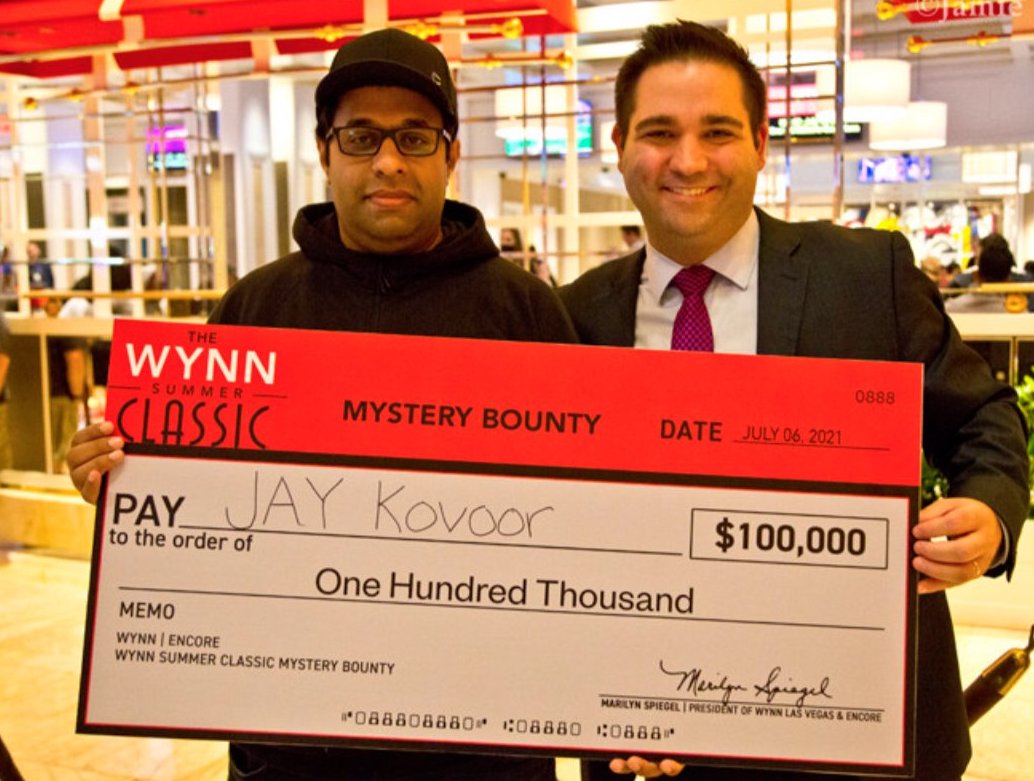
The Mystery Bounty format, like the one at the Wynn recently, might be the middle ground live poker needs to catch up to the bounty craze. It is not a progressive bounty, in other words your own bounty does not increase the more scalps you claim, but it does mean some bounties are bigger than others, and some are huge.
The way it works is, let’s say there are 100 players in a $3,000 MTT and the average bounty is $1,000. There will be some lower bounties, maybe 70 of them will be $500. There will be a few huge bounties, let’s say a $10k bounty and four $5k bounties. Then the remaining 25 bounties will all be $1,400 each.
At no point does anyone know how much the bounty is on another player until they have been eliminated. In fact in the case of the Wynn, anyone who got a bounty spun a raffle wheel to pick their prize, which I think was the right way to do it.
How to play when you don't know the bounty?
So how do we approach this strategically? Especially the fact that we don’t know what the bounty will be when we win one?
I cowrote PKO Poker Strategy with Dara O”Kearney and we devised a formula for calculating the odds you need to call for a bounty, based on the value of the bounty and also the progressive nature of the format. We dismissed what is known as the ‘chip conversion’ method because it didn’t really take into account the progressive value of bounties.
However, the chip conversion method makes sense here, and the mystery element is relatively simple to account for, as Dara explained:
I know you’re joking but strategy would be relatively simple. Just work out what bounty would be on average and assume that’s the bounty
— Dara O'Kearney (@daraokearney) July 6, 2021
Turn the bounty into chips
So first we use the chip conversion method. This is where the value of the bounty is added to the calculation as if it were extra chips in the pot. If a starting bounty is worth 1/3 of your buy-in then it is worth an extra 1/3rd of your starting stack, which you treat like it is dead money in the pot.
So let’s say in our example above the $3,000 buy-in gets you a 10,000 starting stack, in that instance an average starting bounty is worth 3,333 extra chips in the pot. At the start of the tournament that is what you would treat the bounty as, as it will be the average bounty.
Let's just say you are the Big Blind, the blinds are 500/1,000 with a 100 ante, and the Small Blind (whom you cover) shoves for 10,000 chips. It costs you 9,000 chips to call to win a potential pot of 20,900. If you do the maths then this means you need 43% equity to call, assuming we are a long way from the money. However, the Small Blind's bounty is worth an extra 3,333 making the final pot 24,233, meaning you actually need 37% equity to call.
I got video. It was great. https://t.co/UyOKynhnV5 pic.twitter.com/49zvIM1MHn
— Brad Owen (@TheBradOwen) July 6, 2021
But let’s say 50 players have been eliminated, including 40 x $500 bounties, 9 x $1,400 bounties and one $5,000 bounty. That is $37,600 removed from the prize pool, leaving $62,400 in bounties between 50 players. Now the average bounty is worth $1,248 instead of $1,000. $1,248 is 41.6% of our $3,000 entry fee, which means an average bounty is now worth 4,160 chips. So when deciding whether to call for a bounty treat it like there is an extra 4k of dead money in the pot.
If we mirror the first example, the average stack will be 20,000 now, make the blinds 1,000/2,000 with a 200 ante and again have the Small Blind shove into the Big Blind, this time for 20,000 chips. The Big Blind has to call 18,000 to win a pot of 41,800, which would once again be 43% equity. However with that extra 4,160 in pretend chips from the bounty, the final pot is actually 45,960, or 39% equity.
The average bounty is bigger now but we actually call tighter here. The average stack will be 20,000, so the average bounty here is 20.8% of the average stack, rather than 33% of the average stack in the first example. That might surprise a few people, but it is one of the fundamental discoveries we made in PKO Poker Strategy, that bounties are worth the most in terms of equity at the start of a tournament. ICM is also more of a factor, but I haven't included that in my very rough examples here.
I think the Mystery Bounty format is a winner and it looks like the Wynn have found a way to let live players enjoy the fun of bounty tournaments the way PKOs have done online. In fact, I think it is only a matter of time before we see them online too.
Would you play a Mystery Bounty? Let us know in the comments:
