


Post flop ICM is different
Barry Carter shares a hand that really goes against common sense instincts but makes sense when ICM is extreme.
I recently played a final table hand where I was the chipleader (50BBs) in the Big Blind and the Button (30 big blinds, third in chips) opened, I defended. Six players remained, we are in the money, I had QT.
The flop was 732 and I donk lead for 25% of pot, the Button called.
The turn was 5, I bet 25% pot again and the Button called.
The river was J and for the last time I bet 25% pot and the Button called with 66.
This hand seems very odd to an outside observer. I had no hand, no draw and on the river no blocker seemingly making this a terrible bluff. I also bet very small on each street. However, when I put it through a solver it was GTO approved and most of the time the solver preferred a larger bet on the turn and an overbet shove on the river. Spoiler alert, I know from three books I have worked on (my most recent ICM book and two in the works) that this particular spot was GTO approved, so why was it?
ICM is different....
First of all, this was a spot where I had a significant range and nutted advantage. When a Button opens and the Big Blind defends, the Big Blind tends to have range advantage on low flops and the Button is usually ahead on everything else. These are the GTO ranges, first the Button:
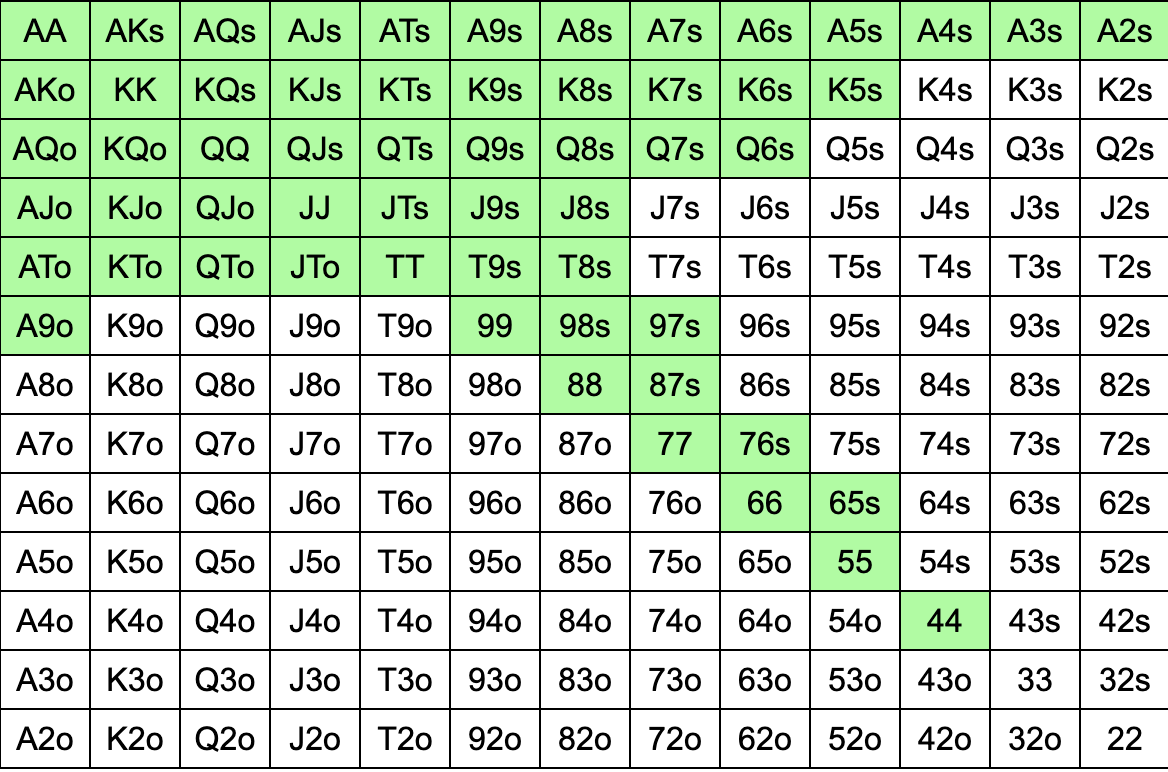
And this is the Big Blind:
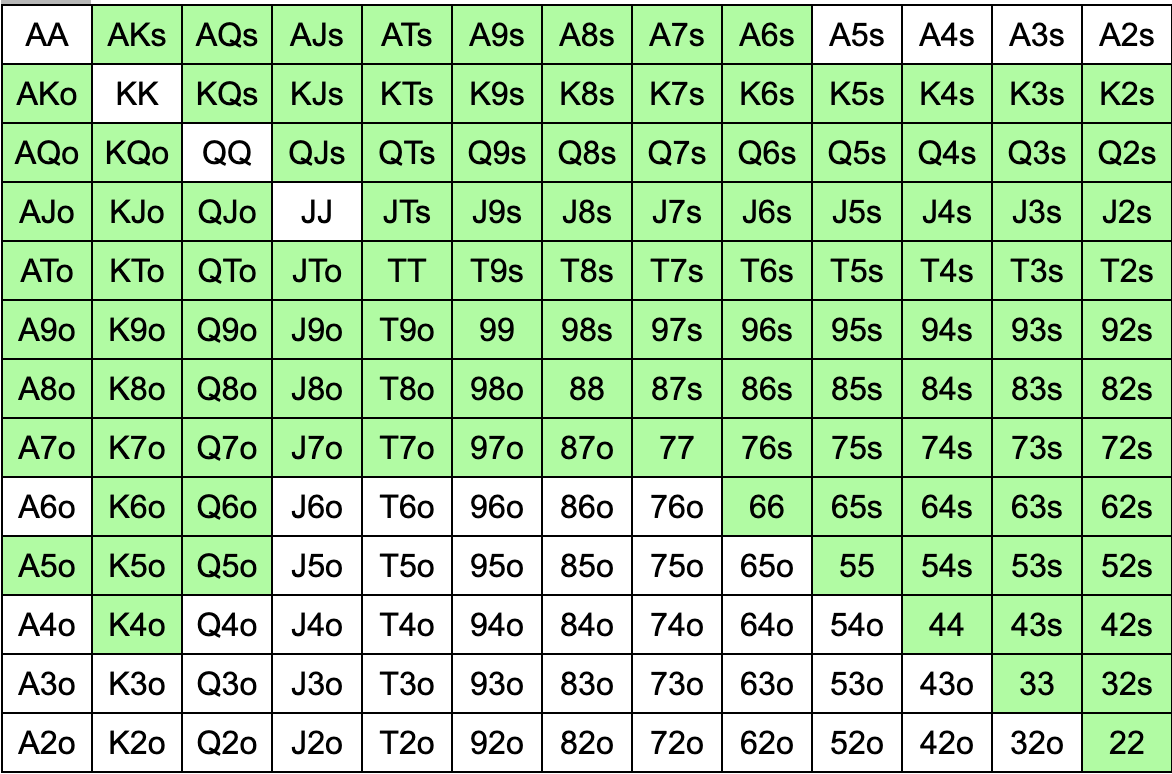
I have all the sets and all the two pairs on this flop, I have all the straights and 5x as the turn and river come. My opponent has overpairs and some sets/quads but their range is more made up of high cards that have missed. So even in a non-ICM scenario there is a very strong case for leading out with most of our range here, as opponent cannot have many strong hands. They have to fold a lot of big hands and play their better hands passively to protect their range.
The other significant factor is that we cover our opponent and as such exert significant ICM pressure on them. GTO will make the chip leader donk lead a lot of flops in this spot even when they do not have range advantage, because ICM forces the Button to fold a lot of medium strength hands. Being the coverer tends to trump range and positional advantage when it comes to who gets to be the aggressor in the hand. In particular the Button covered three other players at the table, so they needed a monster to justify going broke to me and miss three pay jumps.
Regarding my bet sizing, ICM tends to favour very small or very big bets, what we called 'Min or All-in' in our most recent book. Even though we cover our opponent we do not want to take needless risks because we still have ICM pressure on us too. As such the lowest variance lines we can take as the aggressor are small bet or a huge bet that our opponent has very hands they can call with. The worst line we can take is medium sized bet, because we hate being check/raised.
It makes perfect sense, therefore that our 'no hand, no draw, no blocker' hand can be played like this across three streets. Our opponent so rarely has strong hands here and we can eliminate them from the tournament, it means that we can play all our hands like this against them and turn a profit. I must admit I was surprised to see that the solver preferred us to shove the river here. In this case the small bet is mostly targetting better high card hands like Ax and Kx, but the overbet folds out lots of overpairs.
It's only now that solvers are becoming ICM aware that we are really seeing just how different strategy is at final tables and bubbles. It is proof that perhaps poker is far from solved.
Did this hand surprise you? Let us know in the comments:
