


Solvers show you how to exploit too
Barry Carter shares some more musings from his deep dive into GTO and solvers from his latest book project.
As you may know, I am working on a book about GTO with Dara O'Kearney and sharing some of the interesting nuggets we find along the way in our research.
One big misconception about GTO is that solvers do not show you how to exploit bad players, they only show you how to play GTO against good players. Nothing could be further from the truth, PIOSolver, the main solver out there, has a feature that shows you the best way to exploit your opponents if you know their tendencies. Not everyone uses it, but they should, it is called Node Locking.
A solver will show you how perfect GTO players will play their assigned ranges against each other, using the preselected bet sizes available. This provides you with a strategy that cannot be exploited, but what about if your opponent plays differently, which they very likely will? In PIOSolver you can change the way your opponent acts to mirror how they play in real life, and it will adjust the strategy accordingly. For example, the solver approved line with a strong range will be to make a small ‘range bet’ which the opponent will have to call a decent portion of the time to avoid being exploited. What if your opponent in real life always bets 2/3rd pot no matter what with all their range? Well, you can give the solver the instruction that they will always do that and a new strategy is created to adjust.
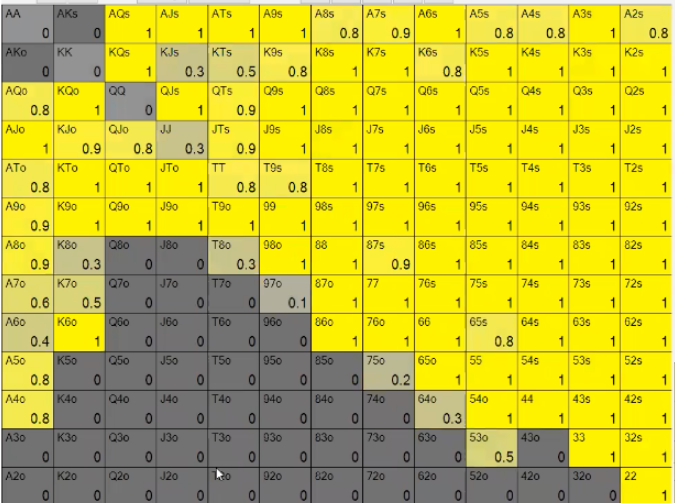
For example, this is a 40BB UTG open range:

And this is the Big Blind defend range:
The flop is 6♠5♥4♦.
I've written about this flop before, you see a lot of leading from the Big Blind on this flop. In GTO world they bet almost 60% of the time because this is a really favourable board for the Big Blind because they have all the sets, all the two pair, all the flopped straights and all the high equity combo draws.
When the Big Blind checks the other 40% of the time, UTG will bet because the Big Blind has a weakened range, but they only bet around 43% of the time, because they are still concerned about the Big Blind having some nutted hands, checked for protection. When UTG does bet, the Big Blind check/raises just 5% of the time.
How to play vs a real life aggro player
That is how the hand goes down with two GTO players. But what about if, for example, the UTG player bets 100% of the time when checked to? This is a common error in a lot of poker players who c-bet too much because they are the preflop aggressor. We can 'node lock' in PIOSolver to get an optimal strategy for that.
In this case, the Big Blind goes from leading out 60% of the time to checking 100% of the time. Then, when UTG bets, they check/raise almost 50% of the time. Doing so makes them 3.9 big blinds on average, compared to the 3.4 big blinds in EV they make in the pure GTO example.
This is a great example of good exploitative poker which the solver has arrived at. They have adjusted a strategy of leading out 60% of the time to one where they check all the time, to capitalise on the fact that the opponent continuation bets too much. This is a perfect example that solvers not only show us the best way to avoid exploitation, but also the best ways to exploit players, if we know their tendencies.
Do you use solvers? Let us know in the comments:
