


Three ways you exploit yourself
'bencb' is back with three tips for making sure you don't own yourself at the tables before your opponents get the chance to.
One of the first things you may have heard when you first started to take poker seriously is the term “exploit.” Simply put, this means understanding and adjusting to your opponent’s tendencies at the table to increase your winnings. When we start breaking into the world of HUDs and stats online, the immediate temptation may be to start adjusting to every stat you see. However, this is a huge mistake if you don’t have enough information, or if you are just over adjusting because you haven’t really grasped the whole concept quite yet. In this article, we are going to be taking a look at 3 common ways that many people try and fail to exploit their opponents at the table, and how by doing these things you might just be exploiting yourself.
1. C-betting everything
You may have heard of the term “Minimum Defense Frequency.” This term (often referred to as MDF) means the minimum amount that your opponent has to defend facing a bet, in order to not be exploited. The formula is pot size / (pot size + bet size). For example, if the pot is 10 and you bet 5, your opponent has to defend 66.6% of the time to meet the MDF.
Now if you are still reading this after all that math, let's break down what this means at the tables. Basically, if your opponent has a Fold to C-Bet stat that is 50%, he would not meet the MDF of 66.6% in the example above. The common reasoning that a lot of players will use then is to just C-bet your entire range, because you are facing an opponent that will overfold, so you can technically autoprofit by always betting. However, what most players don’t take into account is the differences regarding board texture and position. Let's look at an example:
You raise the Small Blind with 7♦ 8♦ and the Big Blind calls. The flop comes A♥ J♥ Q♣. You see that your opponent has a 50% Fold to C-bet stat. Should you bet this flop?
The answer is no, you should not. Even though your opponent technically overfolds according to his stats, that doesn’t mean that he will be overfolding on this board, with these positions. Think about it, if your opponent has any positional awareness whatsoever, he’s going to understand that you are raising from the Small Blind with a very wide range. He also understands that he has a very wide range calling from the Big Blind.
When you bet 1/2 pot on this flop, he knows that even though you technically have the stronger range, it’s not much stronger and he does have position. More likely than not, the Big Blind will be defending a lot closer to correctly in this spot, making 7♦ 8♦ a horrible C-betting hand here. As the Small Blind you do get to C-bet this board a significant amount of the time, but you have the bottom of your range here in a situation where your opponent is likely to stick around. The key takeaway from this is that you have to look beyond black and white thinking based on your opponent’s stats. You have to take into account positions, board texture, and your actual hand strength first, because you will end up exploiting yourself if you just fire away into an opponent with a higher Fold to C-bet stat.
Bluff 3-betting too much
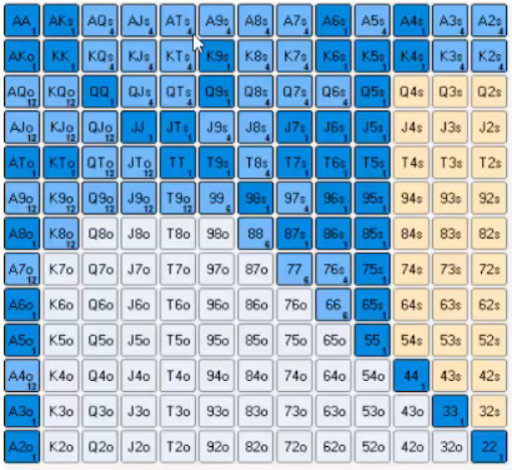
Lets face it, when some newer players see pros on TV 3-betting hands like J7s and T5s they tend to start wildly trying to implement that in their own game, for no other reason than that they saw someone famous do it. Take a look at the hand below and decide if this range is an appropriate 3-bet range for the Big Blind.
The Small Blind raises to 3, and we are in the Big Blind. Take a moment and decide if this is an acceptable range to use as the Big Blind. (Dark blue means 3bet, light blue means call)
As you may have figured out, this is way too wide of a 3betting range here! There are a ton of hands that this range has us 3-betting that work much better as calls against most opponents. You have a ton of EV in calling these offsuit Ax hands, but this range has you 3-betting half of them! Hands like K9s, 22-55, and a ton of the weaker suited hands would play a lot better as calls as well. This range contains way too many bluff 3-bets, however some players are actually 3-betting this wide because their opponent has a bit of a higher Fold to 3-bet stat, so they are trying to exploit them.
There are a couple things to consider when your opponent has a higher Fold to 3-bet percentage. First of all, typically you want to be 3-betting a 1 to 1 ratio of value hands to bluffs. When your opponent is super nitty against 3bets you can certainly increase your bluffs, but not to a point where you have a 25% 3-bet and they can start to exploit you back. By 3-betting 22-55, Ax offsuits, random K9s, T5s hands and everything else, your opponent will start to play back at you and exploit you, since you are so wildly imbalanced in your attempt to exploit them. If you really believe that your opponent is way overfolding to 3-bets, take that 1 to 1 value-bluff ratio and bump it up to 2 bluffs for every 1 value 3-bet. Any further though, and you’ll most likely just be hurting yourself in the long run.
3. 4-betting too few hands
Oftentimes at micro and small stakes, opponents only 4-bet the nuts like AA, KK etc. This means that when you start 4-betting, a lot of times players will overfold to your aggression. A typical balanced 4-bet range at micro stakes may look something like AA, KK, A4s, A3s, A2s. These suited hands are actually very good 4-bet bluff candidates, because they block the Ax value hands that your opponent may be 3-betting with. However, your opponents would have to have an extremely tight 3-betting range for you to only be able to 4-bet this range.
If your opponent is 3-betting a standard amount, he will probably overfold if you widen your 4-betting range. Expand your 4-betting range to include other value hands and a few more bluffs, instead of playing the same narrow range as the rest of the population.
You have to ask yourself a couple questions in order to determine whether or not you should 4-bet lighter. First, is your opponent going to call or 5-bet jam any worse hands than the one you have? If so you should definitely 4-bet! Second, is your opponent going to fold enough to make your 4-bet bluffs profitable? Typically population will overfold, but it’s important to take into account any stats you may have on your opponent. It’s definitely important to not be too scared of 4-betting, you can capitalize on a ton of mistakes your opponents will be making when defending 4-bets. They will typically overfold, especially if their 3-betting range is decently wide anyway.
Get our unbeatable Raise Your Edge discounts

After an exemplary rise to the top of the poker world, starting out on low-stakes SNGs and grinding his way all the way to the top of six-figure buy-in tournaments, Benjamin 'bencb' Rolle launched his own poker training site Raise Your Edge, delivering world-class poker courses that can help anyone to get their own game to new heights.
No matter if you want to master regular tournaments, perfect your skills in bounty MTTs, boost your mindset, or reignite your career with live cash games—there's something in store for everyone at Raise Your Edge. And with our unbeatable PokerStrategy.com discounts at Raise Your Egde that you will find nowhere else, you will be able to save cold hard cash when taking your game to the next level through the elite poker training Raise Your Egde offers.
Up to $250 discount through PokerStrategy.com
Check out our discount overview for all the available courses and pick whatever game format you would like to thrive in. PokerStrategy.com offers the biggest discounts available at Raise Your Edge:

| Course | Standard Price | Discount | Exclusive Price | Discount Code |
|---|---|---|---|---|
| Tournament Masterclass App | $697 | -$100 | $597 | POKERSTRATAPP |
| Tournament Masterclass Exp | $1.297 | -$175 | $1,122 | POKERSTRATEXP |
| Bounty Beast | $997 | -$250 | $747 | POKERSTRATBEAST |
| Unchained Mind | $597 | -$125 | $472 | POKERSTRATMIND |
| Online Cash Apprentice | $297 | -$50 | $247 | POKERSTRATCASH |
| Mastering Live Cash | $397 | -$75 | $322 | POKERSTRATLIVE |
The best part of it all: There's a money-back guarantee on all the offers available at Raise Your Edge, meaning if you completed a course and done the work, but you feel it provided no value, you can get a refund for your purchase within 60 days.
Pairrd App by Raise Your Edge
While checking out the most popular courses on our dedicated Raise Your Edge page, you should also have a look at their unique interactive studying tool Pairrd that is coming with engaging video quizzes, range drilling and hand review quizzes, all based on the most up to date GTO ranges out there.
An essential part when learning poker is the ability to think in ranges and understand the why behind them. Raise Your Edge does a great job of getting that across to their students, meticulously breaking down ranges and explaining the reasoning behind them.
However, memorising ranges is quite hard, and often the only way to learn is by making enough costly mistakes to see one's errors. Thankfully, Raise Your Edge provides a powerful tool to circumvent that with Pairrd.
PokerStrategy.com editor Barry Carter has reviewed Pairrd and concluded about the merits of the innovative app:
"Pairrd is a unique interactive studying tool that provides something relatively new to the world of poker training, a way to practice spots without having to play them at the tables. It is essentially a dynamic way to make real poker decisions without risking money. Since most of us learn from experience, it's a natural way to memorise the theory from Raise Your Edge."
Exclusive 10% discount with PokerStrategy.com
You can get started with Pairrd from just $50 per month or save $100 with an annual plan for $497. What's more, if you join via PokerStrategy.com, you will get a discount of 10% when purchasing Pairrd. Just use our link below and the discount is automatically applied during checkout:
Save 10% on Pairrd with PokerStrategy.com
Key Features of Pairrd by Raise Your Edge
- Interactive Weekly Quizzes: Comprehensive library of interactive training spots covering preflop, postflop, GTO and Exploitative. Train in-game scenarios so they become second nature at the tables!
- GTO Preflop Ranges: Preflop tournament ranges included that will immediately step up your game. Accompanied with built-in practice functions, Pairrd will make you a force to be reckoned with.
- Exclusive Video Content: To ensure you fully understand the concepts being trained, quick and easy to digest video explanations are included in the interactive quizzes.
- Study With Friends: Practice and compete with your friends using Pairrd, including sharing hands, private leaderboards and a built-in chat function!
Find out more about Pairrd by Raise Your Edge
