When equities run close l Strategy with Barry
How should we adjust in formats like PLO when both players have similar strength ranges?

As I've documented here a few times, I've been taking my first steps into learning the strategy in PLO MTTs. One of the core differences between Pot Limit Omaha and No Limit Hold'em is the fact that the equities run very close together in PLO, whereas they don't in No Limit.
But what does this mean exactly? And what does it do to the strategy? This is something I feel like a lot of people claim to understand but perhaps don't.
No more range betting
We can highlight the core differences with a simple No Limit example. Below is the UTG first action in a 50BB effective pot where they have opened and the Button has called, the flop is A82 rainbow:

As you can see, UTG mostly bets here. In fact, you could probably simplify this strategy to just a range bet. This is an example where the equities have not run close together. UTG has 58.6% equity against the Button range, which is a huge advantage. UTG has all the strong Aces in this range, and the Button does not. In fact, they would have raised preflop with their strong Aces.
When you have such a significant advantage, you get to bet a lot, even when you're out of position, because your opponent would be well advised not to re-raise you, or to bet if you checked.
Let's compare this with the exact same situation, but this time around it is UTG1 who has called the open:

Now we see mostly checking from UTG. Why?
This time around, UTG only has a 51.9% range advantage. They are up against a much stronger range because UTG1 has to play tight here because they have so many opponents to worry about acting after them.
This is an example of a spot where the equities have run close. In situations like this, position becomes more important. The two ranges are close to identical, therefore who gets to act last is the deciding factor in the strategy. It would be a disaster for UTG to range bet in this spot because they would be betting into a much stronger range than the previous example.
GTO Wizard has a brilliant feature for showcasing this, which is an equity chart. It shows a visual of the gap between the ranges. For example, below the top chart is UTG versus BTN, and the bottom chart is UTG versus UTG1:
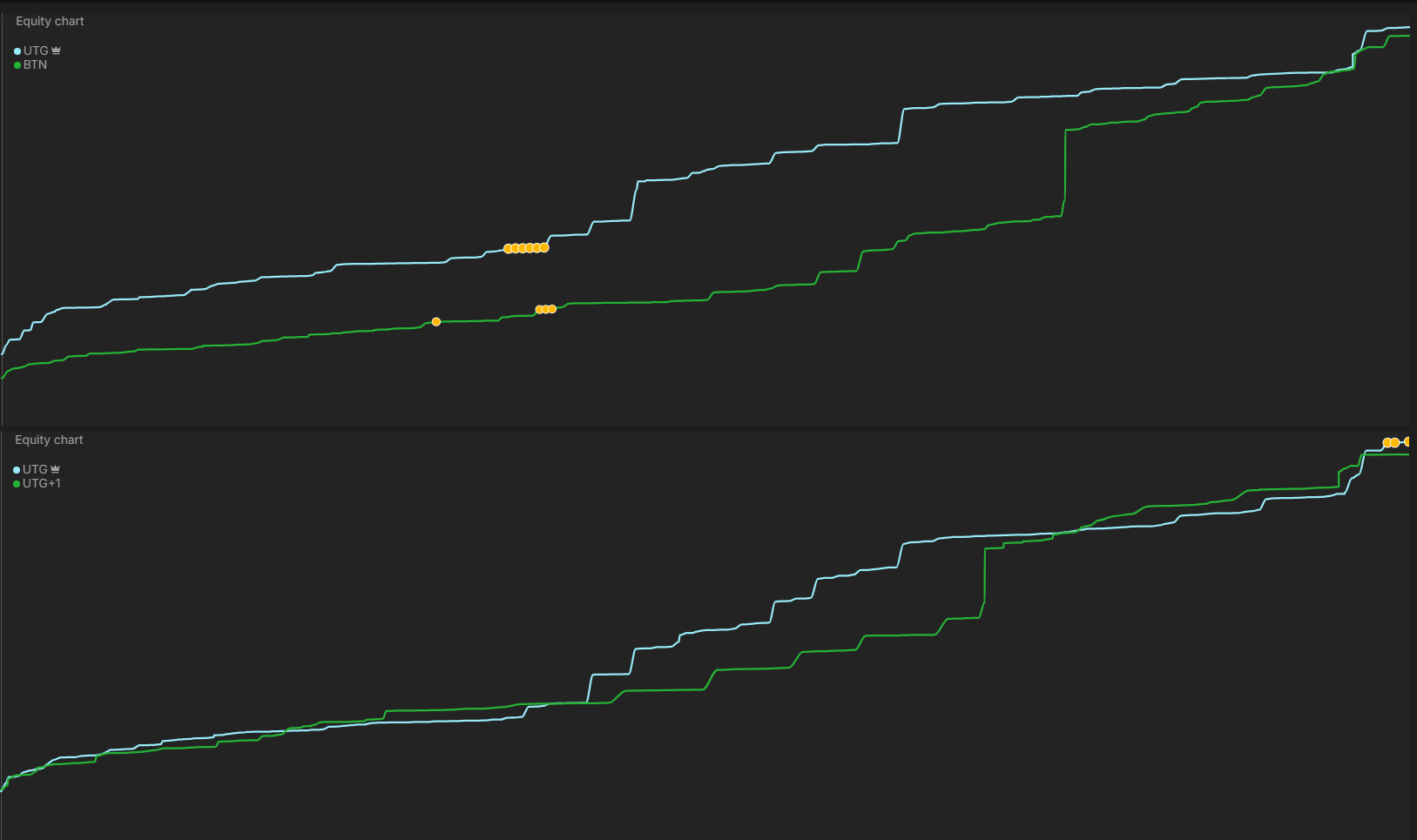
As you can see, there's quite a sizable gap in the top picture, but that is not the case in the bottom picture.
All of this I have seen replicated in Pot Limit Omaha tournaments. Range betting is not a thing in PLO, and position becomes much more important than it does in Hold'em. You will see the same thing replicated in Short Deck Hold'em, another format where equities run close.
This is obviously just the tip of the iceberg in how to adjust in lesser played formats like PLO, but it's a useful starting point.