


When to play for 2nd
Sometimes your better strategy is to let the chip leader do the dirty work and give you an easy second place, says Dara O'Kearney.

A lot of players wilfully ignore ICM and say they would rather ‘play for the win’. ICM gets a bad rap as a strategy for folding your way to a mincash, when in reality it is just a formula we use to make the most money. The players who understand ICM will have the most wins on their records, they’ll just also have the most 2nds, 3rds, 4ths and so on. And most importantly they’ll have the biggest bankrolls, which allows them to win more tournaments.
There are, however, times when ICM advocates a strategy of playing for 2nd place, and that is when there is a chip leader with an enormous chip lead at a final table.
Most people know that when there is a micro stack at the final table the best strategy is to play tight until they bust. The easiness with which you can secure the next payout means you need a monster hand to risk your tournament life.
What most people don’t realise is that when there is a huge chip leader at the final table, ICM also suggests the rest of the table play tight. A lot of people might think the correct strategy is to play loose in order to accumulate more chips to catch up with the chip leader, but that is wrong. The chip leader has 1st place close to locked up, which means the other payouts become more valuable to secure.
Extreme big or small stacks make bubbling more painful
Below is a table from a standard final table which shows each player’s Bubble Factor in relation to another player at the final table. I won’t go into what that means today, but the higher the number, the tighter each player should play against the opponent. Any Bubble Factor over 1.5 means you should tighten up your range considerably compared to the pot odds equity you need. A Bubble Factor of 2 or more requires an extremely strong range, usually AK, QQ+ territory.
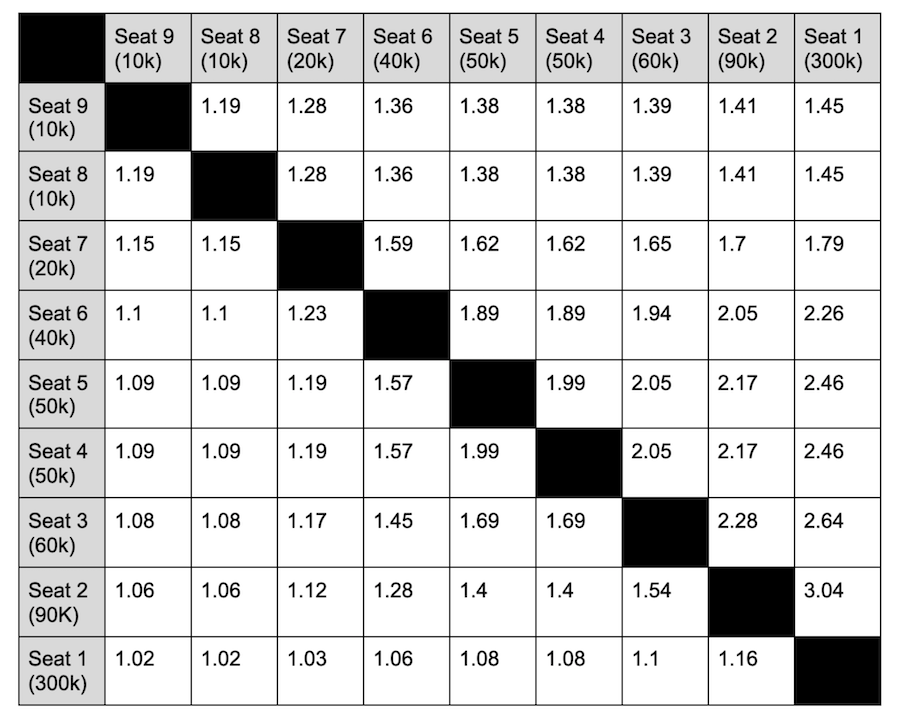
At this table we have a chip leader (Seat 1) with just under half the chips in play. That player doesn’t really have a Bubble Factor but everyone else has a very high Bubble Factor against them, and against each other. The players with the biggest stacks have the highest Bubble Factors against the chip leader. It would be a disaster for anyone else, especially the big stacks, to take on the chip leader when a decent payout is guaranteed.
We have all been in spots like this where we can just wait and let the chip leader bust three or four stacks to secure us a big finish. I recall early in my poker career I made a live final table with one player with an outrageous lead and I was nine of nine, but all the stacks other than the leader’s were close. Everyone else at my final table felt like it was their job to take on the chip leader and I managed to get heads-up without playing a hand. The cherry on the top was the chip leader offered me an even chop despite having a 25-1 chip lead.
There are times to gamble against a big stack with a big stack, but as I wrote in a previous column that is much better when you are on the last two tables when you are not jeopardising too much equity .
It may sound weak advocating a strategy of playing for 2nd, but don’t forget that the tournament carries on when you get heads-up. Securing 2nd place money with a chance to play for 1st but with a big chip disadvantage is a much better strategy than punting away a safe stack against the chip leader with nine players left.
Dara O'Kearney's new book GTO Poker Simplified is out now.
