


Would Chuck Norris play exploitatively?
Roundhouse kick or Game Theory Optimal (GTO) frequencies? lnternet shows you the best way to beat up your opponents.
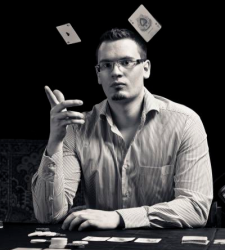 |
| Paul 'lnternet' Otto |
If your opponent bluffs too much, you call him. If he isn't bluffing enough, then you fold against his bets. If he's playing Game Theory Optimal (GTO) frequencies then it's best you don't play against him at all.
In this case you are, at best, breakeven and therefore need to play GTO (Game Theory Optimal) as well. In practice, however, this isn't possible due to the fact that "the rake is no lie".
 lnternet: "If you know how your opponents play, then go play NL5000!"
The problem with the above homage to the exploitative game is that it is often unclear what your opponent is thinking.
In a "busted draw" situation on the river you might assume that your opponent thinks he can't profitably bluff here since the queen on the flop paired.
Your opponent might have a completely different opinion though; he might like bluffing a lot in situations where "nobody bluffs" since he thinks that you will fold your weak bluff catchers and don't have enough queens in your range.
You need to know exactly what patterns exist in your opponent's game to be able to play "exploitatively" with any degree of success. You shouldn't try to guess patterns and then base your play on these guessed assumptions.
The previous maxim applies here: "if you know how your opponents play, then go play NL5000!" This reiterates the idea that we should, perhaps, be more modest when hand reading.
"Sensible" ranges should be preferred to "balanced" ranges
The argument for "balancing" has one big advantage: it is mysterious and nobody really knows how to picture it. That's why you can use it as an explanation for every move you make:
Why did you open raise QTo from UTG? - well, because of balance!
Why didn't you check-raise your flush draw? – well, because of balance!
It can also be a bit more complicated: "Why did you call there with K-High on the River?" – "Well, I have a split range on the turn; therefore I have a top-range hand now and have a frequency call"
Summarised that means "well, because of balance!"
It remains to be seen what we really want to express by using the term "balanced". Most of the time, we don't just call with a flush draw to be "balanced", but to play sensibly. This means that we don't just base our decisions on bold assumptions about our opponent, but assume our opponent is playing sensibly as well.
Therefore he isn't only ever bluffing or value betting in most situations, but has a mix of these options in his game. The interesting point here is that whoever plays more sensibly will win.
"GTO: more Tic Tac Toe than Rock Paper Scissors"
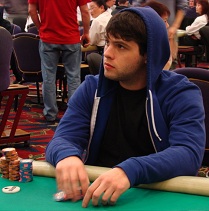 |
| Ben 'Sauce1234' Sulsky |
So far nobody really knows what complete GTO solutions in poker look like. One interesting point here was made by Ben "Sauce1234" Sulsky in his preface to Applications of No Limit Hold'em.
Many people imagine GTO in poker to be like a GTO strategy in Rock Paper Scissors. On the one hand, the strategy is unbeatable; on the other hand, it doesn't win against any other strategy.
That's why it makes sense to imagine a GTO strategy like the perfect strategy for Tic Tac Toe (Noughts & Crosses). If your opponent also plays perfectly, then it will be a draw. If he makes a mistake, however, then he will lose.
If you are interested in studying these concepts in more detail, then have a look at our lesson "Calldown Frequencies" ( Gold+). There are also further lessons in which you can see precisely how an actual GTO strategy works in detail, and how much it costs your opponents to not play sensibly.
To answer the opening question: Chuck Norris would probably stick to the roundhouse kick and therefore collect your stack exploitatively.
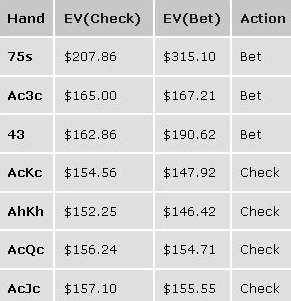 |
| In future lessons you will see what a GTO strategy for every single hand entails! |
