


Column: Are Live Tournament Results Reliable? Part 1
Barry Carter asks whether we can ever truly assess the quality of a player by their live tournament results alone?
Editor's note: This two part series was inspired by a fascinating discussion on the Blondepoker forum.
Whenever non-poker-playing friends watch televised poker, they are usually amazed by the amounts of money on the line. They are completely awestruck that so many players can afford to play in events like this, and assume the players must be living the dream when they win six- and seven-figure prizes.
They are usually pretty disappointed when I tell them that most of what they are seeing isn't real.
Yes the hands really did play out like that, the buy-in really did cost that much and the first prize cheque really was that big - but other than that, live tournament poker is very different to how it is presented to the mainstream.
Bankroll management
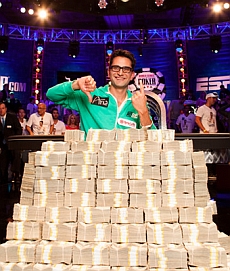 |
| The biggest poker prize of all time |
One of the biggest things I have learned over time in poker is that nobody has anywhere near the amount of money they appear to have. In fact the majority of players you see in the $10,000+ events do not have even close to the bankroll required to conform to the rules of good bankroll management.
It would require at least $1 million a year to play a typical circuit on the major tours (some think even more than that) but only a small portion of the poker community win even close to that amount in a year.
Of course, some people satellite into these events, which is probably the financially soundest way to approach these tournaments. Then of course there are the lucky few who are sponsored to play in these events.
As we all know but the mainstream public does not, most professionals are staked, or have sold action to play in these events. Staking goes largely unmentioned in poker marketing, but I'd hazard a guess that the vast majority of serious tournament players do it.
If you look at any major final table result, the chances are that the true payouts were vastly different to what was recorded. Antonio Esfandiari admitted he was backed for his $18,346,673 One Drop win, as did Greg Merson in his $8,531,853 Main Event win.
We have no idea what they actually won in these events, but the records will only ever show the 'official' amounts.
Long-term losers?
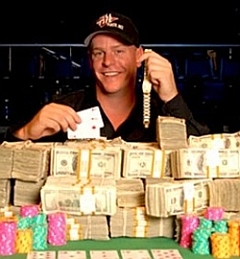 |
| E-Dog is not the big winner TV makes him seem |
Not only are a large portion of these tournament fields staked, many of them are deep in makeup. In other words, they are backed and currently losing, so they need to win a certain amount before they even break even with their backer.
A lot of big tournament wins we see actually don't even get a player out of makeup, which is quite disappointing from a fan's perspective - many of our poker heroes won't be retiring early with their winnings.
Then there is the other side, one which I am glad the wider public do not see: the shady side of staking and loaning money.
Sadly, there is a small section of the poker community that borrows money and tries to avoid paying it back, losing their backers' money gambling on house games or outside the terms of their agreement. Some just out-and-out scam other players.
Unfortunately, a lot of the players we see winning major events on TV are actually freerolling on someone else's money in games they should never have been playing.
Players like David 'Chino' Rheem, Erik Lindgren, and of course the likes of Howard Lederer and Chris Ferguson, all appear to be the stars of the game on television when they are anything but in the poker community.
Profit vs turnover
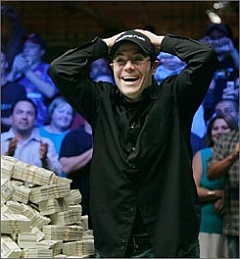 |
| The biggest main event win ever |
Online poker is incredibly easy to track and thus get an accurate picture of results; live tournament poker is the polar opposite and the best tool we have for collecting live poker results is also one of the most flawed.
The Hendon Mob has a long-standing results database with the results of every recorded tournament from the last 42 years. It is where we get our all time money rankings from, and the first place we go to check out the previous results of a player.
However, the Hendon Mob database has one severe leak: it only collates winning results.
This is what is called a selection bias; we only ever see positive results that affirm a player's success, and never any of the tournaments where they busted before the money.
We never see profit, we only see turnover. Anyone who plays enough big tournaments is going to make a six-figure score at some point even if it costs them seven-figures do it.
That goes overlooked on the Hendon Mob database.
For example, right now Tom Dwan has $80,000 in recorded winnings in 2012. A drop in the ocean for Dwan, but a respectable amount of money for the average player. Unfortunately, Dwan played in the $1 million buy-in One Drop event this year, meaning we now know he is actually down at least $920,000 in tournaments for the year, and most likely a lot more given his penchant for high rollers. This is not recorded on his Hendon Mob database entry.
One thing we never see mentioned in the mainstream portrayal of poker (and in fairness rarely within the poker media either) is the crippling cost of travel expenses. Playing the poker circuit racks up a lot of travel expenses, especially for players who like the finer things in life like luxury hotels and first class flights.
A player who can only beat the rake in live tournament poker will ultimately be a loser when you account for the costs in getting there.
Join us later on this week for part 2 of this discussion.
