


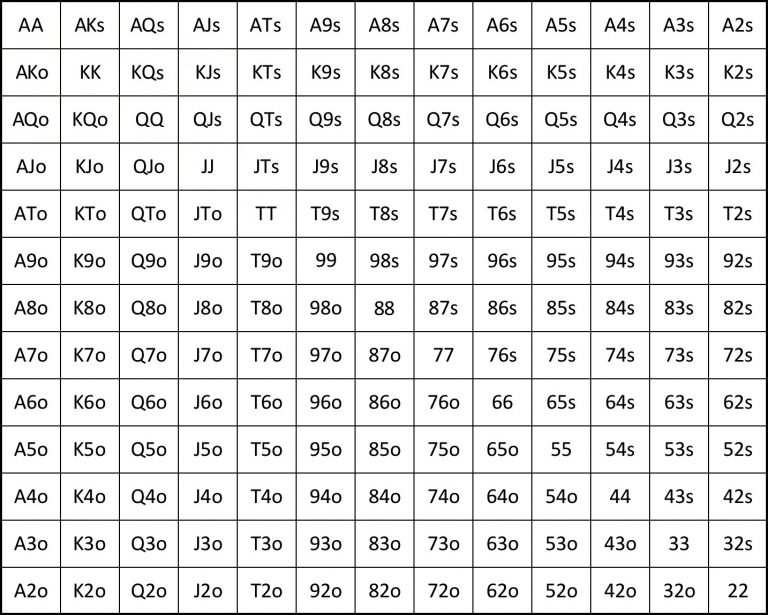
All 169 starting hands in The Grid with Jennifer Shahade
We chat to the PokerStars Pro about her new podcast where each episode she discusses a different starting hand with a top player.

What made you come up with this interesting idea for a poker podcast?
Jennifer Shahade: The idea came to me suddenly but maybe it was a build-up of previous ideas I’ve had. As soon I came up with the idea my husband (who is the producer) and I decided we had to do it. I had seen the great poker writer Pauly McGuire write about Kerstin von Gabain, an artistwho was in China, and started to create a full deck of cards by taking pictures of abandoned cards on the street, I was really intrigued by this kind of scavenger hunt.
There are 169 card combinations, how long do you think this ‘scavenger hunt’ will take to complete?
Jennifer Shahade: We’ve been doing one every week since June, we are already at 10 and have another three in the can. After a while it will be harder to do one a week because of the production task of finding the hands will be more challenging. So I’d say maybe three and a half to four years to complete.
Everyone has a story they can tell with Aces or bluffing with 7-2, how are you going to decide who gets the special hands like Aces or Queens which have more meaning to people?
Jennifer Shahade: Jamie Kerstetter already took Aces right out of the gate, which was a great story. I don’t want to do all the biggest hands first because I want there to be a feeling of randomness to the podcast. They have to be a really good hand or really good story for me to give a guest a premium hand, and I try to encourage my guests to pick out weaker hands for their story.
The easiest hand for a story is Ace King, because in many cases it’s a fantastic bluffing hand because of blockers and it’s often a really difficult spot for value if you are deep enough. It can go both ways and everyone has a great Ace King story.
"Weird hands are a badge of honour"
What is your strategy for getting guests for the random rag hands a lot of people rarely have in their range like J-3 offsuit or Q-2 suited?
Jennifer Shahade: When I announced the podcast I asked people to reserve the weaker hands and I have around 40 cells on my spreadsheet filled out for guests with those hands. I have people for J-2 offsuit and J-5 offsuit already, for example. The really strong players have already prepared weird hands because it’s like a badge of honour. My first guest Lex Veldhuis picked K-4 offsuit and Kevin Rabichow picked 10-5 offsuit. Believe it or not the first hand where two potential guests both had stories was 10-5 offsuit, as Alex Livingston (who just came third in the Main Event) had this epic Twitter thread about how he punted it off in his first Main Event.
It’s unusual to have a podcast with a defined end, have you thought about what will happen beyond this show if you enjoy doing it? PLO hands maybe?
Jennifer Shahade: I don’t think there is enough time in the world for PLO hands. That’s what beautiful about the No Limit format, you can really story tell in a way that somebody listening to the show and doing something else like working out can still follow along.
I love podcasting and having conversations, by the end of it I’ll probably take a break and try and have another idea that doesn’t copy it directly.
"I'm interested in effective study"
I’ve often felt that the best way to learn poker is just to discuss difficult spots with good players. This podcast really speaks to that idea, do you think discussion is the best way to learn and you will come out of this show as a better player?
Jennifer Shahade: I definitely think I’ll come out of it a better player after speaking to all these players, though some of the discussions are not strategic.
I don’t think talking about poker with friends is the best way to learn. It’s a good way to see population tendencies and have fun in this game we love, but as a busy mother involved with chess and other projects, I’m becoming more interested in how to study more effectively, how to get the most value per minute. Working on ranges and strategy for different positions and stack sizes is probably number one. After that maybe working on retaining that information, either by pattern recognition or memory.
It’s probably a selection bias I have as an interviewer that makes me think hand discussions are the best way to learn. The one commonality among almost every elite player I’ve interviewed is how enthusiastically they discuss poker with their peers.
Jennifer Shahade: Absolutely, and with each hand history you have the specific which ties in with the more general strategy where instead of looking at one point on the grid you are looking at your whole range. I find the Grid is more of a release for me from the tactical analysis of one hand. For me sometimes hand histories play a role in poor mental game, and I have been guilty of this, where they get super obsessive spinning their wheels about spots where maybe they got it wrong, when a lot of the time it’s actually really close and they should have spent more time working on their overall strategy. The Grid has given me a greater understanding of that obsessiveness which is both indicative of a strong player but also a dangerous rabbit hole.
Learn more about The Grid and subscribe via Apple podcasts.
What was your most memorable hand? Tell us about it in the comments:
