


Is this collusion?
Four players agreed to go all-in blind at the start of a tournament. Is that harmless fun or a breach of the rules?
Legendary tournament director Matt Savage posted an interesting poll today about a tournament in Texas.
Should players in a tournament be allowed to agree to shove all-in blind preflop?
— Matt Savage (@SavagePoker) August 15, 2024
The cliff notes are that four players agreed to go all-in blind on the very first hand. Savage didn't comment but posted the poll which suggested that the argument against it was that it was a form of collusion.
Collusion in poker is when two or more players work together to influence the outcome of a poker game. The most common form of collusion is signalling to each other about the strength of their hands. Other forms include soft play (not playing hands aggressively against a friend) or chip dumping (purposely losing chips to a friend).
Who does it hurt?
Four players agreeing to go all-in blind in a tournament is collusion because the action impacts players not involved in the hand. We can demonstrate this with the new ICM calculator GTO Wizard.
These are the ICM values at the start of a $109 MTT with 150 players. Not all players are visible because it is quite clear they all have the same ICM value, which is $103.81 (the buy-in minus the rake).

Now let's look at the ICM values when four players go all-in blind. I've removed three bust-outs from the player pool, so 147 players in this example, and given the winner of the hand four starting stacks:

The winner has not quadrupled their equity, their stack is only worth $378.73, not $415.24. Where has the remaining $36.51 gone that was lost by the eliminated players? It has gone to all the other players, who have each seen an equity boost of $0.25. This is ICM in a nutshell, you always gain less equity than you risk in tournaments. The other players benefit from bust-outs because of the payout structure.
A bad precedent to set
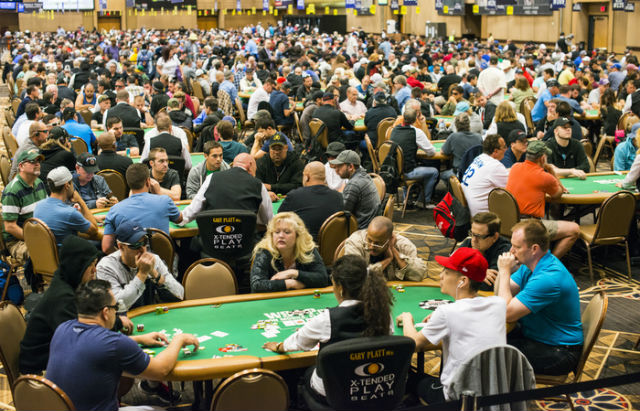
So this is collusion, but a weird form of collusion where those who collude do not benefit. The four players who go all-in blind are recklessly gambling and they do not gain the EV they would want for such a gamble. The real benefactors of the hand are all the other players, who get a minor equity boost at zero risk.
I remember a time when players could run between tables during the bubble of live satellites and canny players who back to their table and announce somebody only had 1bb left on another table, and if we all folded our hands we would be guaranteed a seat. This is another form of collusion that at first glance seems very similar to the example above, in that it is a whole table agreeing to do something, but it is also clearly wrong. Doing this deprives the short stacked player on the other table of a fair chance of outlasting somebody on another table. This is why most TDs make the players remain seated during hand-for-hand.
With that in mind, should this be allowed? I still say no. While the only people who are harmed are the ones who agree to go all-in blind, there is an important precedent we do not want to set here. If players can agree amongst themselves to take a certain action when other players remaining in the tournament are not involved, this could be pushed further at times when it is not so clear-cut that it only harms those who do it.
Should this be allowed? Let us know in the comments:
