Nobody truly understands variance in poker
Barry Carter thinks we are not built to handle variance in poker and that the only way we can appreciate it is by putting in a lot of volume online.
I had a conversation with someone recently where they were complaining that during a live poker festival they played five tournaments and bricked every single one of them. In each instance, they lost with a flip or they had the best hand when the money went in.
In a separate conversation with somebody else, they were bemoaning their bad luck online, during which they revealed that they only played one table at a time on their iPad.
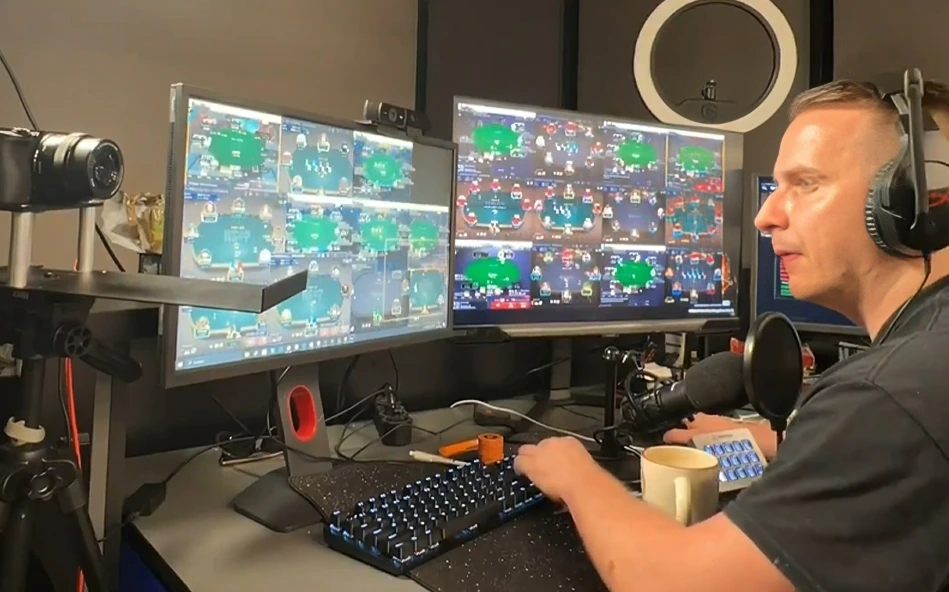
When you play a lot of volume online, it gets really hard to take complaints like this seriously.
As somebody who has spent a lot of time looking at tournament variance calculators, I advise everyone to do the same. What they show us is that profitable players can go for incredibly long stretches where nothing goes their way. I remember once being very struck by the sharkscope graph of one of the best online players in the world. I forget which player it was but I didn't forget that this particular player went 69 (giggity) tournaments in a row without cashing.
Perhaps even more important, variance calculators show that nobody really will run in accordance with their actual ability in live poker. Nobody will ever get in a big enough sample size of live tournaments to realise their actual edge. There will be excellent live players who never have a landmark victory, and there will be terrible live players who manage to make it as a live professional without ever realising they are technically a losing player in terms of ability.
Everyone is on a downswing
I've thought about it a lot recently, and I think the best thing any poker player can do to get to grips with variance is to put in a lot of volume playing a lot of tables online. Even if they are not an online player or a high volume player.
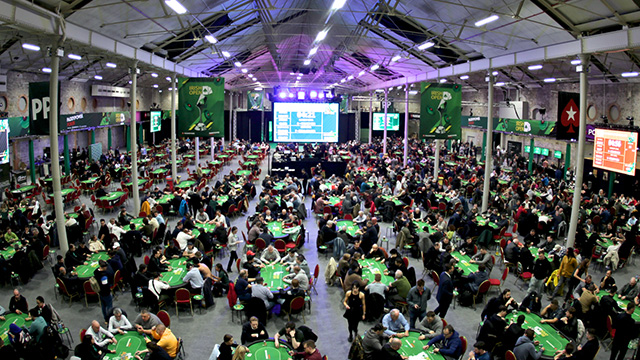
I recently got back from the Irish Open, where I had a terrible festival, which included one of the worst but funniest coolers of my live poker life. As I left the table, desperately looking for somebody I knew to tell my bad beat story to, I noticed that the only thing I could hear in the Royal Dublin Society was essentially a collective bad beat story being told by hundreds of poker players no longer in the tournament.
It reminded me of something that Tombos21 recently shared about how the majority of the players in a tournament run below expectation, because that's actually the nature of tournaments. We always think we're the only ones in poker when we are running bad, but the opposite is actually true.
When my Irish Open concluded, as gutted as I was that it had gone so badly, I put it into context by comparing it to a typical online session. I played six tournaments in Dublin, and I would say that three of my exits were bad beats, two were coin flips and one was a big mistake on my part. Certainly something I might feel I have the right to complain about, but not when I look at it in comparison to one of my online Sunday sessions.
Volume is the only fix

That run of results could have easily been my first 30 minutes in an online Sunday session, something I almost certainly would have forgotten about a few hours in. Indeed, one of the real benefits of increasing volume, and in particular the number of tables that you play, is that you stop placing too much importance on any single one of them.
I was playing a few weeks ago, and somebody I know sent me a private message where they apologised for dishing out an incredible cooler to me. I replied back simply saying that I had absolutely no idea what they were talking about. I clearly did incur a terrible cooler, but because I had eight more tables to worry about, it was quickly dismissed and forgotten. If this cooler had been in live poker, I would have been telling the story for months.
One of the things that makes live poker so tough is that we simply can't do that like we can online. Not only have we travelled to get to this event, but when we are out of the tournament, often it's hard to jump into another one. So all that is left is time for us to ruminate on what has happened.
There's not much we can do about that. Live poker will always be unfair and frustrating for most people. But I still believe that putting in a lot of volume and playing a lot of tables online is the way to deal with these things.
You get to see the extremities of variance manifest, sometimes very quickly. I will play more tournaments in a Sunday session online than a lot of live poker players will play in a year. I can't promise that it would make downswings feel any better, but you will be able to put them into context much more easily.