


Super/System and the Early Advancements in Poker Strategy
We have another sample chapter from The 50 Greatest Stories in Poker History by Marton Magyar,
Today, poker strategy has been spelled out in any number of books, computer programs, poker forums, seminars, and chat rooms. Top universities have even held classes on the subject; for example, MIT ran a Poker Theory course in 2015. In addition, poker has been an important part of game theory, a branch of mathematics, for decades.
However, this wasn’t always the case. There was a time when poker, just like any card game, was considered nothing more than senseless, even sinful, gambling. As we’ve seen, the earliest poker players were less concerned with strategy than cheating their opponents.
Thus, poker was branded as the “cheater’s game” in the mind of the American public. Luckily, this view changed over the years. Partly thanks to the establishment of the World Series of Poker, by the 1970s, the public, by and large, understood that there’s a method to the madness that is poker. Tournament winners started to be celebrated as masters of a game of probability and psychology. Poker strategy books began to appear. Publishers realized that a lot of people wanted to learn how to win money in America’s favorite card game.
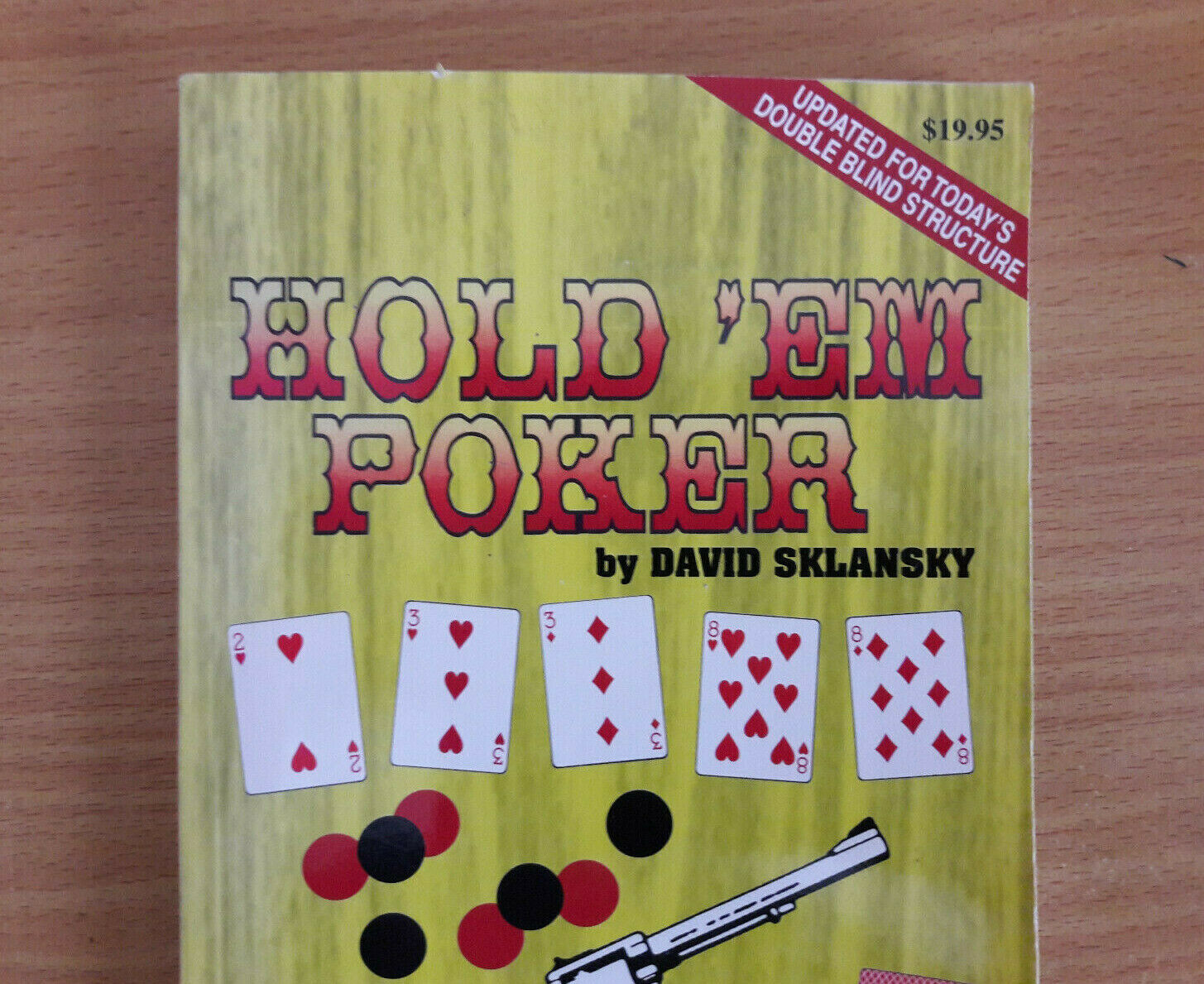
One of the first publications of this sort was Hold ’Em Poker by David Sklansky. It came out in 1976. Sklansky dropped out of the University of Pennsylvania. Later, however, he took multiple exams with the Society of Actuaries, so he does have formal qualifications in statistics. After completing his studies, he became the math expert on card games, such as different types of poker and blackjack. Sklansky is credited with the invention of the preliminary version of the card matrix, the visual representation of all possible starting hands in hold ’em that so many people use today.
Despite his trailblazing work, Sklansky didn’t have the first real bestseller on poker strategy. This might be because he lacked name recognition. He went on to win three WSOP gold bracelets, an undeniably major achievement. However, he won his first bracelet in 1982 (in the $1,000 Draw High event), six years after his book came out.
The game's first celebrity
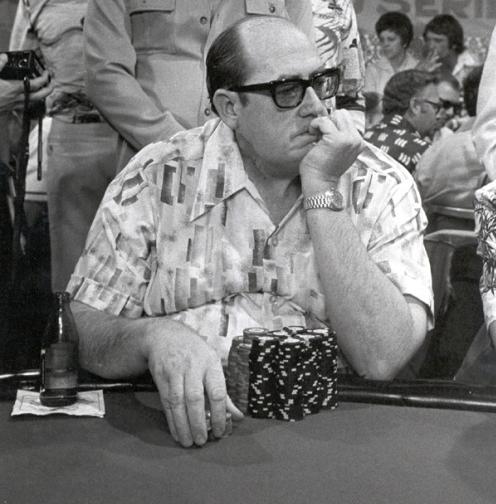
Doyle Brunson, on the other hand, was one of the game’s first celebrities. He won the WSOP Main Event in 1976 and 1977 and had added three additional gold bracelets to his resumé by the time he took up writing. He was also a well-respected older member of the poker community. He’s often called “the Godfather of Poker” for his role in popularizing Texas hold ’em.
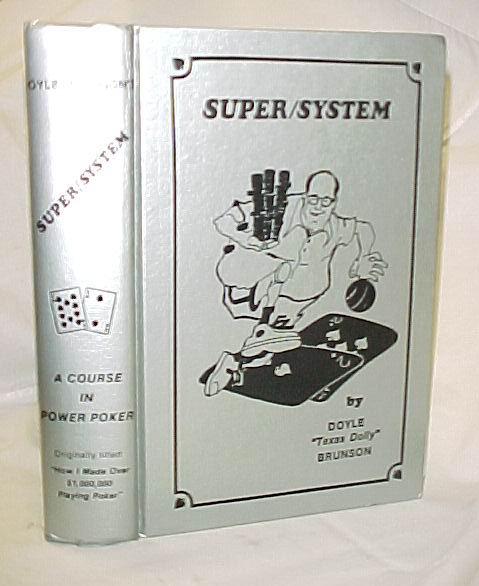
Brunson released his strategy book, originally titled How I Made Over $1,000,000 Playing Poker, in 1979. It’s been published under a number of alternative titles. For the past few decades, his work is most commonly referred to as Super/System. It has some guest writers, such as Chip Reese and Bobby Baldwin, contributing chapters on certain game types, as well.
In the book, Brunson’s approach to strategy is closer to the old-school mostly experience-based style—“street smart poker,” as some call it—than to the modern math-based game-theory approach. In the very first paragraph, Brunson stresses, “Poker is a game of people. That’s the most important lesson you should learn from my book.” He later clarifies that he believes that: “Poker is more art than science. Knowing what to do, the science, is 10% of the game. Knowing how to do it, the art, is the other 90%.”
That said, the book aptly covers the fundamentals of poker probability. Brunson talks about how the hold’ em hand ranking is based on the odds of certain hands being dealt, information that might be new to some casual recreational players even today. He also covers basic “pot odds” and “implied odds.”
It's influence cannot be over stated
However, he also talks with sincerity and at length about the intangible elements of the game. He devotes a chapter to extra sensory perception, something you’d have a hard time finding in modern poker strategy books.
Another detail that rings odd for a present day reader of Super/System is that 4th and 5th streets in hold ’em are never called “turn” and “river.” In fact, Brunson writes that the word “turn,” along with “fall,” is a synonym for the flop.
After the release of Super/System, a whole slew of other strategy books started appearing on the market. They became especially numerous in the mid-2000s, following Chris Moneymaker’s celebrated WSOP Championship in 2003 (covered in an upcoming chapter).
Brunson’s book was updated and published as Super/System 2 in 2005. While the author claims that he spent more money on producing it than he got paid for it, its influence as the earliest poker strategy bestseller cannot be overstated.
This is an excerpt from The 50 Greatest Stories in Poker History by Marton Magyar, available now from Huntington Press.
