


Was this 11 way chop a bad deal?
$84,633 awaited the champion but 11 players decided to deal for $26,058 each - we review the deal in the RunGood Poker Series.
Deals happen most of the time in live poker tournamens, but usually with around 3-5 players left. 11 players in the $575 RunGood Poker Series Main Event decided to break with convention and chop before the final table.
851 entries made it to the event and the first prize was officially $84,633, but the 11 finalists decided to chop it up for $26,048 and play on for the title and a seat in a Pro-AM event later this year.
One player had 7 big blinds and another had almost 60, so was this a good deal?
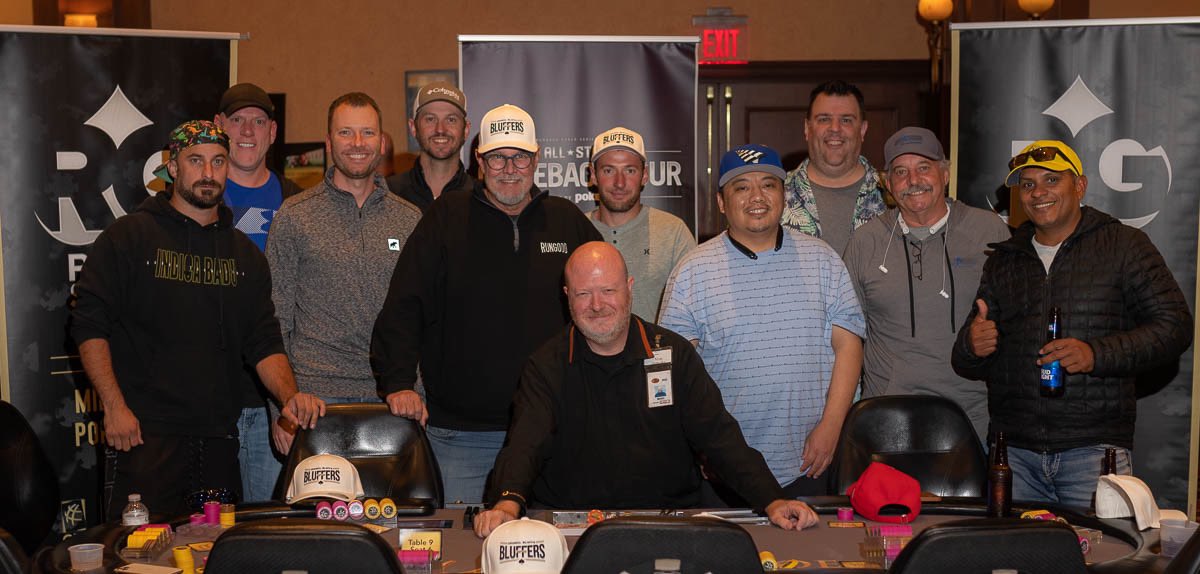
Was this a bad deal?
As luck would have it, this writer is currently working on a book where we discuss deal making in detail, so I decided to have a look at who gained the most from the deal.
Below I have put together a table with the chips, as reported by PokerNews, just before the deal was done, the official payout had that player maintained their position and the ICM value of their stack, which I got from ICMIZER. Most final table deals end by paying out the players based on ICM.
With $85k to the winner, most people would assume that the chip leader has something like $50k equity with 11 players left. Kyle Hinnerichs actually only had $36,849.09 in equity. Most would assume the short stacks only had close to their mincash amount of $6,480, but they actually had at least $18,679 in equity.
In fact with 11 players left, and crucially, quite tightly bunched together stacks, everyone actually had equity close to the $26,048 that they dealt for. Jon Stanfield gained the most, $7,369 to be precise. Hinnerichs lost the most, they gave up $10,801 in equity to secure the pay day.
The deal was not quite as horrendous as it seems, the three biggest stacks were very close to each other and did not hold a commanding lead over the next four players. Anything could have happened with 11 players left (indeed the 9th lowest player in chips Freeman Kauffman went on to win the trophy and seat) and this was a way to reduce variance. For $575 buy-in, a $26,048 prize is still more than most 1st prizes for MTTs of that level.
| Position | Player | Chips | Potential Prize | ICM Value |
|---|---|---|---|---|
| 1 | Kyle Hinnerichs | 2,780,000 | $84,633 | $36,849.09 |
| 2 | Steve Vang | 2,605,000 | $52,298 | $35,611.92 |
| 3 | Brantley Grace | 2,250,000 | $38,523 | $32,923.60 |
| 4 | Bhaskar Setti | 1,750,000 | $28,749 | $28,654.74 |
| 5 | Ron Koenemann | 1,475,000 | $21,735 | $26,013.17 |
| 6 | Matt Morfitt | 1,400,000 | $16,644 | $25,250.44 |
| 7 | Ryan Fetherkile | 1,380,000 | $12,907 | $25,043.75 |
| 8 | Paul Strohm | 875,000 | $10,134 | $19,308.01 |
| 9 | Freeman Kauffman | 875,000 | $8,055 | $19,308.01 |
| 10 | Timothy Sciscoe | 850,000 | $6,480 | $18,995.41 |
| 11 | Jon Stanfield | 825,000 | $6,480 | $18,679.86 |
I'm not saying it was a good deal, other than the fact that any deal is good if the participants are happy, it's a bad deal. It's a bad deal for the three chip leaders and splitting it up by ICM would have clearly been the better approach and likely would have made most parties happy. The chip leaders tend to give up equity in a non-ICM deal but I think they have given up too much here. The short stacks got a really good deal and must have been the ones arguing for an 11 way chop with equal payouts.
It is an interesting example because it highlights a key misunderstanding about ICM and that is the big stacks tend to get overvalued and short stacks undervalued. I think most players who have not studied this would think the chip leader was worth more than $36k and the short stack much less than almost $19k.
What is eye catching about this story is the fact that the players chose to deal before the final table, and didn't take chips into account when splitting up the prizes. Clearly somebody was a very smooth talker amongst these 11 to get such a good deal for the shorties.
Thoughts on the deal? Let us know in the comments:
