Ga naar het forum
Column: Are Live To...
 
Meldingen
Alles wissen

Column: Are Live Tournament Results Reliable?

9 Berichten
7 Gebruikers
0 Reacties
4,791 Weergaven
Hoofdbeheerder
Lanfear81
Lid sinds: 04.11.2007
Oldschool Grinder

Barry Carter asks whether we can ever truly assess the quality of a player by their live tournament results alone?

Editor's note: This two part series was inspired by a fascinating discussion on the Blondepoker forum.

Whenever non-poker-playing friends watch televised poker, they are usually amazed by the amounts of money on the line. They are completely awestruck that so many players can afford to play in events like this, and assume the players must be living the dream when they win six- and seven-figure prizes.
 
They are usually pretty disappointed when I tell them that most of what they are seeing isn't real.

Yes the hands really did play out like that, the buy-in really did cost that much and the first prize cheque really was that big - but other than that, live tournament poker is very different to how it is presented to the mainstream.

Bankroll management
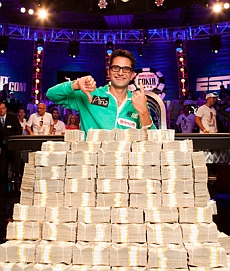
http://resources.pokerstrategy.com/2012/11/15/Antonio_Esfandiari_one_drop.jpg
The biggest poker
prize of all time

One of the biggest things I have learned over time in poker is that nobody has anywhere near the amount of money they appear to have. In fact the majority of players you see in the $10,000+ events do not have even close to the bankroll required to conform to the rules of good bankroll management.

It would require at least $1 million a year to play a typical circuit on the major tours (some think even more than that) but only a small portion of the poker community win even close to that amount in a year.

Of course, some people satellite into these events, which is probably the financially soundest way to approach these tournaments. Then of course there are the lucky few who are sponsored to play in these events.

As we all know but the mainstream public does not, most professionals are staked, or have sold action to play in these events. Staking goes largely unmentioned in poker marketing, but I'd hazard a guess that the vast majority of serious tournament players do it.

If you look at any major final table result, the chances are that the true payouts were vastly different to what was recorded. Antonio Esfandiari admitted he was backed for his $18,346,673 One Drop win, as did Greg Merson in his $8,531,853 Main Event win.

We have no idea what they actually won in these events, but the records will only ever show the 'official' amounts.

Long-term losers?

http://resources.pokerstrategy.com/2012/11/15/erick-lindgren.jpg
E-Dog is not the big
winner TV makes him seem

Not only are a large portion of these tournament fields staked, many of them are deep in makeup. In other words, they are backed and currently losing, so they need to win a certain amount before they even break even with their backer.

A lot of big tournament wins we see actually don't even get a player out of makeup, which is quite disappointing from a fan's perspective - many of our poker heroes won't be retiring early with their winnings.

Then there is the other side, one which I am glad the wider public do not see: the shady side of staking and loaning money.

Sadly, there is a small section of the poker community that borrows money and tries to avoid paying it back, losing their backers' money gambling on house games or outside the terms of their agreement. Some just out-and-out scam other players.

Unfortunately, a lot of the players we see winning major events on TV are actually freerolling on someone else's money in games they should never have been playing.

Players like David 'Chino' Rheem, Erik Lindgren, and of course the likes of Howard Lederer and Chris Ferguson, all appear to be the stars of the game on television when they are anything but in the poker community. 

Profit vs turnover

http://resources.pokerstrategy.com/2012/11/15/jamiegold.jpg
The biggest main event
win ever

Online poker is incredibly easy to track and thus get an accurate picture of results; live tournament poker is the polar opposite and the best tool we have for collecting live poker results is also one of the most flawed.

The Hendon Mob has a long-standing results database with the results of every recorded tournament from the last 42 years. It is where we get our all time money rankings from, and the first place we go to check out the previous results of a player.

However, the Hendon Mob database has one severe leak: it only collates winning results.

This is what is called a selection bias; we only ever see positive results that affirm a player's success, and never any of the tournaments where they busted before the money.

We never see profit, we only see turnover. Anyone who plays enough big tournaments is going to make a six-figure score at some point even if it costs them seven-figures do it.

That goes overlooked on the Hendon Mob database.

For example, right now Tom Dwan has $80,000 in recorded winnings in 2012. A drop in the ocean for Dwan, but a respectable amount of money for the average player. Unfortunately, Dwan played in the $1 million buy-in One Drop event this year, meaning we now know he is actually down at least $920,000 in tournaments for the year, and most likely a lot more given his penchant for high rollers. This is not recorded on his Hendon Mob database entry.

One thing we never see mentioned in the mainstream portrayal of poker (and in fairness rarely within the poker media either) is the crippling cost of travel expenses. Playing the poker circuit racks up a lot of travel expenses, especially for players who like the finer things in life like luxury hotels and first class flights.

A player who can only beat the rake in live tournament poker will ultimately be a loser when you account for the costs in getting there.

Join us later on this week for part 2 of this discussion.

By Barry Carter l Barry Carter on Twitter


Beantwoorden
Citeren
8 reacties
Wolfske
Lid sinds: 24.02.2009
Poker Player

nice, dit vroeg ik me al een tijdje af eigenlijk. Ik vraag me eigenlijk wel af welke spelers op die events nu eigenlijk wel winstgevend spelen .. dat kunnen er eigenlijk niet zo heel veel zijn ..


Beantwoorden
Citeren

Een aantal zullen zeker wel goed verdienen, zeker ook aan de sponsoring. Het beste voorbeeld lijkt me Daniel Negreanu die kwaliteit met poker koppelt aan een goed imago op televisie.
De kosten voor hotels en dergelijke vind ik er niet toe doen. Dit kun je zo duur maken zoals je zelf wilt. Je huis kost ook elke maand geld net zoals het reizen dat kost. Je krijgt er wel een fantastische ervaring voor terug elke keer. :)


Beantwoorden
Citeren

elke week reizen naar toernooien, hotel overnachtingen + eten. is flink duurder dan je huur + boodschappen per maand.

Natuurlijk kan je het zo goedkoop maken als je wil. Maar ga jij nou echt in één of andere crappy $20 motel slapen wanneer je in toernooien van duizenden dollars speelt. En het is onwaarschijnlijk dat je elke dag gaat (kan) koken zoals thuis sinds je zo ongestructureerd leeft. Na een vlucht/toernooi van 10 uur denk ik nooit.. laat ik maar is even boodschappen gaan doen en koken. :D Dus aan eten zal je ook aardig wat uitgeven.

Tenzij je elke dag pizza, shoarma etc wil eten.


Beantwoorden
Citeren
Lanfear81 Topicstarter
Hoofdbeheerder
Lanfear81
Lid sinds: 04.11.2007
Oldschool Grinder

Barry Carter continues his discussion about whether we can ever truly assess the quality of a player by their live tournament results alone?

In the first part of his discussion about whether or not live tournament results are a reliable example of skill, Barry Carter discussed staking, scandals and results databases. Today he is back discussing the role of variance in live poker.

Editor's note: These two columns were inspired by a fascinating discussion on the Blondepoker forum.

Sample size

http://resources.pokerstrategy.com/2012/11/15/doyle-brunson-36-114.jpg
Has Doyle got a big
enough sample yet?

The great thing about online poker in comparison to live poker is the sheer amount of volume you can put in.

In a few months, you can play as many hands online as Doyle Brunson has done in a lifetime and get a decent picture of whether you are profitable as a player.

The same cannot be said for live tournaments - in fact you would need one or maybe two Doyle Brunsons worth of years on the live circuit to come even close to assessing whether you were a winning player.

There are simply not enough events on the circuit, or indeed days in a year, for live poker tournament results to ever truly accurately reflect how good a player is.

This excellent blog from NoahSD highlights how solid winning tournament players can still end up losing over a sample of tournaments in their thousands before the luck evens out.

A live cash game player can easily accrue a big enough sample to prove he is a winner. This is because the sampling is based on number of hands but most importantly because you can find a live cash game to sit in at any given time.

The same is not true for tournament players, where the sampling is based on tournaments played. The variance is also much, much higher in tournaments, meaning you need a bigger sample than in cash games in the first place.

Most significantly, there are never enough games running to attain a good sample size. Days will be wasted travelling to tournaments, there will only be a small number of events on offer when you get there, and you could bust them all in the first hand - then you have to travel again before you can play another tournament.

The survivor bias

http://resources.pokerstrategy.com/2012/11/15/jerry_yang_2007_wsop.jpg
Is Jerry Yang one of
the best in the world?

This means that a truly great tournament player could go the rest of their career without ever making a significant profit.

Perhaps most notably in the context of this discussion, it also suggests that a large number of our biggest names might actually just be running extremely well.

We all know that Jamie Gold and Jerry Yang will probably end their careers as some of the biggest winners in the game despite not necessarily even being close to the best, but maybe a lot of the players we idolise are just as lucky?

There is an excellent book by Nassim Taleb called Fooled By Randomness, wherein he asks of some of the most successful entrepreneurs and traders in the world: "what if they were just lucky?"

The same could be true in poker. We could have what is called a survivor bias, where we wrongly try to learn from and give respect to someone who has survived due to good fortune.

In poker terms, an extreme example would be the idea of what would happen if the only people who entered the WSOP were complete amateurs?

Despite the odds of any one of them winning it being very slim, one eventually would, and we might therefore wrongly assume they were a talented player because they had just won $8 million and the world title.

I have a theory that everyone reading this column (or anyone who takes a serious interest in poker), is on the right end of a survivor bias already. Nobody likes to lose, so I cannot help but think that anyone who is still playing poker after the first year probably ran incredibly well in that first year. Otherwise we would not have had the motivation to keep on playing and learning the game.

Respect

http://resources.pokerstrategy.com/2012/11/15/GregMersonWSOP.jpg
Merson has the money
and the respect

Back to the WSOP and this year's champion Greg Merson is currently being heralded as an incredible talent. The difference is that he is getting a lot of praise not just for winning the Main Event and Player of the Year title, but for the manner in which he won it.

The live stream showed how good a player he was, not the result, and the classy way in which he played and conducted himself at the final is perhaps a much more lasting accolade than the money and the title.

The same can be said for all the players who have the universal respect of the poker community. Phil Ivey, for example, is considered by many to be the best in the world. His live tournament results are clearly exceptional, but it is what he does when we see him at the table and the respect he commands from other well respected players that puts him in so many of those 'best of' lists.

Live poker tournaments are my favourite part of the game as a player and as a writer. They are the engine for which most poker marketing is driven.

I don't want to get down on poker tournaments or ruin the image of one of your heroes. I just want to note that there are much better ways to measure success, ability and integrity in poker than the number of flags on your Hendon Mob database.

By Barry Carter l Barry Carter on Twitter


Beantwoorden
Citeren

I do not totally agree on this one... the thing with live poker is that you can have tells based on someone's behaviour. Something you do not have in online poker (even with a HUD). Therefore you can not compare these tournaments with online tournaments.


Beantwoorden
Citeren

Tells are bogus.

The absence of a HUD and the fact that you are forced to 1 table does make a difference in how well you play, however.


Beantwoorden
Citeren

And endurance? It is much easier to beat a turbo tournament then a live tournament which takes days


Beantwoorden
Citeren

Oorspronkelijk gepost door xXShinryuuXx
Tells are bogus.

Nooit live gespeeld neem ik aan.
Of daarbij niet opgelet.


Beantwoorden
Citeren