


Five reasons you can't beat low stakes
These five mistakes could be preventing you from making a profit in the small stakes games.
Trying to grind too many hands
If you frequent a lot of poker websites, you may agree that many of them feel like a "grinding cult". Much of their learning content either targets grinders directly or actively promotes high volume play.
However, many of you are not grinders and may never become one. There are different reasons for that. For example, poker is just a hobby. In that case don't try to squeeze as many hands as possible into what limited time you have at the tables. Just don't play too many tables at once or try to fast fold every junk hand in Zoom Poker.
Every hand has a meaning. Let it flow through you. Believe me, you'll be surprised at how much more effective this is compared to 200-300 hands played without any thought at all.
Overusing HUDs and statistics
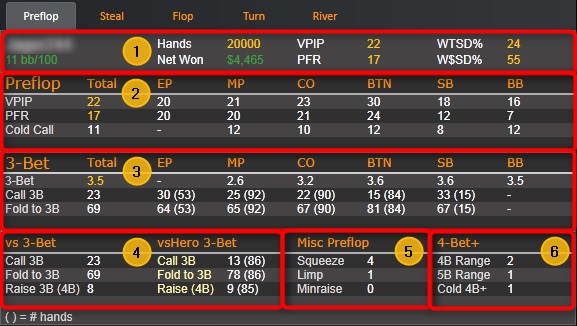
If at the lowest stakes the gameplay of a winning player is barely imaginable without some kind of HUD. Even newcomers are being recommended to buy Hold'em Manager or PokerTracker as fast as possible in order to start crushing their opponents.
Let me tell you something: premature attempts at using stats won't help a beginner to raise their winrate - it can even harm them. Moreover, this will lead their attention away from more important strategy aspects and will also impede their progress in understanding poker.
If you play less than 10,000 hands per month, HUDs are practically useless to you. First, you just won't have a decent sample size on your opponents, and their stats will be unreliable (and if you use unreliable stats based on smaller sample size, you risk big mistakes in evaluation of your opponents' play). Second, any stats that finally become more or less reliable would be "expired" at the time, because your opponents also evolve and try to change the way they play.
Of course, you can still use e.g. Hold'em Manager to see some basic stats like VPIP and PFR and also to check your own, but in this case you're paying a substantial amount of money for a software that you will use only at a few per cent of its capacity.
Personally I doubt it's worth it. But I believe that learning actual ranges and some solid strategy concepts will bring you much more value.
Practice minus theory

There's a popular rule in the poker world: 80% for practice and 20% for theoretical studies. This is a nice balance but only for those who have already developed their own model that requires just some tinkering, maintenance and further upgrades. For grinders, that is.
If a beginner, who can barely guess the correct play in most situations, will learn poker by the same ratio, they are most at risk of ending up broke before learning solid basics.
The balance between practice and theory should be determined by the actual number of difficult situations at the tables. If you have questions about every other hand you play or you doubt your decisions, then for now you should probably stick to 80% of theory and 20% of practice.
Underestimating variance
Unfortunately, while looking at their results, almost everybody underestimates the role of variance or even randomness.

The thing is, even if you have a nice enough winrate there's still a pretty high possibility of losing money after a lot of hands! You should check out the article below before running to hasty conclusions having played a few thousand hands with negative results.
Appreciating Variance and Dealing with Volatility
Grinders playing tens of thousands hands per month have their results more or less close to their real winrate. But if your limit is only a few thousand hands per month, just be ready for losing months, maybe even in succession. Furthermore, you'll never know your current winrate. You'll be able to only say that you've played "X hands" with "Y winrate".
P.S. I strongly recommend you to read Nassim Taleb's book "Fooled by Randomness". Believe me, after that you'll be looking at the world differently.
Trying to be unexploitable

Actually, the difference between optimal and balanced play deserves an article of its own, as many of the most common delusions of poker players are connected to it.
For now, just remember this: to exploit other players, you should be exploitable yourself. Many of you will have seen such "fishy" players that have unexpectedly good results at low stakes. Seat such a player at higher stakes, and they'll lose all their money really quick. But the strategy they use on their "home" stakes is one of the most effective.
