


The Top Five Biases in Poker
Following his recent columns on the reliability of tournament results, Barry Carter picks out the five statistical and psychological biases he sees the most in the poker world.
Last month I wrote two columns about the reliability of live tournament results in poker. Both part 1 and part 2 included mention of some of the biases we encounter as poker players, which I was asked to expand on by several PokerStrategy.com members.
We encounter bias in all aspects of life and I think poker is an area more prone than most to have psychological and statistical biases.
This is because poker involves so much uncertainty. We don't know what the players at our table are holding, what card is going to come out next or whether somebodie's results are reliable indicators of their ability. We don't even know what the future looks like for poker, because the modern game is still so young there is no road map for us like there would be in more established industries.
With so much uncertainty and incomplete information we naturally try and fill in the gaps ourselves, and we are much more likely to fill in those gaps with biased viewpoints.
There are literally hundreds of different statistical and psychological biases that have been documented, I have picked out the five I feel most apply to poker:
The Gambler's Fallacy
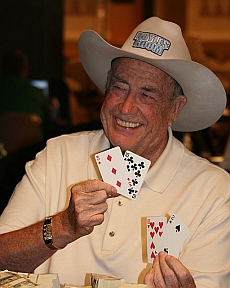 |
| Doyle loves 10-2 |
The gamblers fallacy is when you wrongly predict the outcome of a pure chance event based on recent previous trials.
So if an ace has come out on the flop the last three hands, you assume that either an ace on the next flop is more likely, because aces are lucky today, or less likely because aces have already been out three times in a row.
The truth is no matter how much it card being drawn has occurred in the recent past, it has no influence on what will happen next.
Another related example in poker is that of having a favourite or lucky hand. Like Doyle Brunson and his infamous ten-deuce offsuit hand which he used to win the final hand of both his main event championships.
The Dunning/Krueger Effect
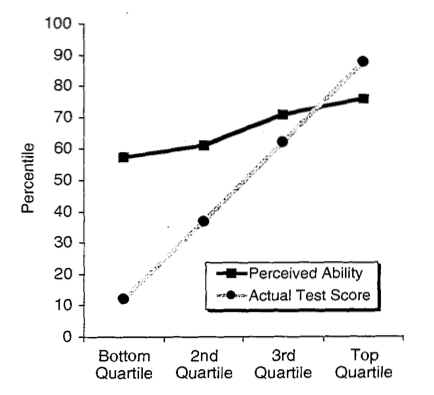 |
| The Dunning Krueger Effect |
This is another interesting cognitive bias related to skill.
Unskilled people can suffer illusions of superiority because they do not have the skill to recognise their incompetence. Likewise highly skilled people can suffer anxiety and low confidence precisely because they have so much skill, they become more aware of small errors.
Think back to when you first started playing, the chances are you ran pretty well early on and got addicted to this feeling of crushing souls every time you played. New players often feel invincible when they first start winning at poker.
It is only later on, as your skill and experience develops, that you can look back at those times and realise you were actually probably very bad. In fact you probably are a lot less confident now even though you are more likely a much better player.
The Dunning Krueger effect is what makes new players overconfident, which makes them play in games they shouldn't, and thus is what makes poker profitable.
Selection Bias
 |
| Did Ivey really have a great WSOP? |
A selection bias is a statistical bias caused by an error in choosing participants to take part in a scientific study.
I've already mentioned this in the columns above, but a good example of a selection bias in poker is the all time money rankings. This is because they only go on money won and do not include any information on the tournaments a player entered but didn't cash in; so they show turnover instead of profit.
So the all time money list, for example, shows that Phil Ivey won $576,052 at the WSOP this year. He also came 5th in the WSOP Player of the Year rankings. All of which seems very impressive.
Not so much when you consider that Ivey played in but didn't cash in the $1 million buy-in One Drop event. In fact the likelihood is he played in most of the bracelet events this year with combined buy-ins of well over $1.25 million.
The money rankings and player of the year rankings would suggest Ivey had a great WSOP, the reality is he was down at least half a million dollars. He actually had a less successful WSOP than a player who played in just one $1,000 event and min-cashed.
Survivor Bias
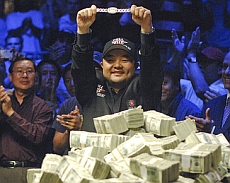 |
| Did Jerry Yang just survive? |
The survivor bias is a form of selection bias that is particularly important in poker. A survivor bias is where we concentrate on something because it survived a process while at the same time ignoring those that didn't survive the process.
The most obvious example of a survivor bias in poker is the winner of a tournament. When someone wins a big event we tend to assume they are talented, and often that leads to their profile being raised, their strategy advice being respected and even them getting sponsorship deals.
The biggest simple example of this is the WSOP main event winner, who almost always will be remembered in history as one of the best, will be high up in the previously mentioned all time money rankings, and usually has their pick of sponsorship deals to choose from.
What we tend to downplay is the fact they simply could have gotten lucky. No matter how unlikely it is for any single person to win a major tournament, the fact is one of them is going to do it.
I once overheard a WSOP official say that Greg Raymer won 16 coin flips in a row on his way to becoming the 2004 main event champion, something which is highly statistically unlikely, but is almost certain to happen to someone in an event the size of the main event.
This is not to say that all tournament wins are pure luck, simply that it probably makes up a much bigger part of them than most people would suggest.
Confirmation Bias
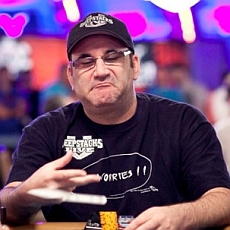 |
| Does Mike Matusow really run as bad as he says? |
A confirmation bias is where you put more weight into things which confirm your theory and ignore those things that don't.
Without doubt the biggest confirmation bias in poker is when it comes to a poker player's assessment of their own skill.
It is rarely certain whether you played any single hand well or whether the result was mainly down to luck. However ask almost any poker player and they will tell you that the wins were down to skill and the losses were down to bad luck.
As a result we find lots of creative ways to justify winning and losing days. If we win, we look for things we did right and ignore the hand where we hit a two outer on the river. If we lose we remember all the hands where we got our aces cracked and conveniently forget the hands where we got owned by a reg.
A confirmation bias is really difficult to spot within yourself and sometimes might need a friend or coach to give you a reality check.
It can also really hamper your progress as a player by stopping you from working on your game; as when we win we assume our game doesn't need work, and when we lose we rationale the same thing because we would have won were it not for bad luck.
